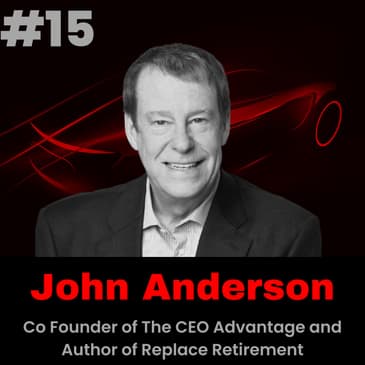
During the pandemic, as routines are turned upside down and corporate playbooks tossed aside, John Anderson—entrepreneur and author of Replace Retirement—brings a fresh perspective on leadership, vision, and the concept of Retirement with his rallying call: “Don’t retire, refire.”
John’s story starts at IBM, where he began his career before building a successful office furniture business. Along the way, he found mentorship in Verne Harnish and worked with thought leaders like Jim Collins and Patrick Lencioni to develop transformative coaching practices for executives.
A key part of his approach is the 10-year vision—a tool he uses to help leaders set clear goals, handle challenges, and align personal and professional priorities. Inspired by Ari Weinzweig’s visioning methods and Stephen Covey’s focus on “what matters,” John explains how leaders can use a long-term vision to guide their teams, even in uncertain times.
Instead of chasing the traditional “work-life balance,” John suggests focusing on energy management. For him, a fulfilling life is about identifying what energizes you and intentionally designing your career and personal life to maximize those pursuits.
Throughout the episode, you’ll hear advice, including tips on developing vision statements, communicating transparently during crises, and building routines that support personal and professional growth.
By the end, John inspires listeners to rethink their legacy and embrace self-transformation, regardless of age. For leaders facing uncertainty or figuring out their next steps, his insights provide a roadmap to navigating change with confidence, resilience, and a renewed sense of purpose.
Featured guest: John Anderson
What he does: John Anderson is a business advisor, entrepreneur, and co-founder of The CEO Advantage, a coaching and consulting firm dedicated to helping organizations achieve exceptional results. With extensive experience guiding companies across public and private sectors, John specializes in helping executives and entrepreneurs develop clear visions, build strong management teams, and drive meaningful outcomes. He is also the founder of Replace Retirement, where he inspires leaders of all ages to rethink their future, adopt an exponential mindset, and craft a purposeful, rewarding, and fulfilling life plan.
Mentioned in this episode:
Episode Highlights:
[00:04:16] John’s story
[00:09:54] Developing a vision for your business
[00:22:21] Crisis leadership style
[00:26:16] A daily routine to set you up for success
[00:41:45] Time to rethink retirement
[01:03:55] The tapestry of your life
[01:12:05] Your legacy map
[01:14:38] This is the time
[Transcript]
[00:00:00] Jan Griffiths: Welcome to the Automotive Leaders Podcast, where we help you prepare for the future by sharing stories, insights, and skills from leading voices in the automotive world with a mission to transform this industry together. I'm your host, Jan Griffiths. That passionate, rebellious farmer's daughter from Wales with over 35 years of experience in our beloved auto industry and a commitment to empowering fellow leaders to be their best authentic selves, stay true to yourself, be you, and lead with Gravitas, the hallmark of authentic leadership. Let's dive in.
We remain in the midst of the pandemic. Yes, we're all living the realities of the Corona Virus crisis. And we are working from home. We're in isolation. We're in quarantine. Life as we once knew it has completely changed, but this also offers a great opportunity. Not only is this a tremendous opportunity for us to step up and lead and make this the most exhilarating leadership experience of our lifetime, it's an opportunity to challenge the norm. The day-to-day rule book of routines and corporate playbook that's out the window right now. So, let's use this time as an opportunity to think about where we're going. What do we want for the rest of our lives? Two different perspectives, whether it's a vision for our company, for our business, for our team, for our industry, or whether it's for ourselves, our own personal vision for our life. What does that look like? What's our legacy look like? What do we want to be in 10, 20, 30, maybe 40 years’ time? This is a great opportunity to step back away from normal life; let's face it, we have no choice and really spend some time mapping that out. I can't think of anybody better to help us with this than the disruptor himself, John Anderson. John is the author of the book Replace Retirement, where he challenges the retirement model, and in his words says, "Don't retire, refire." And right now, we're questioning what retirement could look like. The stock market is down; maybe that pot of money that we want to have at a certain point in time is not going to be there, but that's okay. There's an opportunity to rethink that model and John is the perfect guy to help us through that. John is a lifelong business strategist and entrepreneur. His entrepreneurial spirit has guided much of his professional life, starting in the office furniture business. He was the first Gazelles business coach to work with Verne Harnish. And now, this organization is considered to be one of the leading executive coaching organizations. John is an active, corporate speaker and coach, and he has had equity in a variety of entrepreneurial companies, including the CEO Advantage, Dogtopia, Visby, and Exponential Advisor. In the late nineties, John founded the Detroit chapter of the Entrepreneurs Organization, recognized by Michigan's Future 50 Award, Today's Workplace of Tomorrow Award, and in Crain's list of 40 under 40. He served on the Leadership Oakland Board and the Oakland County Business Roundtable and is considered one of the most networked entrepreneurs in the region. Please welcome John Anderson.
[00:04:15] John Anderson: Thank you so much for inviting me. I'm really excited about this.
[00:04:19] Jan Griffiths: John Anderson, what is your story? Tell us, please.
[00:04:24] John Anderson: I'll start post-college, so I went to work for IBM, which was a recommendation by my father because he had worked 37 years for the same company, and that was kind of the path we took back then, and I ultimately left IBM. At the time I left the company, they were the most profitable company in the world. So, I was really working at the best company in the world at that time. And I left because I had married into a successful entrepreneurial family, and in conversations with my father in law, I said, "I think I could run a business myself," and he was open to helping me with that. And after a couple of different false starts, I ended up purchasing 50% of Gorman's Business Interiors, which was a Hayworth Office Furniture Dealership in Southeast Michigan. We also had a location in Midland, Michigan, and took that company from $2.5 million in sales to about $15 million in sales. And the real growth in that business was my own leadership in the sense that now that I've gone from being a salesman at IBM to running a business, I really knew nothing about that. And my business partner, Bernie Moray, who's still working there today in his mid-90s, was my mentor. And the other thing I did was read lots of magazines and publications, and Fast Company was out, and Inc. Magazine. I was flipping through Inc. Magazine, and I saw a picture of Thomas Edison and Henry Ford, and I knew that Edison, Ford, and Firestone from Napoleon Hill's book, Think and Grow Rich had done mastermind groups. The caption under their picture was the "Birthing of giants," and it said every year, we invite 60 entrepreneurs from around the world to attend this program at the MIT Enterprise Forum. I applied for that and was accepted. At that program, I was introduced to a gentleman by the name of Verne Harnish, who later went on to write The Rockefeller Habits or sort of Mastering the Rockefeller Habits, and then, more recently, Scale Up. And Verne, to me, was like Obi Wan Kenobi. I'm like, this is the guy I need to study and understand if I'm going to be successful in business. And so, this relationship launched, this was almost 25 years ago. It would be about 25 years ago. And so, from Verne, who was my business coach, I started to learn about all these different practices and tools and ways to make you more effective as a leader and a leadership team. So, I decided that this office furniture dealership business is not my long-term path. And Verne asked me, "What do you think you're going to do?" And I said, "Well, I was actually thinking of getting into business coaching." Now, this is over 20 years ago. So, unlike today, where everybody's a business coach, that was a rare thing 20 years ago. I was going to work with Jack Stack, who wrote The Great Game of Business and teaches people open-book management. And Verne said, "Well, wait a minute. Why don't you become my first coach? I'm gonna take the program we have at MIT on the road, and I'm gonna call it the Master of Business Dynamics, and you can be the first coach." And I said, "Great." So, Verne flew into the town, and we went on meetings each and every day, and Verne would present, and I would take notes, and then at the end, they'd say, "Yeah, we want to do this. Who's going to be our coach?" And he'd go, "John's going to be your coach." And so that was kind of like my coaching training if you will. And it was like day three, I guess, and he said, "You're going to do the presentation tomorrow." And I'm like, "No, I can't do it." I was too nervous. So, he gave me one more day. On day four, he said, "No, you're going to do it today. You'll do great." And so, I started presenting and by like 11 o'clock at the break, Verne said, "I'm going to catch a flight and go home. You got this handled." And that was my sort of inception into business coaching. Now, from that point on, I continued to read and study with Verne. He ended up creating some tools we could use. And my business partner and I out of that, created a company called the CEO Advantage. And it was really founded on Verne Harnish's Mastering the Rockefeller Habits. Jim Collins, who had just released Good to Great, we saw him present Good to Great before the book went on the public market. And then, Patrick Lencioni, was the third part of our triangle. And at that time, Patrick had only released one book, and I used to get Patrick to come into town and present for us for free. He gets $120,000 to keynote now. And he actually facilitated two of our annual planning sessions in San Francisco. So, we were very lucky and fortunate to have Verne Harnish, Jim Collins and Patrick Lencioni as kind of our triangle. Jim, by the way, was the only one who said we would pay a fee to Verne every month and we'd pay a fee to Patrick every month, but Jim said, "You didn't have to pay me anything, just make sure my content is called my content. Don't repackage it." And so that was the foundation of our business coaching practice that evolved out of my office furniture dealership. And I've been doing that for 20-plus years. And then, more recently, you know, got into publishing.
[00:09:42] Jan Griffiths: That's great. So, you have a tremendous depth of knowledge and experience when it comes to business leadership of your own and then coaching others. Leaders today are trying to figure out how to lead during the pandemic. We're in the middle of a crisis. One of the things that we often talk about in authentic leadership is the need to have a vision. And it's very hard to have a positive vision when you're in the middle of a crisis. What advice would you give to the leaders out there regarding developing a vision to get out of this crisis and to motivate the business and the team?
[00:10:27] John Anderson: It's a great question, and I have a number of suggestions around this. The first and foremost part, and you're using the word, right? Vision is for myself could be different for others. Some may be using pictures or thoughts, but I actually find words to be very powerful. So, I would encourage leaders to sit down and write what is the vision for the company. And I think 10 years is a good time frame, although, I don't have a problem going longer than that. I do have a little bit of a reservation going shorter. The reason why I think a 10-year vision is so powerful is it's far enough out there that you don't know exactly how you're going to get there, and yet it's not so far out that it seems like kind of crazy, like we all know we're going to be 10 years into the future. And so, sitting down and saying, what would the ideal vision look like for your company and the team of people you have worked with for 10 years hence look like and describe it not in a linear fashion, but in an exponential fashion. And if the word exponential kind of tongue ties you a little bit, then think of it in an ideal. Ideally, where would we want our company to be 10 years hence? Where would we want our customer relationships to be? Where would we want our employees to be? What does that look like? Not the steps of how we get there, but simply what does it look like? One of my mentors, and I have a number of them, is Ari Weinzweig from Zingerman's Deli. And Zingerman has done a great job, and Ari's really a leader in this particular area of writing vision. So, you can go and either read his books, which, by the way, are tremendous, but there's about 650 pages. And it's small print, so Ari's book takes a bit of work to get through and they're so content-rich that you want to like underline everything he writes, but he's fortunate in the sense that since he's from the food business, he treats his books like a cookbook and then you can buy these little recipes, which are little sections of the book. And he does, I think, maybe four or five on visioning, some are on personal visioning, some are on business visioning. So, I learned a lot about my visioning from Ari. He's not the only source, but he did a great job, the most masterful I'd seen of writing a 10-year vision for that company that has tremendous detail and depth.
That's the same process I've gone through for my own company. And even today, I continue to do that and write a vision just for the end of 2020. Now, the end of 2020, of course, is more linear, but it comes from this bigger, expanded 10-year vision that I have in terms of where we're going and what we're going to look like, despite the upheaval and changes that are happening right now, in real time.
[00:13:33] Jan Griffiths: I know that there are leaders out there right now. They're probably listening to this, and maybe there are two thoughts running through their head. One would be, "Oh, I already have a vision. It's to be the world class manufacturer of X widget and satisfy or be the choice, the best choice to our customer." You know, every, certainly every automotive company I've ever dealt with has got a vision statement like that, which, honestly, to me, is meaningless. You cannot attach to that. You cannot emotionally attach to that. It's not a feeling, a state of somewhere or something that you will be in the future. So, help us understand, you know, what is great content for a vision? How do you get your mind in the right place to develop a vision that's going to be so powerful that you will just feel the pull toward it?
[00:14:27] John Anderson: Well, again, you're right on this topic. It's so powerful, and it's not easy; that's the challenge in this. So, the reason why one of the things, one of the reasons that business coaching took off is that because of the work of Lincione and Collins and Harnish and others, they're not the only ones. But Collins did such a great job, right? He said, "You gotta have a BHAG." And this was back in his Built to Last book. And he said that great companies have a big, hairy, audacious goal. He said that a BHAG has to be 10 to 30 years old, thinking beyond just tactics and strategy, but it really is visionary. You don't really know how you're gonna get there, a 70 to 50% probability of success. Companies really latched onto that, and Verne put it in his one-page plan, and we put it in our one-page plan, but it became more of an exercise to your point. Let's just fill that sentence out. Let's describe some point in the future or kind of an idealistic way we want to be as a business in one sentence, one-liner, and I do think that's valuable so people can remember it. Remember, he used, his example was, we're going to get a man to the, you know, the John F. Kennedy: We're gonna get a man on the moon by the end of the decade. And so, that was simple to understand, and so on. That became kind of like a checkbox on this page. We got to get that done. We got to get that done. What you're talking about and what you and I understand is that, no, you got to go deeper into that. And Collins did bring that up, but I think everybody kind of ignored it. He called it an envisioned future. So, what he was suggesting is if you wrote this detailed envisioned future that I was discussing earlier as Ari did, then you can come up with that one-line statement for people to remember. So, it's really, and I'll talk about this again later, but it's really, Stephen Covey had the four quadrants of time management, and he said, quadrant one is important and urgent. Quadrant two is important but not urgent. And in Quadrant three and four, we can sort of ignore. They're just busy stuff. It doesn't get you anywhere. When I work with leadership teams, I tell everybody I'm sitting at the table because they're all the executives. What got you into this room, and the same with our listeners, what got you into the room was your ability to execute in quadrant one, the ability to handle both urgent and important items and to really get through that fast and not be messed up in quadrant three and four. They weren't doing nonsense stuff. They weren't, you know, checking Facebook posts and so on. They're really good. There's an issue; we're going to attack the issue. However, Covey said in his book, The Seven Habits, that all progress, and I want to be clear on this, not some progress; all progress happens in quadrant two, which are the things that are important but not urgent. The vision you and I are talking about that's quadrant two. You have to sit down, and it takes iteration after iteration to define what this future vision looks like, and it's hard; it's a lot of thinking.
So I have found by practice, I've gotten better at it, and I enjoy it more, and maybe because I've written a book, it's also easier to write, but with a client recently, the way we went about it, so there's a little prescription, is we started by having everybody read Ari's little recipe on visioning. So, they read Ari's vision; they read how sort of visions are developed, and the process he recommends. Then I said, "Why don't you guys on the whiteboard, I'll write it down. Just tell me why do you think this vision is so impactful? You know, why is it powerful? How did it touch you? And they used words like emotion and it was real. And they felt like they're part of the team and all these different descriptors. So now we have those descriptors, we would want our vision to look the same. Then I had him do another exercise; I won't get into all the details of it now, but basically, it described for me what the employee experience would be like. Describe for me what the customer experience would be like. Describe for me what our financials would look like and so on. So that we had sort of painted this broad-brush framework, if you will. And then, we stopped for the day, we're probably three and a half hours, four hours in. We stopped, we let that incubate, and then we came back a couple of weeks later, and I actually took responsibility for it because I enjoyed it. And I got on the keyboard, and we did it on the big screen, and I took all those notes and ideas, and I started building out the sections, you know, paragraphs into each of these sections. So, they had the beginning of a written vision, and then their job was to take that and go through it again and enhance it and enrich it, then share it with their expanded leadership team, get their input, then share it with their board of directors and get their input. And then, finally, when they felt really like they owned it and they were excited to share it, then go forward with their entire employees, you know, the whole company and share that vision.
So, those were the steps that we took. If you can't write it yourself, and I understand that's hard for some people, then get someone to help you write it. But, again, go through this process because otherwise, you're going to always get sucked back into that quadrant one thing, the urgent and important, which feels comfortable and familiar. And, of course, in a time of crisis, we're going to go to what's comfortable and familiar, except nothing right now is comfortable and familiar. So, it's really the quadrant two, the vision, if you will, the things that are important but not urgent, that keep you focused on going forward and not falling back.
[00:20:21] Jan Griffiths: Yeah. Well, that's great advice, John. And I think that there's some leaders out there right now, they're going, what are they talking about? A vision in 10 years? I've got to deal with this crisis, you know, we're in crisis mode right now. But this is where I see what we're going through right now is a tremendous opportunity to think differently because everything has changed. Our lives have changed. Our routines have changed. There is no real corporate playbook for a pandemic. So, this is a great opportunity to perhaps sit back with your team and really start to generate a vision statement of where you're going to be in 10 years that will pull you toward it. I love there are some vision statements that really resonate with me, and I use them as examples to help people think through this because it's not this one statement that you throw on a PowerPoint and, you know, there are a few posters up in the office, and you're done. I like Starbucks’: To nurture the human spirit, one cup of coffee at a time. You know, they didn't just wake up one day and say, "Oh yeah, we're going to sell X number of cups of coffee and open X number of stores." you know, it's much more, it's deeper, much more meaningful, and it guides who they are as a company. And the other one I love is a fairly new company, it's called Canoo, it's the old Evelozcity, it's an electric vehicle company out of California, and they want to, and I quote, "Free people of the tyranny of ownership of a vehicle." You know, how powerful is that? So, I see this as a tremendous opportunity for people to really sit back and develop that vision, but let's come in more near term. So we are in a crisis mode. What advice would you give to leaders on how they lead in terms of the leadership style that they employ right now? Because we've heard that there is a tendency to move into command and control, but we know that we need to connect with people emotionally at a much deeper level now. We have to create psychological safety for people. So, faced with this crisis right now, what advice would you give leaders today?
[00:22:38] John Anderson: I guess three different thoughts on this: the first and obvious one, which is exactly what we're doing right now. Patrick Lencioni has put on a weekly podcast, it's actually designed for coaches and advisors, but I'm seeking that out and then did one with Chip Conley. And so, this idea that I need to go out and learn from others, what they're doing, and how they're navigating through it. So, that's the first and obvious one. So, it's kind of ramp up the education. Two, and again, this is from what I've been listening to and learning from, is there's a lot of recommendation to communicate more frequently to give employees an update each and every week that is transparent in the sense that, and Verne was using this a week ago saying, "Don't do the sandwich," which is like good news, then bad news, then good news. I think he called it a shit sandwich or something, but I liked it. It was a good metaphor, and I liked it. He was suggesting that first, you start off with what isn't great and then move into what is great, so I like that. That was a good suggestion. It resonated with me; maybe it'll resonate with others. Then, I think of Lencioni who's so transparent that I've always been drawn to him for the last 20 years. Of all the presenters I've seen, he seems the most genuine and transparent. And then, you know, later, I don't know, maybe it was 10 years ago or so, I got introduced to Brené Brown. And that's her whole thing, right? You have to be vulnerable and transparent. So that would be my next recommendation is what I can do as a leader to be a little more vulnerable and transparent. These are my concerns, not in a griping, bitching kind of way, but in a true humility way. And then there are some things that I'm optimistic about. So if you want to kind of share the bad and the good. I would, on a sort of a third wave of this thing, so we got what's coming out of, you know, various recommendations and reading and listening, then what are tools that other effective leaders are using? And then my, so again, communication that transparent, open, vulnerable communication. The third one that I'm most at home with and comfortable with is that I had been in the process of developing my own personal leadership skills for the last really 10 years or so, which led to writing the book. I believe that what's helping me so much today is that I have a process and a routine I follow, and I just keep following that, and it gives me confidence. So not only do I have a 10-year vision, which we were talking about earlier, but a written vision, which is dated July 1st, 2026, so, you know, mine's already in motion. So, I know what that time looks like. I spent time writing what this year looks like and how I'm going to use the pandemic as a catalytic mechanism. And then, finally, I have activities and behaviors I do every day to keep my confidence.
So, in my case, pre-pandemic, I felt like if I was going to go in and meet with my customers, 'cause I don't have employees, right? I have clients. If I'm going to go in and do a workshop with a client, I have to go through this two-hour routine that kind of gets me ready for the day. It includes mental, physical, and spiritual exercises so that I'm game on. I'm suited up for the day. I created that for me as an advisor, because I can't show up in front of, excuse me, in front of clients with my confidence shaken, with frustration, with untied issues, with lots of noise in the background. Otherwise, I can't be fully focused on them. So, I created that as a client delivery mechanism before this. Now I realize it fits really well today because I have this whole process and philosophy that I need to sort of game up every day, or suit up, I guess, is the better description. And now, I'm getting to apply it in a bigger game. Does that make sense?
[00:27:20] Jan Griffiths: Yeah, it makes perfect sense. Would you share some of that routine with us, John?
[00:27:24] John Anderson: I will, and just before I do that, one of the, in this two-hour process, one of the practices I do is writing. And I journal, and then I write. So, the journaling is kind of just, kind of gratitude and things I'm thankful for and just kind of get my mind in the right place. It can really be any thought. The writing part is I'm either writing a blog or I'm writing the vision. I'm always writing something every day on the computer. In my writing last week, I came to this insight, and so this is really new. I'm going to do a video series on this, so you're the first person I'm sharing this with, other than my business partners and my wife, and in the first public domain.
Because, so I'll back up at my story earlier, I did a really accelerated one. I talked about Verne Harnish and going to MIT, and he was kind of like Obi-Wan Kenobi for me; when I met him, I'm like, "Oh, I got to study this guy." Like, I want to learn the ways of his force, if you will, and so that's been a 25-year journey. About, oh, it's almost 10 years ago now, somewhere between 8 and 10 years ago, I met Peter Diamandis, and Peter had just written his book, Abundance: The Future Is Better Than You Think. And I sat in that audience, and I'm like, this is the next, this is Yoda. Like, I need to know this guy. I need to become friends with him. I need to study his ways. I need to hang out with him. I got to figure out how I'm going to become friends with this guy who was listed by Forbes as one of the 50 most influential people in the world, so this was no easy feat, but I accomplished it. So, he considers me a friend today, and I certainly consider him one. Peter says that you're either going to be disrupted by technology or you're going to be a disruptor, which led to the idea of writing this book, Replace Retirement. So, I didn't want to be disrupted; I wanted to be a disruptor. So, all this is out of this concept, what he calls the exponential trends, right? Ray Kurzweil is kind of behind that. And so there's all this information and data on this technology uptrend, accelerating almost like a hockey stick, fair enough? That's what an exponential curve looks like.
Last week, I was sitting in. And the pandemic is essentially, if you look at all the curves on it, right? It's a hockey stick, and they're trying to get it back into a bubble and then flatten it back down, right? Flatten the bubble. So, this thing starts off really almost like innocuous. It's like it's not even showing up. We can ignore it. It's not a big deal. Yeah, it's happening over in China, but it's not going to affect us. And then, it starts this exponential doubling rate, and it starts doubling, doubling, until now it looks like a hockey stick. So, in my book title, I wrote Replace Retirement: Living Your Legacy in the Exponential Age. So, I threw this label out called the Exponential Age. I would suggest to our audience that we have officially entered the Exponential Age with the pandemic as the catalytic mechanism that launched it. So it's been around, some of us have been aware of it; a lot of us haven't. So, this idea of thinking linearly versus exponentially is really going to become the Achilles heel, not for 95% of the population, but for the 5% of us who are leaders and entrepreneurs; we have got to learn how to think exponentially. Stephen Covey gave us a little insight into quadrant one and quadrant two. Essentially, what he was saying is that quadrant two is how you create time to think exponentially when you're not dealing with the urgent but with the important. So it's like, that's the new era we're in. We have officially locked into that, and if you don't know how to think exponentially or put time in quadrant two, now's the time to build the muscle. Does that make sense?
[00:31:41] Jan Griffiths: Yes, makes perfect sense.
[00:31:43] John Anderson: Okay, so how do I get into the sort of exponential mindset each and every day? That was the question you asked. So, I wake up in the morning, and the first thing I do as soon as my eyes open is I say a prayer, and I go through a whole sort of prayer sequence that I learned years ago, and I'm just laying there with my eyes closed, and it follows more or less the same framework every time. And I pray for myself and my wife, and then I pray for all kinds of friends and extended family. And it's kind of like almost perfect. It's so long that if I get out of order, I have to kind of start it over again, but I do that every day. Then, the next thing we started doing is meditating. So right after the prayer and my wife, now that we're home every day, we're doing it together. So, we spend 10 to 15 minutes in meditation. And it's a guided meditation on an app I use, Calm. So, there's lots of guides on that. So, I'm growing my meditation. Then, I head downstairs, and I begin doing my first set of, and I don't like, I've never been, I know lots of people love working out, I don't love working out, I've always struggled with it, I know it's important to have the quality of life I want, but I don't get joy from it, so I hit the floor, and I do push-ups, and I do three sets of 20 pushups, three sets of 33 crunches, and three sets of 20 squats. And that's kind of my thing right now. So, that I always do some sort of physical workout. Now, I don't do all of those in order. I do the first set, and then I go into my office, and I've always got, I've got spiritual kind of guidebooks, and then I've got business books and so on, and then I get the journal out, and I put the date on, and I have a couple of different things I track so I do the count on that like meditation now I'm up to like 176 days or whatever it is so I track things like that, and then I start writing, and again I mentioned earlier my default mechanism is just gratitude. Thank you so much for this day. Thank you for my health. Thank you for our lifestyle, etc. Thank you for this beautiful home, on and on. So, sometimes, it's real insight; other times, it's always gratitude. And then I read, I have a kind of like a little spiritual book. And then I read, something from another book from it's called The Grapevine. It's a sobriety kind of tool that AA has. And then, I do another workout set. And then I come back because I don't like the work. So, I got to get the workout out of the way and then I do something fun. Now, for someone else, it might be the opposite. They might do the journaling or something and then the workout. So, I'm always, I'm playing off of these habit-forming tools.
And then I read the Bible; because I've read thousands of books, I figured I might as well read that one. So, I read a little bit of the Bible each day and then journal from that. And then I have a business book. And I mentioned Ari's books sometimes those I'm into. But I'm very selective on what's the book I'm reading and writing from. So, I want to sort of draw content from that. I do sort of my final set. Now, my exercise is out of the way. Thank God for that. And then maybe brew some coffee and then finish the journaling. Then I go, and I start to do the writing, you know, I mentioned earlier. So I get on and I work on either of them, a blog or writing a vision or whatever I'm writing on in the book when I was doing that. So there's some writing, and then I write a personal note of gratitude to somebody, a handwritten note. And I do that because years and years ago, I was working with the CEO of Domino's Pizza, David Brandon, and he taught me the value of writing personal handwritten thank you notes. Here he is running Domino's, for God's sake, and he would write me a personal note thanking me for meeting with him. Like, he's the guy, right? The important guy, and he's writing me a note. So I'm like, well if he has time to write a personal note, I certainly have time to write a note. So because of that influence, I have picked up this habit of writing notes every day. So, just a little handwritten note. And then, I jump in the shower after all that. So that whole cycle takes me about two hours, fair enough? And then I can head off to my meeting or whatever. So, in this case, the meeting is sitting down with you. So that's the process I take every day that's designed out of this greater tool. So those are my daily alignment habits that come from my legacy map, which is a tool I developed. So, I have a whole plan for my life, and in order to become the person I've defined in my life plan, I have to do these things on a daily basis. One other piece of information: I do that five days a week, not seven days a week. However, I developed habits like meditation, 'cause that's the newest one, that I am doing seven days a week. I find if you're trying to cement a habit, this is my personal experience, it's not 21 days. Yeah, basically you got to go 90 days. If it's something you enjoy, journaling was the very first one I ever took on. Journaling was relatively, I found, and there's a London study in my book I mentioned it says 66 days, but somewhere in that 90 days, approximately around the 66th day, it went from being something I got to remember to do to something I enjoy doing. Fair enough? The only habit when I touched on earlier was exercising is not something to this day; I enjoy doing it. I only enjoy it because I enjoy the benefits from it. But, journaling, writing the personal notes, blogging, all these other habits, the meditation, the prayer, these are things that I do not because I have to do, but because I enjoy them, almost like brushing your teeth. And so, I went from seven days a week, then I backed it off to six days a week 'cause my wife was kind of teasing me, "Can we like, you know, spend time in bed before you go off and do all this stuff?" And I'm like, "Yeah, I guess I could take a day off." And then I realized, "Oh, I could take the weekend off." So, it's so cemented, and again, some of these are more than 10-year habits. So that's kind of the routine of the morning.
[00:38:00] Jan Griffiths: That's quite a routine; that's a time commitment, but it puts you in the right place. Your head, your mind, your heart, everything is in the right place, right? After two hours.
[00:38:13] John Anderson: And that's, you know, so many of the books we read, lots of people talk about this, and this is fundamental in the Rockefeller habits. Verne has just three habits: one is your top five and one of five, the second one is rhythm, and the third is metrics, you know, measurable outcomes. And the top five, one of five, which is habit number one, I resonated with Verne because I had experienced this in my 20s when I was listening to Earl Nightingale, and he did a whole bunch of series about The Strangest Secret and so on, and he brought this up, and it basically was Rockefeller and Carnegie had studied under Ivy Lee in the short version on this, and I'm sure a lot of your listeners are familiar with Ivy Lee's story, but he basically had these guys say, "You can't have 25 things on your list, you got to have five or less, they need to be prioritized from one to five, and you need to start on number one before you go to number two, and so on." I even heard Warren Buffett share the same story, right? He was with his pilot or something; his pilot was bemoaning all the things he needed to do. And he said, "All right," I'll make up the name, Bob, Bob the pilot, "write down for me all the things you need to accomplish in order of how they have to be accomplished and not just in terms of it's easiest thing to knock off, but the most important." What's number one, two, three? So, he got his list done. He said, "Okay, Get rid of everything below number five, throw it away, just focus on those five." So even Warren Buffett, so this is not a new tool, it's not a new rule, and I was enamored with that. I started practicing it in my late 20s when I ran the office furniture company, and I practice it today.
So that made sense, and it's like, well, if morning's my best time, then I had to start out with the first, most important thing. So I thought prayer was the first most important thing, and then the second most important, well, I think maybe meditation's the second most important thing. So, even the order of that morning as it grew from 10 minutes to two hours was basically aligned with that idea. What's going to be the first most important, second most important, and so on? Before I go engage with a client or whatever the next activity is, before my day starts to get all crazy and frantic and urgent and so on, I need to make sure that I know what's most important in my life and that I made it a priority in that day before I go on to anything else. I think that's what leaders do. I think that goes back to my insight of last week is that we're in this new age. If you don't know how to do it, you need to figure it out and do it soon. Otherwise, you're going to get overwhelmed by fear and change and all this stuff because the world's moving at this hockey stick rate, and it can be quite overwhelming.
[00:41:01] Jan Griffiths: Well, and we both know that you can't lead others until you know how to lead yourself. And you're talking about how you lead yourself. I think that many people, not just leaders, but many people out there today will have to rethink retirement. The stock market is down; it's crashing horribly left and right, and we can look at it and say, Oh my gosh, you know, maybe people are close to retirement. I have this number or this pot of money that I'm supposed to have, or a time in my life that I'm supposed to just stop working and do nothing, which, you know, you and I have talked about this before. That's something that I could not get my mind around. I was not going to move, live my life to get to a certain point or a part of money, and then do nothing. You know, I had a vision for my life for what I wanted to do. I wanted to form this business, and I'm doing it, and I did it before I retired and walked away from my corporate role, but there are people out there right now that are maybe thinking, "Oh no, because of this pot of money that I have or don't have, because of what's happening in the stock market, maybe I'll have to work longer in this corporate job," because they're on this path of this is what I'm supposed to do. But what I absolutely loved about your book is that you want to talk about being a disruptor. You challenged that whole mindset that so many people are on that path. So, this could be a great opportunity for people to sit back and think about the vision that they have, not only for their business, but for their own life. So, tell us a little bit about the book, John, and how you challenge that thinking.
[00:42:49] John Anderson: Well, thank you. And everything we've talked about so far has been leading up to this, and I knew it'd be hard not to talk about the subject as we were sharing. And so, I've been peppering all through our conversation, little tidbits. But I started with the story of Peter Diamandis and, you know, his challenge was either you're going to be disrupted, or you're going to be a disruptor. When I first, and this is so appropriate for today, right? Because we're all being disrupted. So, when I first heard this, now remember, I've had years, I've been in this program, he has a program called Abundance 360, it's every January in Beverly Hills. And we just finished, I think, year eight, and it's a 25-year journey. So I got exposed to this year after year. So, I had a lot of time to think about this. So, when I first got exposed to this idea of disruption, I went into fear; everybody does. Well, I'm not going to get disrupted. This can't happen to me. I wouldn't even know how to manage it. It's all the things you were just sharing, like it's overwhelming. I don't really know what to do. I'm just going to ignore it. Then, as time went on and I thought about this disruption thing and technology, I said, "Well, okay, I can see how Ford Motor Company is going to be disrupted with autonomous vehicles and electric cars and so on. If they don't figure this out, they may not have a business anymore." The technology and the changes that are coming, and they'll get bypassed, right? They won't know how to adapt quick enough. So, I can see how Ford's going to get disrupted. They better watch out. And then I let some more time go by and I said, "How would I get disrupted?" So, as I thought about that, I used the example and I know it won't work for all listeners, but hopefully a lot of them. There's a character on the old Star Trek series called Data. There was various versions of Star Trek, but Data was artificial intelligence. He was basically a robot, a very sophisticated one; he was human-like, and he was run by artificial intelligence. And Data, for those of us who are familiar with the character, was like a trusted member of that team. He wasn't just a technology that they used. He was human-like in his relationship with those members. They counted on Data to be there for them, and they protected Data if he was at risk. So he was so human like, he was treated like a human. But the cool thing about Data, and this is where I saw my disruption is, imagine there's an AI technology that already exists, you know, like Watson, IBM's Watson computer and others, that could be the coach, if you will, the business coach. So instead of having a real meeting, you show up at a virtual meeting, and then this artificial intelligence is answering questions for your team, and it's appraising things, and it's telling you everything about the history of your nuts and bolts business and all the projections going forward and stock market trends, and it's doing all this real-time analysis so it can give you all this stuff, right? I can't do that, so that's kind of disrupting to me. And then, because we do the meeting in virtual reality, you could skin it as Jim Collins or Einstein or Abraham Lincoln; you pick what he wants, you want him to look like. So now it's not, you know, I don't have the intelligence this thing does. It can look like somebody who's a really, you know, George Washington, you pick it. Somebody, you know, you admire. So, what do we need John Anderson in the room for? And just to put the kind of like the icing on the cake or the nail in the coffin, if you will, it's like $95, like, I don't charge $95, but it's so ubiquitous that you get this technology, and so on.
So, I said, I can see how I can be disrupted. So, I don't just see how people are going to be disrupted and Ford's going to get disrupted. John Anderson's way of life could be disrupted. And so, I started to think about it and say, okay, and I mentioned Earl Nightingale before; he was a mentor to me in my twenties; I've listened to his program thousands of times. So, Earl would always say, "There's a field of diamonds right in front of you. Don't go searching all over the world for it. They're right in your backyard." So, I said, okay, well, I'm a baby boomer, and I don't think this retirement thing doesn't really work for me. And I think there's others out there. So, if there are approximately 80 million boomers, and let's assume using a statistical bell curve that 20 percent of them will resonate with my message, that's how you and I got together, right? Jan's like, "I totally get it. I'm on board with you. Show me this path." Then, if I were really to make a penetration, it'd be 1.6 million. So, I'll take the 20 percent or 16 million baby boomers who would resonate with this message. If they simply heard it, they're like, "I get it. I want it. Show me the way." And that 10 percent of that group, or 1.6 million, would actually sign on and be a follower of this. I call it a movement; they would get on board with the movement. So, that became my BHAG, if you will, or moonshot, is that we're going to, by January 1st, 2026, we'd reach 1.6 million boomers. It doesn't have to be all boomers. It's really people between 45 and 65. So, some boomers are older than that. So, now we've got this idea. We're going to replace retirement. We're going to change the existing paradigm of retirement to one in which you are contributing and working all the way through, although on your terms. So, in the book, I use myself as an example. Essentially, and somebody recently just asked me this, one of the things I'll kind of share my year from a planning point of view, I take the month of February off, I take the month of August off, and I probably, if you take holidays and so on, I extend it another month. So, I take about three months off a year. And it still gives me plenty of time to work with clients. And all my clients understand this. They know this is the whole design of our program. And so, on the month off in February, I'm a big-time snowmobiler; it's one of my passions. And so, this season, I snowmobile about 9,000 miles; clearly, I'm very passionate. Other people have other passions; that's my passion. So, while I was snowmobiling, I was up in Quebec, and this guy said, "Are you retired?" I get that question a lot because here I am snowmobiling for three weeks. And I'm like, "No, yeah, sort of?" Like, 'cause I designed it myself.
So, what I found, and in my book, I talk about this, I used to use kind of the balance wheel idea, and then I realized, maybe it's not balanced. Maybe there is no balance. Maybe it's really energy management. So, everything in the universe is built off energy, right? And so, we know we can tap into this energy. So, I said, one of the things that seems to wane as we age is our energy. So, what are the things I do? What are the people I spend time with? What are the books I read? How do I get up in the morning? I want to do things that give me energy, and I want to slowly get rid of things that take energy away. And so, I would say that my book and myself are on a self-transformation, a 10-year self-transformation to slowly get all the energy drainers out of my life and attract more energy givers. And I share that because, again, as we age, our energy does start to wane. And so, I want to be more judicious where I can spend it. And in presentations, I talk about that. When I was 20 and worked at IBM, I remember, and IBM it was a really tough company. To get into sales, you needed a minimum of 90% passing grade on all the internal sales training. So, when I was an IBM salesperson, they trained us for 12 months, and in those 12 months, if you didn't achieve 90%, you were let go. You lost your job. So there was a lot of anxiety in all these people going through the training, yet some of us still did the all-nighters. We're done for the day of training. Maybe it was like a Thursday night, and then we went out and did like an all-nighter, and we came in at 4:00 AM, all hungover and stuff. And then, at eight o'clock where we, you know, do our sales calls and all this stuff with our trainers, and I could do that. I could get away with that. I had that ridiculous amount of energy. I was foolish with it. I don't have that kind of energy today. And so, what are the practices in my life plan that attract and give me energy? And how do I get rid of energy?
So that was essentially the nucleus of this book is that we're entering this period of disruption, there's a group of us who don't necessarily want to quote unquote retire. We're not used to parts that need to be cast to the side, and I'll even take a personal journey on that; I watched my father, and I used him in my presentation. He was the, first he served in World War II, and he was the first in his family to get a college education. He worked 37 years for the same company, going from a draftsman all the way to president of the company. So, he had a great career path. He put all three of his kids through college. We didn't have to pay for college. He picked it up. So, we were all launched successfully in life, and he inherited nothing from his family but was able to save a little over 3 million at the time of his retirement just from being very frugal. He was a good Scott. And so, he had done everything right. He had the career, he had the kids launched, he could now enjoy his retirement and yet within just a few years, I would call him up and say, "Dad, so how's it going? What are you doing?" "I'm surviving," that was what he would say on the phone, "I'm surviving." And it wasn't that he didn't visit his grandkids; he did. And it wasn't that he didn't travel; he did. But this "I'm surviving" statement, which I really kind of said, you got to stop saying that, did kind of set the tone for his retirement. He was just a shell of that former leader that I had seen. And I would suggest, well, why don't you engage in this and that and so on? "Well, I can't do that anymore." You know, he lost that sort of spark. So I said I do not want to follow that path. I have a client right now; he's in Grosse Pointe, and his home is on Lake St. Claire. So, we all know what that area looks like. Sold his company for a gazillion dollars. He has a home in Florida, a home here, he's got boats. He's in great health, his wife and he are happy, his kids are all successful, but he has anxiety from eight to five every day. And by the way, he doesn't have anxiety on vacations; he doesn't have anxiety on the weekends, but in those hours that he used to work, he has anxiety. So, we created a legacy map for him, and that's one of the challenges he was going through. At 75, he would often say, "I wish I never sold my company; I'm so happy running that business, and I miss all those people." So I'm not suggesting that we work like workaholics all our lives, and I'm not suggesting we don't sell our companies or whatever particular things we're working on. I'm just saying that you should be intentional about your life and have a design for what that ideal looks like. What does it look like 10 years hence? And how are you contributing the way that you choose to contribute with the people you choose to contribute? And by the way, I even have a push-pull on that. Here I am, I authored this book, and we've got replaced retirement, and we're reaching out to the public and pursuing customers and all the things you do with a business. And yet I take the month of August off, and I take the month of February off. My business partner, my CFO, and COO understand that, and I'm like, "I wrote a book on this stuff, so I'm not going to not enjoy my life, but I wanna have this balance." So, even our business has to modify and adjust to this lifestyle, if you will, so that it's full and complete, because I don't wanna finish, right? We see that happen too, where I work, work, and then I realize, "Oh, I didn't spend enough time with important relationships in my life." And that's what August is. August we're at the cottage, all family coming up, and spending time there. And again, there's no rush, there's no agendas, it's just chime time to be together. So, those are all things that I designed into my plan, but everybody has their own plan. And, my partner, by the way, he was great; he got involved in this. And he went from, kind of working out sometime to then becoming, start running, then he decided he wanted to run a race, so he ran, I don't know, the Free Press Marathon or whatever, which was the longest marathon he ever did, and qualified for the Boston Marathon. So, now he's training to do the Boston Marathon. So, these are things that give him energy, and these are goals that he never thought he could accomplish, right? Well, wouldn't it be nice if I had the time? So, he designed his life to have the time to do this thing that makes him healthy and hang out with others that he wants to spend time with, doing the things he wants to enjoy. So it is a retirement of sorts, but it's not the paradigm we were accustomed to.
[00:55:55] Jan Griffiths: And you said it, right? It's on your terms. It's on your own terms. And it's not an either-or decision. I think that we, you know, we often think that either I'm working full tilt, full time, whether it's running a business, running a department, whatever it is, or I'm not, or I'm retired. It's not an either-or decision. You can design your life and your retirement to be on your terms, the way that you want it. Of course, there's a financial element to that. This is a decision that, as you know, I faced two years ago when I made a decision I'm a single mom with a house with a mortgage in Birmingham. And again, we know what that is, right? And I made the decision to end my corporate career because it was draining me. You talk about energy, the things that give you energy, and the things that drain the energy out of you. It was draining the energy out of you. What gives me energy is standing on stage and inspiring a group of people to feel good about themselves and the potential that they have. I'm in a complete state of flow, but back to the reality, how do you support yourself, you know, to do the things that you love? So, I made the tough choice, and I said, "Okay, I'm going to take my income to zero overnight, by design because I believe I have this bone-deep commitment in myself that I will make this work." And you have to have that. If you're going to walk away from the model or from the money, you've got to know, you've got to be very comfortable with the decision that you're making and make it. But to the way we started this podcast, you have to have a vision. You have to have a vision that's pulling you. And it pulls me, you know, I'm going toward it every single day, and honestly, John, I think it gets stronger every day. And a lot of people don't have that vision for their lives, but this is the time to create one. This is a perfect time to sit back and look at where you're going in your life and recreate that retirement model. And your book some of the things I loved about your book are you talk about there's a need there's a need for seasoned, experienced people in the workplace, but engage with the workplace on your terms.
[00:58:23] John Anderson: I agree with that, and I would add a couple of thoughts that you sparked. One is that in the book, I talk about this idea that there was sort of two drivers to this: one is that I was with a friend actually at my cottage, you know, on an August break, and he was complaining, I don't know if he was complaining, but he was talking about either his children or someone else's. And, you know, that old line, "You know what's wrong with kids today is X." And I kind of laughed, and I said, "Oh my God, we sound like our parents," right? I mean, like we've rolled into this position. And so, one of the things I made the decision is that I don't want to be that guy. I'm not going to be the one who complains about everything that's wrong in the world. I'm going to go out and do something to make the world a better place. And I do that for one; the obvious reason is I'm kind of a glass half full versus a glass half empty, but I wanted to do it. One of the things that's kind of interesting is I'm remarried, and my stepchildren, my daughter says, "You gotta go to dinner with my stepfather because it's like going and having a TED talk." Now. That's the way young people should describe you. Not that, "Oh, he is that complaining." And so, that was kind of a driver. And the other one is that in my first marriage, I mentioned way back in the beginning of this that my father-in-law helped me in sort of getting in the business because they were successful entrepreneurs, and one of the things that was beneficial in that marriage, and there was a number of things that I love. I still love my ex-wife. We're very close. We talk weekly. We sometimes spend holidays together. She's still the executor of my will that gives you the closeness we have, right? 'Cause I was calling up, and I'm like, you know, I don't think my kids need as much of this, and I'd like to get more to Molly, my current wife, I'm married for the second time. And this is what I'm talking with my ex-wife about, and she agreed. She's like, "Yeah, our kids are set up, and you probably should." I mean, that's the kind of relationship we have, okay? So, we're very close. One of the guys that I really appreciate is Chip Conley and Chip's writing a lot about modern elders and so on, but years ago, this was at the EO 20th anniversary in Las Vegas, he presented a book he had just written called Peak: How Great Companies Get Their Mojo from Maslow. And I loved it because he took Maslow's hierarchy, which is five levels, down to three levels. And he called it a kind of job, career, and calling. And so, I started using that in my business coaching, because there's the, Jeffrey Smart talks about there's A player, so if I walk into a room of six leaders, let's use 10 because the math works better. And I said to all 10, "How many of you in this room are A players?" Every hand is going to go up. Well, from a statistical standpoint, that can't happen, you know, if you look at the statistics, you're going to have two that are A's, you're going to have six that are B's, and you're going to have two that are C's, statistically, in that room of leaders, fair enough? Because some are going to be really high performers, and now, in another organization, the C's might be in A's, but in that group, so there's a statistical rule that's happening all the time. So, I change it, and I walk in, and I say, "How many of you is this is your career?" Everybody's hands go up. "How many of you in this room is this your calling?" Well, no hands go up, or maybe the owner's hands go up. And certainly, my hand goes up. So, recently, Chip was sharing on one of his podcasts. He was talking about this book; again, he wrote, I don't know, 15 years ago, Peak: How Great Companies Get Their Motto from Maslow. And he took those three, and he said, "The bottom is survival, the middle is success, and the top is self-transformation." So that spoke to what I was getting at all along is that I believe that what you went through or going through is self-transformation. You said I got past the survival thing. I'm not worried that I'm not going to survive, right? And I did the success thing, but I found that it was still wanting, and now I'm going for the self-transformation thing. So, Maslow said that was a normal hierarchy of needs. Same thing for me, right? I went from survival to then marrying into this great success. I had wealth beyond all measure, and I'm ready to go for self-transformation. I'm going to step away from the security of that world into one of self-transformation. You and I, through errors or stupidity, some may say, have stepped into self-transformation. But this goes back to our exponential age. I think we're all into self-transformation, meaning that we are contemporaries if they want to raise their hand, I understand that some are in survival mode, and I respect that, and I empathize with that, but our audience that are listening to us are really kind of in success, which is a little bit of a question right now.
So now, self-transformation, what would it take to transform yourself so that you're comfortable, that you don't worry that you can't put food on the table, that you can't survive in whatever the world throws me? You feel that way. And I feel that way. And we understand. You just got to go out and create tremendous value. It may take more work to do the value and then, boy, you better be getting energy from it because what's the point in working to death and not getting it? Like, then you've ruined it and you missed the whole point of the thing. Like, okay, so I'll do this, I did this on another podcast. I'll try it here.
So this is a story or a metaphor I share with people, and so I'm going to take a chance on this, I'll be vulnerable. So, I've shared with you that I'm certainly a spiritual person, and I believe in God. And so I'll use that as kind of the framework. So, you die, and you go to heaven or wherever you go, you pick your place, and you're sitting there with this greater power or God, whatever you want to call it. And he's like, "John, we're going to do a review of your life right now." Because that's kind of the story we hear, right? And it's like, "No, I'd rather not look at my life. I don't want to see the whole thing. I get that you got to watch this movie reel, but can we just like to skip it? Because there's lots of parts that are embarrassing, and I don't want to see it again." He's like, "No, we're going to watch the whole thing. You're going to really enjoy it." I'm like, "Really, I don't want to do this." And he's like, "You got to trust me on this." And he said, "But before we do that, we're going to do it. But before we do that, I want you to look over to the right here." And there's this Huge tapestry, okay, like we see in Europe, right? In some castle. It's a beautiful, huge tapestry on the wall. And he said, "Look at that tapestry for a minute and tell me what you think." And you look at it, and you start to weep. It's the most beautiful thing you've seen in your entire life. And you're really choked up. I mean, you're emotional, and you're not even sure why you're crying. It's just like, "Oh my God, that's the most beautiful thing." And he's like, "It really is, isn't it?" And I'm like, "Yeah, I'm just, I'm sorry. I'm like speechless. It's so beautiful. I don't think I've ever seen anything in all my years that was that beautiful." And he said, "That's your life." Now you really lost it. You're like, you're just a wreck, right? "That's not my life." "No, that's your life! That's how beautiful your life is." And so you finally get your composure back, and he gets up and he said, "Let me explain this to you," he said, "You see all the different colors?" "Yeah, that's why I was that's why I was weeping. It's so beautiful." He said. "It really is. Isn't it beautiful? See, from your vantage point, you couldn't see the whole picture, but I could. I could see the tapestry unfolding. I knew what it was going to look like. It is beautiful. So now you get to sort of see it. But he said, "You see that purple section over on the right there?" And you're like, "Yeah, I was looking at that. It really makes the whole thing like punch, that color." And he's like, "It does. Doesn't it? And you see the gold thread going through the purple? It really stands out." "Yeah, that's stunning." And he's like, "And it would look really good with just the purple. Do you agree?" "Oh yeah. But the gold really kind of gives it that final touch." And he said, "That gold part, that was that really scary, difficult, horrible time you were going through." And you're questioning, "Why do I got to go through this? Why is this happening now? Don't you love me and care for me?" And you were all in a panic. And I saw you going through that, but you persevered anyway. You just kept staying with it, and so on. And now, from this perspective, you can see how it all comes together. So I use that example because that's how I view life is that every day, we're like weaving that tapestry, and no matter how you weave it, it's going to be beautiful. So you don't need to worry about that, but now you're weaving the gold sections, you're getting into these little minute things that really make the whole thing punch out. And so that was my idea of replacing retirement is that why not do that for your entire life? Do it for yourself, do it for your children, and do it for your grandchildren, so that when the day comes that you leave this earth, they're like, You know what? My dad and my mother were creating their whole life; they were always reinventing themselves, they were always trying new things or always taking on risks. My wife is upstairs working for me right now, she's getting her doctorate in her fifties because she went through the legacy map process. She said, "Oh, I'd like to get my doctorate." Now, there are plenty of days she wants to quit, and I always ask her, "Well, think of what you're saying to your children. The fact that you went back to school, it's like the coolest thing; they're so impressed by it, I'm impressed by it, my ex-wife is impressed by it, everybody is." I mean, it's really amazing that she's going back in on her doctorate. And so, you can choose not to do that, but boy, if you do it, just think of the legacy you leave your kids. It's like my mother had the courage to do this. I may have that courage, too. And so, that's how I'm living my life. That's how you're living your life. And we're looking for others who want to do the same thing. It's like we can either complain about the world and the challenges we're going through, or we can do something to make the world a better place and have fun doing it. Again, it's your tapestry. You can sew it. You can design it in whatever way you want. I think we all have beautiful lives, and we're all beautiful people, but what's left in us? What else can we do? And as I mentioned before, with my snowmobiling, it's not that I don't do fun things, too; I do. It's just that I don't want to snowmobile all the time. I don't want to golf all the time. That traditional idea of retirement, of just stopping one day, doesn't work. I'll add another experience that's happened in the last couple of weeks. I was in the shower and I was kind of relating. I'm like, boy, this is what retirement could feel like, that you've stopped going to the office, and now you got all this time at home. Now, if I didn't have all these practices and ways to start my days and things to contribute and so on, I'd have a lot of time on my hands, and I'd be a little bit like, well, what do I do with it? But I don't have that problem because I got a full plan. This is not disrupting to me. And to your point, I actually see it as an opportunity. It's like a little window people are getting to taste, hmm, maybe this retirement thing, maybe staying home all the time and not having like necessarily to get up at the same time he used to get up and so on is necessarily going to be what I want. Like, I don't know. I like parts of it. It's nice to be with my wife every day. It's nice to take the dog for a walk each evening. Those parts I'm enjoying. But what about all the stuff in the middle? And so, in my case, because I already had this plan and structure and path to follow, I feel like I'm still on plan. Nothing's changed. And so that's a piece. The other thing on that, you know, I think that wisdom for our age group is that, you know, we went through the recession. We had the recessions in the eighties and, you know, the Dot-com, Boston, the early nineties. I mean, this isn't our first rodeo. And in the last downturn of 2007 and 2008, I actually had my greatest growth. So, I realized that all, see, I've never had a contract with a client. So, all my agreements are verbal. So, every client I have today is a verbal agreement. There's no reason they can't call me up this afternoon and say, "John, we got a cash crunch and so on," like a really easy line to drop off, "so, we're just going to discontinue the work." So, I'm in that situation today, and I was in that situation in 2007, 2008. So what I did in that particular case is I went back and I said, you know, I'm charging you X dollars today, I'm willing to cut that number in half, but I'm going to come in 12 times a year because at that time it was coming in five times a year. I'd do a two-day annual and then meet every quarter. Instead of coming in on this quarterly basis, I'm going to come in every month, but I'm going to knock the number in half. So, in reality, I was making more money in a year, but they were getting a much higher rate and seeing more of me. So, they saw the value in saying, okay, yeah, that's nice. John's taking a hit with the rest of us. He's reducing his rate. He's going to spend a lot more time with us. And yes, at the end of the year, they were actually spending more money, but they felt there was enough value that it was worth keeping on rather than discontinuing. I think, like seven clients immediately went for that, I got a real big shift. So, I had my biggest growth year in the worst year in the economy. And that's when the legacy map I use now evolved. It was called a Success Map at the time, and I created it for the owners for the same reason. I wanted them to have a tool so they could deal with the anxiety and the fear and all that, that they had their plan to launch their day, to know where they're going, and why they're going to the vision and so on. And so the tool evolves out of that time. And then later, one of my clients said, "Well, I'm not interested in success anymore. I'm interested in my legacy." And so we called it the legacy map and then eventually that led to the book and where I am today.
[01:12:52] Jan Griffiths: I love the legacy map because it's visual and I'm a very visual person and it forces clarity of thought. It forces you to put down your life plan on a piece of paper and really think through all facets of that and all the people who are involved in your life. One thing it did for me, John, as I thought about health, personal health, and where I wanted to be when I'm 80 and 90, I wanted to be this; I have this image in my head of this really fit trim 80-year-old, right? Who's got this same haircut, only it's silver gray, right? The same body form. And what that did for me when I started to think about that, and then I was working out, at the time I was working out at Equinox, and I would see from the treadmills, I could see a mirror in the other side of the gym, and I would look in that mirror, and I would visualize the 80 and 90-year-old me on that treadmill. And what your book taught me was to say, "Okay, if I can visualize what this picture looks like, that means that I better be hammering it out on that treadmill right now in order to get to that physical condition that I see for myself in my eighties." And it was very powerful. So, if people have not, you know, not familiar with this idea of a legacy map, I would highly recommend the book. And if you do nothing else, draw a legacy map for your life because now is the time. Now is the time where we say, okay, you need to get off the treadmill and then take a step back and look at your life so you can project forward. We've all been forced to get off the normal treadmill living. It's been forced upon us, whether you want it to or not. So you can look at this as an opportunity to develop a vision or legacy map for your business, for your team, and for your life, or you can let this opportunity go by. And my message would be, please don't let this opportunity go by because it is an opportunity. And, you know, you have also supported that fact that you've been through a bad situation, you turned it around, you made progress, and you know, you've gone nowhere but up since then. So, with that, John, how would you like to close? What would be your message to our audience today?
[01:15:24] John Anderson: Well, you did such a nice job of it. I think I'll just piggyback on your comments. It is an opportunity and, maybe even more importantly, back on my sort of transitioning from a linear age to an exponential age is that if you're going to be successful in the future as a leader and an entrepreneur, again, not as a follower, but as a leader, then you have to lead with confidence and courage and all the things that we've seen in leaders throughout the decades. And now's the time, to your point, to step up and do it. The tools are there; the resources are there, and we're here to help. There's so many resources. We've never been in a world that didn't offer so many resources. I'm not the only one in this game, but yeah, this is the requirement. I don't know, I guess I wouldn't; I don't want to be in survival mode. I mean, it's just like that I don't think in those terms. Imagine if I was leading others and I was thinking that way; it just wouldn't be healthy. And I'll share with you that I was coaching a client just last week. Yeah, 'cause this is a Monday. And he's allowed to kind of wind with me on the phone, obviously, that's part of our role, but he was doing kind of as good news check. And then he was sharing the good things, right? Because we always start off with good stuff. And then he was sharing. And I could remember he was a little pissed off a little bit like he's like, I'm working on putting this big deal together, and I feel like I'm doing all the work, and everybody else is kind of riding my coattails. And that was justifiable and I had empathy because I remember being in that situation, too. He's in his 30s, so he's really working hard, and he really is building something. And my comment to him is, "I empathize with you, and I get it, but that tone doesn't serve the person I see in you. You are amazing. I wouldn't invest the time in you if you weren't an amazing leader. So, we need to kind of get that out. We're going to get that tone out of your language, and I'll help you with that. I'll be your feedback and sounding guide." So, there was that one. And then, I was skiing with some guys just before we had the whole kind of clamp down we managed to get back in time before they closed the ski areas, but I was with a friend, and he was saying, boy, this is like being at a spa because we were skiing, we were eating healthy, and we were having these really compelling conversations, and that's why I was calling it a spa. It's like everything here is healthy." And so, that's the other thing that I'm big on is that once you go on this journey, it's like you and I got connected right through somebody else, you start to change the whole world and circle you're in where I don't really hang around with people who are negative, I only hang around people who are out there creating value and making the world a better place. And I don't think that's by accident. I think that's back to the tapestry. That, you know, you're just one more element in this tapestry, and I'm one more element in yours. So, there is what they call the theory of attraction, right? So we're attracting into our world those things that are designed to our vision. Our vision's coming true, not exactly the way we want, you know, it's not a straight road, but it's happening. And so, please join us on this journey if this reaches out and calls to you. And if not, then God bless you and take care of your family and your friends and your employees and whoever's in your world. And I empathize 'cause I have been there; I've been in that fearful spot. You know, I'm a former addict, so I know what it's like to be pulled down by all the dark forces, and I choose today; that's not the path or the vision I have for myself, just like you. So, join us on this. All right?
[01:19:42] Jan Griffiths: Beautifully said. John Anderson, thank you very much for your time. And everybody, let's make this the most exciting and exhilarating leadership time of our lives. Thank you.
Thank you for listening to the Automotive Leaders Podcast. Click the listen link in the show notes to subscribe for free on your platform of choice. And don't forget to download the 21 Traits of Authentic Leadership PDF by clicking on the link below. And remember, stay true to yourself, be you, and lead with Gravitas, the hallmark of authentic leadership.