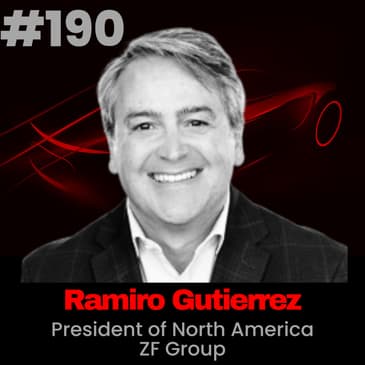
Tariffs bought this industry a window. Ramiro Gutierrez, President of North America, ZF Group, is not convinced we are using it.
He has spent 30 years in the automotive industry, and he left it once. Aerospace turned out to be slower than he expected, with cycles running roughly five times longer, and he returned to ZF for engineering. What he came back to is a company spending around 8% of revenue on R&D and now under real pressure to prove that money produces a return.
That pressure is where this conversation starts, and it goes somewhere most tier one interviews do not. Ramiro walks through what his Chinese customers are doing with hardware ZF has already put on the vehicle. A customer looked at ZF’s active suspension and figured out that lifting a wheel lets you change a flat tire without a jack. At CES, ZF showed a tire-noise function built from a damper and a chassis sensor, both already on the car. Same hardware, new functionality, software doing the work.
Meanwhile, the Western specification book has been growing for a hundred years, page after page, all for good reasons, until it moved past anything a customer can feel. The cost is real, and the value is not.
Ramiro is direct about tariffs. He calls them a tool in the sandbox, useful for buying time. He is just as direct about what happens if the industry spends that time defending the status quo instead of closing the gap.
Then there is the leadership half of it. He is president of ZF North America and head of the global steering business unit, sitting between a German foundation owner under enormous pressure and a workforce spread across the US, Mexico, and Canada. His answer to that complexity is not a new org chart. It is communication treated as an investment, people sent to see other realities with their own eyes, consensus built and then closed, and accountability that sounds like “where are we” rather than “why didn’t you.”
The clock is running. Ramiro believes the future is bright. He also believes we have to move.
Themes Discussed in this Episode
- Creating value through software, not more hardware
- Why Chinese OEMs adopt technology faster
- Tariffs as a tool with an expiration date
- The hundred-year specification problem
- Communication as a leadership investment
- Positive accountability without micromanagement
- Leading a German-owned business across three countries
- Engineering ambition meeting financial discipline
This episode is sponsored by Lockton, click here to learn more
🎥 Watch the full episode on YouTube:
https://www.youtube.com/@jangriffithsautomotiveleaders
Featured Guest: Ramiro Gutierrez, President of North America, ZF Group
Ramiro has led ZF Group's North America region since June 2024, based in Northville, Michigan, and he also heads the company's global Steering business unit, which puts him at the center of the by-wire chassis technology ZF is now putting into production.
This is his second tour at ZF. He joined in 2005 as a sales director, rose to senior vice president of sales, and left in 2017 for Aptiv and then Howmet Aerospace, where he was president of Engineered Structures. Thirty years in this industry on both sides of the Atlantic gives him a read on the Chinese market that very few North American executives have.
About Your Host – Jan Griffiths
Jan Griffiths is the champion for culture change and the host of the Automotive Leaders Podcast. A former automotive executive with a rebellious spirit, Jan is known for challenging outdated norms and inspiring leaders to ditch command and control. She brings honesty, energy, and courage to every conversation, proving that authentic, human-centered leadership is the future of the automotive industry.
Mentioned in this Episode:
Episode Highlights
[02:14] Two tours at ZF: Ramiro left automotive for aerospace, expecting something different, found the cycles about five times longer, and came back for the engineering.
[06:38] Engineering money has to earn its keep: ZF spends roughly 8% of revenue on engineering, and Ramiro explains why every euro of it now has to show a return.
[08:58] The flat tire that changed the conversation: A customer took ZF’s active suspension and figured out how to lift a wheel instead of using a jack, then how to rock a car out of a sand trap. All of it through software.
[13:42] Cost reduction versus value reduction: Jan asks how to get this thinking into legacy automotive. Ramiro names the trap: taking cost out by taking value out, and the customer feels it.
[15:57] Steer-by-wire and video games at the charger: Decoupling the wheel from the rack opens up functionality nobody paid extra hardware for, and Ramiro names who is doing it first.
[18:58] Tariffs are a tool in the sandbox: Useful for buying time to compete and change. Dangerous if that time creates an artificial bubble instead.
[20:57] Send him to China: Rather than another briefing, Ramiro told his government relations lead to get on a plane, because some realities cannot be explained through words.
[24:57] The engineering dream meets the P&L: As a foundation-owned company rather than a listed one, ZF has always had financials in the room. Ramiro explains why they are now the drumbeat and what that does to culture.
[28:54] A hundred years of specifications: Page after page added for good reasons, until the spec book passed what a customer can perceive. Ramiro’s engineers drive a vehicle from another region and call it no good, and the answer is that people there buy it by the hundreds of thousands.
[31:46] Who are you as a leader: Straightforward, sometimes too direct, consensus first, and then execution. He describes the two kinds of people you find when a commitment slips, and which one you can build an organization on.
Top Quotes
[27:35] Ramiro Gutierrez: “The adoption of technology that we have in front of our Chinese OEMs is exponentially higher than the adoption of technology that we have from our traditional OEMs.”
[34:00] Ramiro Gutierrez: “If you have the first kind of individuals, the only option for you is to go micromanage, and then it’s going to kill you.”
[35:56] Ramiro Gutierrez: “I look at communication as an investment. You invest in getting everybody aligned with what you think is the right thing to do.”
If this episode resonated, share it with a fellow automotive leader and subscribe to The Automotive Leaders Podcast, where we’re shaping the future of authentic leadership in the automotive industry.
This podcast episode is also available on YouTube. Check out our YouTube channel at Jangriffithsautomotiveleaders
Send us your feedback or questions — email Jan at Jan@Gravitasdetroit.com.
[Transcript]
[00:00:00] Jan Griffiths: This is the Automotive Leaders Podcast. Straight talk from the CEOs and innovators who cut through the noise, create clarity, and drive transformation across this industry. The old command and control playbook is dead. Culture is the operating system. Authentic leadership is the edge. We're rewiring it, starting now. I'm your host, Jan Griffiths, that passionate, rebellious farmer's daughter from Wales and the champion for culture change. Let's dive in.
This episode is brought to you by Lockton. Rising benefit costs aren't inevitable for you or your employees when you break through the status quo. Independence matters, it means Lockton can bring you creative, tailored solutions that truly serve your business and your people. At Lockton, clients, associates, and communities come first, not margins and not mediocrity. Meet the moment with Lockton.
My guest today is Ramiro Gutierrez. He is president of ZF North America. Over 30 years in this industry with two tours at ZF and a stint in the aerospace industry. He leads a German-owned company which is one of the top five largest auto suppliers on the planet.
He leads a company that deals with the cultural complexities of a German-owned company, and he himself, within the North American organization, has the complexities of a North American workforce, US, Mexico, and Canada, leading through these incredibly challenging and transformational times.
What pulls me into this conversation is "how." How do you do that? With all of that complexity, how do you lead and grow a business?
Well, let's find out.
Ramiro, welcome to the show.
[00:02:11] Ramiro Gutierrez: Thank you very much. I'm very happy to be here today.
[00:02:13] Jan Griffiths: Great to have you.
Now, I gotta ask you, two tours at ZF. So what brought you back?
[00:02:20] Ramiro Gutierrez: Well, I think, when I left automotive and I went into aerospace my expectations were to go through a change and experiment something different. Then, being inside aerospace is funny because you find it to be slow. Why? Because the cycle is way longer than automotive, probably five times longer.
[00:02:43] Jan Griffiths: Yeah.
[00:02:43] Ramiro Gutierrez: And then, start to miss that dynamic of automotive. And, uh, funny enough, when you come back to automotive, you say, "Hmm, maybe the speed is a little bit too much." But, I think what brought me back to ZF was the opportunity to work again for a company that has a vast investment into engineering.
It's an engineering-driven company, sometimes too much engineering. The dedication of the team, the focus on technology is what brought me back that opportunity to drive technology into the market and being engineering-driven.
[00:03:20] Jan Griffiths: It's funny you mention that, going to aerospace, you got the sense that it was too slow.
I did a very similar thing. I actually moved into the appliance industry. I worked for Maytag. I left automotive, went to Maytag, and had the exact same experience. And I remember being in a meeting once. We were talking about a new program launch, and you know, in automotive, it's the launch date. It's the launch date, right?
You don't miss job one. You have PSW dates, and we have all this structure, and the idea of missing an SOP date is unheard of. There would be a sea of dead bodies around you. And I remember in the appliance industry, they said, "Oh, we'll just launch it in the next home show." And I thought, what are you talking about?
It's just, it's a different... It's not good or bad, it's just different. And the pace was very different. But the one thing that I learned was that it taught me to really think about the way that we do business in automotive and challenge some of those assumptions that we go along through our automotive daily business, and we don't challenge it because we've always done it that way.
Did you find that? And what did you start to challenge when you came from aerospace back into auto?
[00:04:34] Ramiro Gutierrez: So a couple things. I think from the customer-supplier relationship is very different in aerospace than in automotive. Then obviously the number of suppliers in aerospace is probably is smaller than the number of suppliers in automotive, but it's a more balanced relationship to the extent of a more collaborative environment rather than one-sided environment.
Automotive in some cases, right? We experience sometimes very much a one-sided relationship, and I think in aerospace is more balanced. Then, I think the other portion that I experienced was the technology dynamics. So, in aerospace, the cycles are longer, but the technology position is very strong.
The experience and expertise in certain areas of the business is very much respected by customers. And hence, that trust from let's say, the Airbuses or the Boeings, or the Embraers, or the Lockheed Martins on the supply base and what they bring into the table, that dynamic is also different.
It's more about how you can resolve this problem rather than you're gonna need to go and do this and that other thing, and what you're doing for this other guy doesn't work for me. I think, those two couple of things are an strong element of the aerospace business, and we have things to learn on that dynamic into automotive.
[00:06:13] Jan Griffiths: This episode is powered by Seraph. When manufacturing leaders need to launch scale, relocate production, or navigate supply chain disruption, they call Seraph. Hands-on operators. Measurable results. Learn more @seraph.com.
Have you incorporated those elements into your leadership style?
[00:06:38] Ramiro Gutierrez: Yeah, I think, one of the things that we're trying to do at ZF is, that strength that we have with the amount of money that we spend every year in engineering. We are spending to the ballpark of 8% of our revenue, which is 40 billion euro, which is about 50 billion, US.
8% of that amount is going into engineering spend, right? Then the question is whether there is a return or there is no return of that money, and whether it makes sense to develop one thing again and all over again, or it makes sense to invest in a particular product. So I think when it comes to the product strategy, what one of the things that we're trying to do is making sure that where we invest the money, there is actually a return, and we are not going to reinvent the wheel or developing a thing that we have done for a customer again for a different customer.
So we are more careful with the way we deploy capital, with the way we spend engineering money, making sure that what we're doing has a return.
[00:07:46] Jan Griffiths: ZF is what I would call a hardcore engineering company.
I mean, look, you've grown through acquisition. TRW, it doesn't get any more hardcore than TRW. Wabco. These are hardcore hardware kind of engineering businesses and products. But now we're evolving into this SDV space and software and more of the technology side of it. What challenges does that bring to you as a leader as your company evolves more into that space?
[00:08:18] Ramiro Gutierrez: Yeah, I think it's all around the value creation. I have experience or I am experiencing the different dynamics, for example, in the China market or with the Chinese customers than the Western customers, and this focus on the value creation. They are able to visualize value creation in a much faster, clear way that we do on this end.
I am challenging my engineers into try to look beyond the hardware and the primary functionality of the hardware plus the software that we are developing to develop through software multiple applications. I give you an example.
[00:08:57] Jan Griffiths: Please.
[00:08:58] Ramiro Gutierrez: For example, we are developing what we call sMOTION. sMOTION is basically active suspension into vehicles, and the primary functionality of that is on the vehicle dynamics when you're going around a corner or you find an obstacle on the road, your vehicle, when you go left to right or right to left, is gonna compensate that oscillation of the body and then keep it as flat as possible, which would, provide a much better way to go around that obstacle or take that turn.
Then you have the hardware sitting on the vehicle, right? And it's a fantastic product. Now we have a customer, one of our customers, Li Auto, said, "Oh, we love that product, and you know what? What we're gonna do is now that we have the product on the vehicle, we're gonna develop some extra functionality around it."
I said, "That sounds fantastic. So what is that?" And, they came up with the idea, well, now that I can manage each of the four wheels independently, I wanna provide my customers with a situation where they have a flat tire, I'm gonna bring that tire up. So instead of putting the jack and turning it and bringing the body up, the tire is gonna come up for them.
I'm gonna put a jack for safety purposes down there to keep it sure that it's not gonna come back down, the car, and then they can change the tire straight away. I tell you more with this overall version of the vehicle that we have, when they go into a sand trap, I'm gonna oscillate alternatively each of the four tires, so they can get out of the sand trap without any problems And I go, "Listen, this is thinking beyond the primary element that you're bringing there, which is the active suspension, and now you are developing value through software, which we all know is way cheaper than developing value through hardware
[00:10:55] Jan Griffiths: Yes
[00:10:56] Ramiro Gutierrez: and get more out of that technology, right? So I'm challenging my engineers to think before our customers or think like our customers on how we can bring that. At CES this year, we presented a tire noise reduction product, right, which is similar. We have a head adjusting sensor for controlling the front lamps into the vehicle, and that head adjuster can also tell me what is the frequency on the tire.
And then I can use my shock absorbers to generate a counter-frequency to eliminate tire noise by three decibels. Then three decibels may sound like an very small number. I was, myself, actually surprised how customers reacted to that, and you cannot believe the amount of buzz that was generating with them and how much they want that technical solution.
And again, we already have the shock absorber. We already have the head adjusting sensor in there. And developing through software that counter frequency that is using the two pieces of hardware that are already in the vehicle. So isn't that a beauty? You can get that for the same, basically the same investment that you have made in developing the primary functionality.
[00:12:10] Jan Griffiths: This episode is sponsored by UHY.
Did you know suppliers now spend 157 hours on an average RFQ and still face the same roadblocks as 20 years ago? UHY and the Center for Automotive Research, break it all down in their new white paper.
Download your copy. There's a link in the show notes.
Tariffs, disruption, uncertainty. Your supply chain has answers. Tradeverifyd helps you ask why and what to do about it. Visit Tradeverifyd, that's verifyd with a yd.com.
But this, what you're describing is a way that the Chinese OEMs are thinking.
[00:12:57] Ramiro Gutierrez: Correct.
[00:12:59] Jan Griffiths: How do we bring that thinking into legacy automotive, into the US? I mean, we've got thousands and thousands, tens of thousands of engineers, and we all know typically in legacy automotive, we think very much in our silos.
But what you're talking about, it's they're good ideas, but it's not rocket science, right? It's looking at, it's looking at the vehicle, and it's through the eyes of the user. How does the customer experience the vehicle? It's not necessarily optimizing for a particular silo or particular product type.
How do we bring that kind of thinking into legacy automotive?
[00:13:42] Ramiro Gutierrez: I think this is a fantastic question. In some cases, I think we need some non-automotive people to get involved
[00:13:48] Jan Griffiths: I would agree ...
[00:13:49] Ramiro Gutierrez: because they would think out of the box and just say, "Oh, now that you can do that thing with the tire, wait a second.
I mean, you can move up the tire and you don't need a jack to take the tire out." So that is one, but I think the other portion is that in the legacy automotive, there is too much thinking about, how do we reduce the cost? And reducing the cost is a good thing, but the not such a good thing is reducing the cost by reducing the value.
Then, the tendency is, oh, I have this component out there that, yeah, it has a functionality, but you know what? It's not that critical, so let's take it out. But the end customer is gonna see that the value has been reduced. Yeah, maybe or hopefully the cost has been reduced more than the value.
[00:14:35] Jan Griffiths: Mm.
[00:14:36] Ramiro Gutierrez: But still, you're presenting to them a product that reports to them less value.
Then how the Chinese OEM think? Hmm. So if I reuse this product that you are already selling and commercializing with my competitor, my customer is not gonna have any complaints because it's already working good at this other competitor. You have the tooling. You have done the engineering. You have the capacity.
It's not a visible element of the vehicle, so it's not a differentiator for me. I'm gonna go reuse it. And instead of spending, whatever, a million dollars in engineering and another million dollars in capital to have my own version of it, I'm gonna save that money, and that is gonna revert back. Those $2 million is gonna, is gonna revert back into a cost reduction for the entire vehicle.
And I am not touching my value proposition for the customer. The customer is still gonna see the value proposition. And at the same time, what I may gonna do is use some of the hardware that is sitting in there through software with the software-defined vehicle that we have now-
[00:15:54] Jan Griffiths: Yeah ... to develop some new functionality,
[00:15:57] Ramiro Gutierrez: I am also, on top of being the North America, president, I am the head of global steering for the company. And in global steering, we have another example where, we're developing electric power steering. Actually, now we are delivering to our customers steer-by-wire.
And steer-by-wire is decoupling your steering wheel from your rack-and-pinion. Then let's say you have an electrical vehicle. Let's say that you need to charge your vehicle for 20 minutes. Then now I can give you the possibility while you are waiting for the charge to be completed or to get to 80%, I'm gonna give you the possibility to play video games with your steering wheel and your pedals, because I can give you the ability with the steer-by-wire to basically steer your steering wheel and play with your pedals without moving the physical wheels of the vehicle.
And then you can use your big LCD screen that you have there to display the motion. So you're gonna have a good time. Actually, you may wanna charge to 100%.
Instead of 50 because you're having a good time. But again, I can do all that through software. The hardware is already sitting in there. It has a primary functionality, which is steering left to right, but now I'm developing a new functionality out of it.
And do you know what, who is doing that first? our Chinese customers Yeah.
[00:17:21] Jan Griffiths: You mentioned it would be a good idea to have people outside of the industry come in and help challenge us. But as an industry, we haven't had a very good track record with that. When we see, when we bring in Silicon Valley talent into the traditional OEMs, they often leave because the traditional legacy culture chokes them, throttles them, and then they end up leaving.
Rather than talk about this on a macro automotive industry level, how are you doing that at ZF? How are you bringing in maybe different ways of thinking, helping your engineers and your company as a whole think differently?
[00:18:01] Ramiro Gutierrez: Well, I am spending a lot of time in getting together with our engineering team and actually making the right questions.
And the right questions is trying to go deeper into the conversation about the value creation, the product differentiation, what we can do, and challenge them on that. And then, certainly sometimes fresh eyes into the equation, it brings some fresh air. But to be clear, what we do in automotive is extremely remarkable.
So automotive engineering is a great thing. Then what we should not negate is that there is room for improvement, and also what we should not negate is that there are areas of this world that are moving at a different speed that we do on the Western world. And, then far from demonizing that part of the industry, what we need is to find ways to catch up and to change our culture.
Maybe our culture is saying too much, but to adapt our speed to that new speed and making sure that we are able to compete and to create. I mean, entering into maybe a controversial topic, which is tariffs, right? I think tariffs are useful as a tool. It's a tool in the sandbox. Is a tool that is gonna allow us to buy some time to be able to compete to change.
But if we don't use that time to do that, we're gonna create a kind of an artificial bubble that is not gonna be healthy for any of us. It's not gonna help us to be more competitive. It's not gonna get us more ambitious in evolving our technology, in bringing new things and create value for our customers.
So we need to be careful the way we use the tool. We need to make sure that we use that time in an intelligent way.
[00:19:52] Jan Griffiths: And that time is so precious because the clock is ticking And I understand, I hear you talk about value creation, and we talk about transformation, and there are a lot of leaders like yourself, C- CEOs of tier ones, that, that talk about that.
But how do you provide clarity of that vision to your team? And let me explain that. I see companies that talk about redesigning their organization around value streams. But then I see the same people in the room who created the original structure, to your point about bringing in outsiders.
So there's.. It's the same people, and you're expecting these people to recreate the silo structure around, now around value streams and go across silos and develop as an old structure around value streams with very little clarity of vision of what that end game is. How do you lead ZF around these topics that are not so clear-cut?
[00:20:57] Ramiro Gutierrez: I think you need to spend a lot of time and communicate. If the team doesn't see you often and, you don't communicate with the team, it's gonna be very difficult to generate the change. Then, in some cases, you're gonna need to force them to think, force them to go through the exercise. Not everybody has the opportunity to go and experience different regions or experience different realities, right?
And it's important that the leadership is able to transmit that, and it's also able to give them access to that different reality. I mean, the other day I was talking to one of our, my team members, and he's in government relations. And, as you know, there is a lot of back and forward with Washington, DC about regulation, about tariffs, and about geopolitical topics.
And I say, "Do you know what? I think you need to take a trip to China, because there is so much talk about China, but have you been in China?" Yes. Yes.
And the guy goes, tell me, "No, I haven't been." I said, "Well, this is what we're gonna go do next, because it will help you to be there to understand what is happening in there, and then you will have a different perspective on how things work.
Because, if you don't experience it, it's difficult to explain." So we as a leadership, we need to make sure that, one, we communicate, we explain what is going on, we try to transmit as much as we can what need to change, and then also we should put some budget availability, which is difficult these days-
[00:22:43] Jan Griffiths: Yes
[00:22:44] Ramiro Gutierrez: to make sure that we get them exposed to that reality.
[00:22:48] Jan Griffiths: Yeah.
[00:22:48] Ramiro Gutierrez: 'Cause in some cases, it is difficult for them to understand what is really happening just through words. Yeah. So I think it's very important, and I spend a lot of time, in communicating, in trying to apply common sense to things, get the people to understand why is there rather than the one-way communication, you're gonna need to do this, this, and that, and I need it by this day and the other day. That normally doesn't work. Right. It may work on a very short period of time, but it's not sustainable, right? Yes. So you need to get people engaged into a different dynamic. And if they do not understand why, it's gonna be extremely difficult to get them convinced that is the right way to do things.
[00:23:37] Jan Griffiths: Yeah. And you're right. And it costs money. It's an investment to do that. It's an investment of your time, of your leadership team, and there is an investment to help people, like you say, see that different reality. Now, let's talk about a reality that we see playing out in Europe right now.
We know that particularly the German OEMs are in trouble. We've got massive restructuring going on. We've just got a recent announcement from Volkswagen. They had originally announced, 50,000, they were cutting their workforce by 50,000. Now they're talking about 100,000, approximately 15% of their global workforce.
Massive implications, ripple effects all throughout the supply base. So you're a German-owned company. You've got a different type of ownership model. You're a foundation. You've got all of this happening in Germany, which I've got to believe is putting a lot of pressure on you. You're leading a division, and then you've got tariffs to deal with.
You've got USMCA to deal with. You've got the EV pivot, so some investments, maybe some capital that you're not gonna use that you have to write off. Maybe there's some of that going on. Tremendous amount of challenges, and oh, by the way, you've got to transform and completely restructure this organization at the same time.
How do you do that? What's the playbook?
[00:24:57] Ramiro Gutierrez: I think for ZF, right, is transformation. We talk about before how ZF is an engineering-driven company. Then all that reality has to connect what I call the engineering dream with the financials. And, traditionally, ZF, as per being a foundation and not a traded company in Wall Street financials have always been there, but they were not, the drumbeat of how the company was moving.
Then, all this situation is forcing us to get more financial discipline, which I believe is a very good thing. And, but the culture need to change along with that, right? I mean, the guy that is developing an engineering product in core engineering needs to understand that whatever that person is developing, it has to meet the market expectations.
It has to meet the company need for profitability and not just for the sake of developing a cool technology that would make sense in the marketplace. So there are changes that are happening on that end in terms of having finance playing a bigger role into how the company's being managed.
Then, you said about the differences. Obviously regulation in North America has become very different than the regulation in Europe. And obviously we have the geopolitical, part of the equation. So you were asking how Europe is doing it.
I think, Europe is in a tough place right now.
Yeah. Right? Contrary to the US, Europe has decided to go more for the free market kind of approach, and they have decided not to raise tariff barriers against the Chinese competition. Then, I think over time they are rethinking that strategy, but certainly they are not deploying the same kind of approach as the US.
Then, there is an urgency to catch up. Chinese OEMs are deploying capital into Europe. Actually, in some cases they are taking over existing facilities from traditional OEMs to produce their vehicles, and there is a significant number of Chinese vehicles hitting the road in Europe.
So, that is tough. That is tough. I think, in our conversations with our German customers or our European customers, one of the things that we are explaining to them is they are asking, "What is the secret recipe? How-" you guys are doing with the Chinese OEMs. I have to say, we have a great time with our Chinese OEMs.
I mean, the adoption of technology that we have in front of our Chinese OEMs is exponentially higher than the adoption of technology that we have from our traditional OEMs. We are selling way more content per vehicle in China than we do in the Western world. You would say, "How is that even possible?"
[00:27:57] Jan Griffiths: Why? Why? Tell me why.
[00:27:59] Ramiro Gutierrez: Why? And I think the... This is what I said before. I don't know. I can give you more examples. If I have a rear steering system, which is a beautiful product, they don't have a problem in getting my off-the-shelf steering system and put it into their vehicle. You as a driver, you are not gonna know whether the steering system that you have is coming originally developed for JAC or BYD or General Motors to say a name, right?
Yeah. So why would you change it? So they are getting it, into the car for a marginal engineering cost, for a marginal capital cost, and then they go run with it. This is not what is happening in Europe or what is happening in the US. Same way with the specifications. I think in the Western world, right, we have 100-year plus of a story developing cars.
Through this 100-year story of developing cars, now we have been adding pages to the set of a specification, all for good reasons.
[00:29:03] Jan Griffiths: Yes.
[00:29:04] Ramiro Gutierrez: Pages and more pages and more pages. But I think it has got to the point that we're going beyond what the customer feels and see and perceives into the vehicle. I have examples of my engineers maybe coming into a different region and I give them the opportunity to go drive a vehicle that has been developed in that region.
And very quickly, they go say, "Oh, this is no good." And I go, "Why isn't it good?" And then they give you all kind of examples why it's no good. Oh, because there is this noise and vibration, and there is this, asymmetric behavior, and then when I do this, the car has a tendency to do that.
And I go, " well, that is interesting because, customers in this country, they are buying this thing in the hundreds of thousands."
[00:29:59] Jan Griffiths: Yes.
[00:29:59] Ramiro Gutierrez: And they don't have any problem with it.
[00:30:01] Jan Griffiths: They don't even think about it.
[00:30:03] Ramiro Gutierrez: Right. So- '
[00:30:03] Jan Griffiths: Cause your average person buying a car is not an NVH engineer. Exactly.
[00:30:08] Ramiro Gutierrez: Exactly. So I think to an extent there is a kind of a disconnection, or we have been going a little bit too far, and that is driving cost into the equation.
[00:30:19] Jan Griffiths: Yes.
[00:30:19] Ramiro Gutierrez: And this is not what the Chinese OEMs are doing. Maybe because they are younger into the industry, and therefore their set of specifications haven't been growing over 100 years or-
[00:30:31] Jan Griffiths: Yeah. They started with a clean sheet of paper ...
[00:30:33] Ramiro Gutierrez: or maybe initially they copied specifications from the Western world.
Or they may maybe have specifications for the Western world, but over time they've been trying to reduce it rather than making it more complex. So I think there is a lot of cost being driven into the equation that doesn't necessarily create value. We're going back to the value.
[00:30:52] Jan Griffiths: Mm-hmm.
[00:30:54] Ramiro Gutierrez: And I think they have found a better formula to create the value there that we haven't been able to evolve in here.
I mean, the value is the result of a factor functionality divided by cost. Then if you reduce the cost element, then the, automatically the value grows because the factor is bigger. But this is not the only way to do it, and that is the key element. I mean, they are able to move the F into the functionality in a way that we haven't been able to do it.
[00:31:27] Jan Griffiths: Yeah. Well, but now is our time.
[00:31:30] Ramiro Gutierrez: It is.
[00:31:30] Jan Griffiths: Tariffs are here to give us that window.
[00:31:32] Ramiro Gutierrez: Correct.
[00:31:33] Jan Griffiths: So now is the time to do it. I'm gonna ask you a question that I normally lead with, but we went off into some different directions, which is perfectly okay.
Who are you as a leader Ramiro?
[00:31:46] Ramiro Gutierrez: So I am a very straightforward person. Normally, I don't go around the bush and fly around the topic. I normally to the key elements of the discussion. Sometimes that comes across a little bit too direct, but this is the way I am.
So fundamentally, I trying to be a rational person, and as I said before, I spend a lot of time in communicating.
And when I communicate, I try to explain the rational person or the common sense, what is the reason why those things are important to us. Then I'm trying to drive consensus. So this is my reason. If you have a different opinion, let me know. But when we get to an agreement that this is actually something that we should do, now is time for execution.
Yes. So I'm gonna hold you accountable in the positive way. Not in the negative way. I'm gonna, come back to you and say, "We talk about this. We agree that was a good idea."
[00:32:47] Jan Griffiths: Yep. Where are we?
[00:32:48] Ramiro Gutierrez: Where are we with?
[00:32:49] Jan Griffiths: Yeah.
[00:32:49] Ramiro Gutierrez: So I'm gonna let you run with the ball, but then it's not that I'm not gonna go back and check with you that you are running or you are not running. Then if you are not running, I'm gonna say, "So what happened?"
You made a commitment with me, not with me, with the company that you were gonna go do this. You haven't done it, and what is the problem?
[00:33:10] Jan Griffiths: Yeah.
[00:33:11] Ramiro Gutierrez: You didn't call me asking for help, so I was assuming that everything was running the right way.
And then you find two different kind of individuals, right? And this is behavioral. You find individual that is gonna give you a list of excuses like this, say, "Oh, you know, Peter didn't do that, and Jane didn't give me that," and so forth, and that's why it didn't happen.
[00:33:35] Jan Griffiths: Yeah.
[00:33:37] Ramiro Gutierrez: But that is a bad one, right?
And then you have the individual that is coming to you and say, "Yeah, I screw it up. This is my plan to catch up, and this is how we're gonna go do it." Well, the second individual is the individual that you wanna have in your organization. The first individual is the one that either changes or we need to find that person a job in the competition, 'cause maybe.
[00:33:59] Jan Griffiths: Yeah.
[00:34:00] Ramiro Gutierrez: But no, I am joking. But in reality, if you have the first kind of individuals, the only option for you is to go micromanage, and then it's gonna kill you.
[00:34:08] Jan Griffiths: Exactly.
[00:34:09] Ramiro Gutierrez: 'Cause you don't have time to micromanage. You need people that you trust. They are running with the ball, they have the right attitude, and they're gonna pick up the phone and say, "Hey, I need help.
This thing is not moving. I need to unblock it."
I think this is what I am looking every day. I mean, I am trying to set up certain priorities, the important things that are for today and tomorrow, and then also think about what is gonna be needed in the months to come kill the today and tomorrow first, and then go and discuss where are we going, giving direction, explaining the team, or actually also learning from the team what is the new things that we need to face and how we're gonna go around them.
[00:34:55] Jan Griffiths: And listening to you talk about accountability, I mean, obviously you lead a large organization. People have to be accountable. There are results, and there is such a thing as positive accountability. Sounds like you support that, you drive that, but you also spend a lot of time explaining the why behind the transformation.
And I find that it's often difficult for leaders to get that balance right. It's like, how much time do you spend out there meeting with people, doing what I believe is the real leadership job, right? Explaining, painting the picture of the vision, getting people excited about the vision, talking about the why, but also keeping your eye on the business fundamentals.
And I don't know that there's a perfect answer to that. There's not a cookie cutter response to that. I always say it's each individual brings their whole self to the equation, and they have to figure that out. But what advice do you have for leaders who are perhaps struggling with that, finding that balance?
[00:35:56] Ramiro Gutierrez: I mean, I look at communication as an investment. You invest on getting everybody aligned with what you think is the right thing to do. Actually, you're learning through that process because there are different perspectives from different people.
[00:36:15] Jan Griffiths: Yeah.
[00:36:15] Ramiro Gutierrez: And you don't always have the right solution for everything.
So it's important, that communication with the team. Then, obviously, the day has only 24 hours, and then you need to set your priorities right. I mean, there's gonna be times where you need to be focused on something, and you need to make sure that something is happening. And there are some times where you can invest more time in communicating, in working with a team, in understanding what is going on.
There has to be a balance and, but it's not a fixed balance. And but it
[00:36:47] Jan Griffiths: It changes over time.
[00:36:48] Ramiro Gutierrez: Right. Yeah. And, these days, maybe two weeks ago, we thought, the Iran situation was over, and now-
[00:36:55] Jan Griffiths: And now it's back ...
[00:36:55] Ramiro Gutierrez: we're back into the problem. So, you gonna need to react to that.
There is no way around that. And, the same happens with our engineering challenges or our execution challenges or our quality challenges, if you have one, right? So I think we need to be flexible. But I think it's critically important that you get your team behind you, and the only way to get that is communicating with them, explaining them why things are necessary, learning from them what possible solutions we can bring to the table, align, and then stop the discussion on that topic.
It's the time for execution. If we have decided what we need to do, let's just stop discussing about the problem, then-
[00:37:38] Jan Griffiths: Then move ...
[00:37:38] Ramiro Gutierrez: execute it and move. And then, there's a point to move. Implementation is the important one. Because if we have agreed we're gonna do it, I'm expecting you to do it. If a week later I discover that you found an issue, and then you sitting on the issue, and you are not asking for help to resolve the issue, then, my God, I mean, we have a fundamental problem here, right?
[00:37:59] Jan Griffiths: Yes, you're right. And I think some of the challenges, there's a tendency with leaders to want to just come up with a new org chart and just throw it down at the organization because it's quicker, right?
They got all the answers. They, just execute this. But we all know how that ends.
Right. It does not end well. But it's finding that balance, but you also don't have years and years to figure it out and get everybody's input. But, you've got to set up the idea. You've got to set up the why behind the change. You have to get people involved. They have to buy in, and they, their ideas have to be included in the process.
You have to co-create together what this new, operating playbook looks like, how you're gonna make decisions faster, how are you gonna design products differently. But then there comes a point in time where you have to execute, and you have to say go. And maybe you're gonna run on the fly, and you adjust as you're going.
But it's finding that balance that I think is tremendously challenging for leaders today.
[00:39:01] Ramiro Gutierrez: There is a very clear trap in there, which is reevaluating and reevaluating and reevaluating.
[00:39:07] Jan Griffiths: Yeah. It's never gonna be right. It's never gonna be perfect.
[00:39:10] Ramiro Gutierrez: I agree. So go execute, and if we find things that we need to tune up and down, let's discuss those things, but let's make sure that we get going.
[00:39:19] Jan Griffiths: Yeah.
[00:39:19] Ramiro Gutierrez: Otherwise, a year is gonna pass by, and we are still sitting in here without addressing the issues.
[00:39:24] Jan Griffiths: So Ramiro, as an industry, where do we go from here?
[00:39:29] Ramiro Gutierrez: We need to evolve. Automotive is a beautiful industry. Is the dynamics and the way we move this industry is amazing. But, the world evolves and we need to evolve with it.
And, we need to address the challenges that are out there, and not necessarily the old solutions are gonna be solutions that we can deploy today. We need to evolve on those solutions. We also need to observe, who's doing best, who are the best practices, and then not be shy in adopting those practices.
And sometime, some people would be embarrassed to apply the same solution that somebody else did, but if it is a good solution, this would be no problem in doing. Do it.
[00:40:14] Jan Griffiths: Yes.
[00:40:14] Ramiro Gutierrez: So I think, we have a brilliant future, but the future is is bringing challenges, and we need to face those challenges head on.
And there are solutions for them. We should not be shy to apply them.
[00:40:27] Jan Griffiths: Yes, I agree with you. The time is now.
[00:40:30] Ramiro Gutierrez: Agreed.
[00:40:31] Jan Griffiths: The transformation of this industry, the restructure of this industry is happening, but it needs to happen faster. And Ramiro, thank you so much for joining us today.
[00:40:40] Ramiro Gutierrez: Very happy to be here. Thank you for having me.
[00:40:42] Jan Griffiths: Thank you.
[00:40:42] Ramiro Gutierrez: Thank you.
[00:40:43] Jan Griffiths: Thank you for listening. You can watch the full conversation on our YouTube channel. Search for Jan Griffiths Automotive Leaders, and download the 21 Traits of Authentic Leadership. It's a free PDF and the link is in the show notes. And remember, stay true to yourself, be you, and lead with Gravitas, the hallmark of authentic leadership