Nobody outsources the engine. It's the heartbeat of the vehicle, and outside of a few niche players, no large OEM has ever seriously considered handing it to someone else. Tom Lewis is betting that rule's about to break.
Tom is President of Horse Powertrain USA, the company formed by Renault, Geely, and Aramco with 19,000 people and 18 plants across 4 continents. OEMs bet big on battery-electric vehicles and pulled investment away from combustion and hybrid systems, but now consumer demand isn't matching the plan. Many of the hybrids sold in the U.S. today still run on engines developed at the start of the millennium. Horse's answer is fully assembled engines and transmissions from an unbiased partner, some call a tier 0.5, so OEMs don't have to pour capital into technology they can't justify building alone.
The business model breaks one rule. Tom's leadership breaks a few more. He calls himself a catalyst, and he's got the stories to back it up. A purchasing leader once told him he had no chance at an inverter program and to come back next time. Tom asked what the current suppliers weren't solving, pulled together a skunkworks team, found a way to meet the power requirement with a single power module, and slid a quote across the desk without ever receiving an RFQ. His company won the business. Then there's the inflation negotiation, where everyone in the room was hunting for ways to pressure the customer, and Tom stopped the discussion to ask what a positive lever might look like. That offer went straight to the CEO, who said yes on the spot, because Tom wasn't willing to wait for every business unit controller to protect their own turf.
Jan and Tom also get into what it takes to blend French, Spanish, Swedish, and Chinese teams into one culture, why a vision has to be built by the team in the room (and never pulled from an AI tool), and what Tom's leaving behind as he builds Horse's U.S. organization as employee number one.
This one's for every leader who's been told to wait for the RFQ, follow the process, and stay in their lane, and knows the automotive industry can't afford to keep playing it safe.
Themes Discussed in this Episode
- Why the rule against outsourcing the engine is breaking
- The BEV bet and the return of the hybrid
- Tier 0.5: an unbiased powertrain partner for OEMs
- Merging Chinese and legacy automotive cultures
- The leader as catalyst: ambition, vision, creativity, drive
- Breaking the rules to win the customer
- Positive levers in tough commercial negotiations
- Leaving complex hierarchy and decision-making behind
This episode is sponsored by Lockton, click here to learn more
🎥 Watch the full episode on YouTube:
https://www.youtube.com/@jangriffithsautomotiveleaders
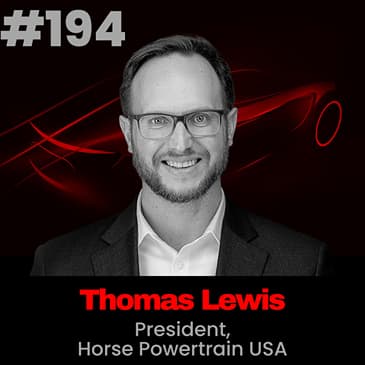
Featured Guest: Thomas Lewis, President, Horse Powertrain USA
Tom is President of Horse Powertrain USA, where he's leading the company's North American expansion and building its U.S. organization from the ground up. He brings more than 20 years of automotive leadership experience from Bosch, Vitesco Technologies, and Webasto, spanning commercial strategy, business development, organizational transformation, and global customer partnerships. A Michigan native and University of Michigan mechanical engineering graduate, Thomas is passionate about building high-performing teams and leading effectively through industry disruption.
About Your Host – Jan Griffiths
Jan Griffiths is the champion for culture change and the host of the Automotive Leaders Podcast. A former automotive executive with a rebellious spirit, Jan is known for challenging outdated norms and inspiring leaders to ditch command and control. She brings honesty, energy, and courage to every conversation, proving that authentic, human-centered leadership is the future of the automotive industry.
Mentioned in this Episode:
- 21 Traits of Authentic Leadership
- UHY Cost Engineering Study | May 2026
- Episode with Terry Woychowski, Caresoft
- Episode with Kate Vitasek, win-win negotiation expert
- China Speed Isn't New: What a 1993 Binder Says About Automotive Culture
Episode Highlights
[01:08] Breaking the engine rule: Jan sets up the rule nobody questions, that large OEMs don't outsource the engine, and why her guest is betting it's about to break.
[02:50] Following the consumer: OEMs bet big on battery electric vehicles, demand fell short, and Horse Powertrain USA is bringing the combustion and hybrid technology consumers want at a price customers can afford.
[05:07] The case for a tier 0.5: OEM-to-OEM collaboration stalls on conflicting priorities, which opens the door for an unbiased supplier with 25 customers and serious scale.
[07:03] Old engines, new demand: Many U.S. hybrids still run on engines released at the start of the millennium, and Horse expects half of the vehicles produced in 2040 to still carry some form of combustion engine.
[12:13] Four cultures, one company: French leaders in Spain, Swedes in Gothenburg, and Chinese teams in Hangzhou Bay work together with a level of respect Tom says doesn't feel forced.
[18:15] Tom Lewis, catalyst: Ambition, vision, creativity, and drive, plus why he'd rather try something and fail quickly than sit on stale hopes.
[21:17] Build the vision together: Jan pushes back on vision statements pulled from an AI tool and slapped on the wall, because people only buy in when they do the work in the room.
[24:19] Breaking the rules to win: No RFQ, no invitation, and a purchasing leader who said come back next time, yet Tom's team found a single power module inverter solution and won the business.
[27:53] Skunkworks and internal pushback: The hardest rules to break were inside his own company, so Tom proved it was possible before asking for resources.
[30:57] What to keep and what to leave: Tom leans into creativity and empowerment and leaves complex decision-making and hierarchy behind.
[32:55] The positive lever: In a heated inflation negotiation, Tom asked what the team could do to delight the customer, and the deal went straight to both CEOs.
[37:58] Employee number one: Tom had to incorporate Horse Powertrain USA Inc. before he could be hired into it, and the new Southfield office will grow to 32 people.
Top Quotes
[08:21] Thomas Lewis: " We're doing the right thing for our customers to bring them solutions that they need at a lower cost of entry, and we're doing the right thing for the consumers because we're giving them the type of powertrain that is evolving with their needs, becoming better and better."
[24:38] Thomas Lewis: "If you can come up with a way creatively to solve an issue or to win, to bring progress, sometimes you have to think outside of the box, and people can call that breaking the rules, or they can just call that getting creative and doing something unprecedented."
[35:40] Thomas Lewis: "The rules were there for a reason, but when the answer is so obvious for something that is different, where you could move quickly for something that could greatly benefit your company, and afterward everyone would know that did benefit the company in a great way, you have to move for a quicker way to authorize that. You don't move without authorization."
If this episode resonated, share it with a fellow automotive leader and subscribe to The Automotive Leaders Podcast, where we’re shaping the future of authentic leadership in the automotive industry.
This podcast episode is also available on YouTube. Check out our YouTube channel at Jangriffithsautomotiveleaders
Send us your feedback or questions — email Jan at Jan@Gravitasdetroit.com.
[Transcript]
[00:00:00] Jan Griffiths: This is the Automotive Leaders Podcast. Straight talk from the CEOs and innovators who cut through the noise, create clarity, and drive transformation across this industry. The old command and control playbook is dead. Culture is the operating system. Authentic leadership is the edge. We're rewiring it, starting now. I'm your host, Jan Griffiths, that passionate, rebellious farmer's daughter from Wales and the champion for culture change. Let's dive in.
[00:00:39] This episode is brought to you by Lockton. Rising benefit costs aren't inevitable for you or your employees when you break through the status quo. Independence matters, it means Lockton can bring you creative, tailored solutions that truly serve your business and your people. At Lockton, clients, associates, and communities come first, not margins and not mediocrity. Meet the moment with Lockton.
[00:01:08] I love people and companies who break the rules, who challenge the outdated norms in our beloved automotive industry because let's face it, that's what we need in order to transform at speed, and we need it now. Let's talk about the engine The heartbeat of the vehicle. Nobody ever thinks about outsourcing the engine, unless you're a small niche player perhaps.
[00:01:40] But the large OEMs, they don't ever think about outsourcing the engine. That rule of not outsourcing the engine, my guest is betting on the fact that that rule is about to break, and I am thrilled to bring on the show today Tom Lewis. Tom is president of Horse USA. Now, Horse, you might think, "What's that?"
[00:02:09] Well, we're gonna learn more about Horse, and then we're gonna learn more about the leader taking Horse to the next level in America. Horse is a company formed by Renault, Geely, and Aramco. 19,000 people, 18 plants. So let's dive in and find out more.
[00:02:34] Tom, welcome to the show.
[00:02:36] Thomas Lewis: Hi, Jan.
[00:02:36] Happy to be here.
[00:02:37] Jan Griffiths: Great to see you.
[00:02:38] Tell us, Horse, what is it all about? You have said yourself that you are challenging the traditions and the norms of the auto industry. What does that mean?
[00:02:50] Thomas Lewis: I'd say at a fundamental level, it's not so crazy and not so complicated. We're here to bring the products that consumers are demanding at a price that our customers can afford.
[00:03:00] There has been, in the recent history a big shift in investments and planning towards battery electric vehicles. OEMs bet big on that. They've reduced their investments, their focus on internal combustion engines and hybrid systems. They've bet big on battery electric vehicles.
[00:03:17] And what we're seeing is that the consumer demand for those vehicles is not as high as they were anticipating or hoping. We make next generation powertrain solutions. We've got a great portfolio across pure ice solutions, hybrid-focused solutions, and those that are made to hybridize Bev platforms.
[00:03:36] And this technology is fresh. We've been developing this for European and Asian markets over the last several years. We have the greatest and latest designs, the technology that brings our engine efficiency to industry high levels, and this is available today for us to sell to external customers.
[00:03:55] Jan Griffiths: It makes sense when you think about it.
[00:03:58] Why would an OEM want to invest all the capital and the energy into developing its own engine or system or next generation, whatever it needs? And this idea of collaboration, there's a lot more talk about that now than I've ever heard of before. Why does every single OEM do their own thing?
[00:04:20] We see it coming through the Chinese OEMs. I hear Terry Woychowski from Caresoft talking about it all the time. Why do we not collaborate with each other like the Chinese OEMs do, particularly when it's things that are under the hood, maybe not unique or specific to the vehicle that the consumer can't see or touch?
[00:04:43] Why don't we collaborate more? And now you see the Japanese OEMs, you see, the CEO of Toyota talking about how do we collaborate more in the industry, the Japanese OEMs. The Nissan CEO coming out saying the same thing. So this idea of collaboration at an OEM level is starting to get some traction.
[00:05:04] But I got a feeling, Tom, it's not gonna happen overnight, is it?
[00:05:07] Thomas Lewis: That's right, and it's particularly difficult when OEMs try to collaborate with each other. There is a bit of worry, a bit of stress about prioritization and what happens when the partner wants to focus or prioritize for their own reasons, their own purposes.
[00:05:25] There's a conflict of interest, right? I think that really sets the stage well for someone to come in, like Horse Powertrain, as a tier-one automotive supplier being unbiased.
[00:05:35] We're here to work together with them to craft solutions that fit to their vehicles, in a way that is unbiased. Some call us a tier 0.5. You may call us a tier one. We make fully assembled engines and transmissions and provide that to customers.
[00:05:53] And currently today we have 25 customers, by the way, which gives us a lot of scale. We have great cost from our supply base. We've got a broad range of platforms that we can leverage to make these new applications and really craft something that a customer wants on a basis that's already high quality and recently developed.
[00:06:15] Jan Griffiths: And you say, you know, we want to develop partnerships and work together collaboratively, but let's be honest, Tom, we've been talking about doing that in this industry since I started, which is a very, very long time ago. The reality of you now going into an OEM with this product, it's gonna be very different, 'cause you're not dealing with a traditional purchasing organization, you're dealing with a whole different cadre of senior level executives.
[00:06:41] So that's a very different approach for you.
[00:06:43] This episode is powered by Seraph. When manufacturing leaders need to launch scale, relocate production, or navigate supply chain disruption, they call Seraph. Hands-on operators. Measurable results. Learn more @seraph.com.
[00:07:03] Thomas Lewis: No, you're right. I mean, the genesis of a lot of these opportunities are coming from the chief strategy officers, strategy departments, vehicle chief engineers, engine or transmission chief engineers who see that they need a new solution and know that they're not going to be able to invest internally for the CapEx and the resources required to bring that to the market.
[00:07:25] Many of the hybrid solutions that are used today, especially in the US, are based on pretty old technology. Engines that were developed and released at the start of the millennium. And Horse Powertrain looks at that and says, "Look, we expect by 2040, still half of the vehicles produced are gonna have some kind of internal combustion engine," whether that's a pure ICE vehicle, a hybrid, or a range extender, and somebody needs to take care that that technology is continuing to evolve, that it continues to meet regulation, that it continues to meet consumer demand, that it continues in a sustainable way, too.
[00:08:01] And if a OEM is trying to go it alone and, invest in battery electric vehicles, which will grow, yeah, that is a growing market, while in parallel trying to keep up with the regulations and demands on the hybrids and internal combustion engines, it's a waste for our industry.
[00:08:17] Jan Griffiths: Yeah.
[00:08:17] Thomas Lewis: Yeah. So we feel we're doing the right thing for our industry to be efficient.
[00:08:21] We're doing the right thing for our customers to bring them solutions that they need at a lower cost of entry, and we're doing the right thing for the consumers because we're giving them the type of powertrain that is evolving with their needs, becoming better and better. And by the way, there's a lot of room for hybrids to be better, yeah?
[00:08:38] And we see that especially here in the US. The hybrid systems that we have developed and launched with customers abroad are excellent. Long range, 800 miles of range, 1,000 Horsepower. Really incredible systems, powering these vehicles. They're very quiet. They're very smooth.
[00:08:55] And, they answer the type of needs that consumers here like. We like range. We like power. We like low cost.
[00:09:02] Jan Griffiths: Mm-hmm.
[00:09:03] Thomas Lewis: And now more than ever, I mean, vehicles are very expensive nowadays So finding a way to bring the cost down in a way that is fun, fast, and affordable is what we do.
[00:09:15] Jan Griffiths: Do you think this is setting a model, an operating model for the future where there could be other tier ones coming together to offer this kind of partnership and solution to the OEMs?
[00:09:28] Thomas Lewis: I think that it can happen, but, it's not easy. Yeah, so yes, we're a tier one, but we were carved out from OEMs. Yes. So we were carved out from Renault, Volvo, and Geely, their full powertrain organization, the R&D centers, the plants. And then came together as a joint venture which gave us that scale that I was talking about.
[00:09:51] But that carve-out takes time, and we started years ago. Before I came into Horse Powertrain, I was watching from the outside, and as the market changed, I was thinking, "What an incredible idea."
[00:10:03] Jan Griffiths: Yeah.
[00:10:04] Thomas Lewis: These guys are here at the right time, with the right technology.
[00:10:08] It's almost prophetic. Like, how did they know?
[00:10:10] Jan Griffiths: Yeah.
[00:10:11] Thomas Lewis: And that took several years to get there. So I think at this time, the iron's hot to make changes now to bring the next-generation powertrain solutions, to bring next-generation hybrids that don't exist here yet in the market.
[00:10:25] And we're ready to do that today. There could be some that follow in the future, but I don't think it'll happen very soon.
[00:10:31] Jan Griffiths: Yeah. Well, I think the US auto industry, as we know, is under a tremendous amount of pressure from the Chinese OEMs, and I've said this, time and time again, we don't see those vehicles here in the US, so we don't feel that pressure.
[00:10:47] It's not in our face. I mean, if you're in the industry, you know it. But you go outside of the US, and now if you go to Canada, I mean, Canada's gonna be getting 49,000 Chinese EVs. So you go to Mexico, you go to Europe, they are everywhere, and they are beautiful vehicles. Even Jim Farley talks about the Xiaomi and how much he enjoyed driving it.
[00:11:09] So we've got this incredible amount of pressure on us, and we're gonna have to do things differently. And the structure that you've created with Horse, you're almost forcing the OEMs to think differently, whether they want to or not. I believe in the very core of my being, I hope that they do it. So that they can spend their energies on developing something else, on doing something else that will advance the industry.
[00:11:36] Thomas Lewis: That's right.
[00:11:37] Jan Griffiths: So I believe in you. I believe in Horse. I believe in the principle behind it, but I also see the challenges.
[00:11:44] Now, we've talked about Horse being, part Renault, part Geely, and a small part Aramco. But if you look at the two dominant auto players, Renault and Geely. See, French and Chinese.
[00:11:59] Wow, okay. Tell me about that from a culture perspective. Does that present any challenges?
[00:12:04] Thomas Lewis: Oh, and we shouldn't forget the Swedish.
[00:12:06] Jan Griffiths: Of course. Well, Geely, Volvo
[00:12:09] Yes ... okay, okay. But yes, you're exactly right. And the Swedes in the middle of all of that.
[00:12:13] Thomas Lewis: That's right. And I say it that way, 'cause you're absolutely right from a company perspective.
[00:12:17] But you could say we kind of have three hubs within our company. We have the Renault side, which believe it or not, that's in Spain. French company, but their powertrain headquarters was in Spain, and that's now what we've taken over.
[00:12:28] Jan Griffiths: Great, so let's add the Spanish into the mix. Great, yeah.
[00:12:31] Thomas Lewis: So we have many French people living in Spain.
[00:12:34] Jan Griffiths: Yeah.
[00:12:35] Thomas Lewis: At our tech center there in Valladolid and our headquarters in Madrid. We have in Gothenburg, Sweden, the side that was carved out from Volvo. And then, Hangzhou Bay in China, the side that was carved out from Geely. And one of the things that I was impressed about when I came into Horse Powertrain was how far along they already were in synergizing and working together collaboratively.
[00:12:59] It was something that I'm no stranger to. I've been in past big companies, big German companies with many divisions, and we always tried to break down silos and try to work together across divisions and regions. And even that is challenging, and there's different cultures involved.
[00:13:17] And to come into this with the expectation that, wow, this is gonna be challenging to get everybody working together, I was blown away to already see that due to the history and the time that it's taken for them to form this joint venture, the Swedish and the Chinese team already very well aligned, very well integrated, and collaborating together on technology.
[00:13:38] The Spanish side as well, so we have core technology that has been developed by our Spanish team. I see a level of respect between those organizations that is very high, and doesn't seem forced. And I think that's one of the key enablers to get the teams to work together.
[00:13:59] They've worked in different ways on different types of technologies until now. The Renault side of the business, so our Spanish organization comes from 125 years of history of making vehicles, making powertrains, and there's something very respectable about that. And on the Chinese side, they've grown so fast.
[00:14:20] I was watching Geely from the outside as an automotive tier one supplier, and it's impressive how fast they've moved, how passionate they are for bringing new technology to the market, and there's something very respectable about that as well. So we have the European side, the Chinese side coming from different backgrounds and respecting each other for different reasons, and in both, uh, situations, creating technology that is complementary. The Chinese consumer is more similar to the American consumer than I expected.
[00:14:55] They like road trips. They like power, so they want range. They want powerful engines. They love Horsepower. And they love SUVs. I didn't expect that, to be honest. But my trips there in China, show a very, let's say, American-type, user experience, and consumer behavior.
[00:15:14] In Europe, they focused more on smaller displacement, high-efficiency engines. And both of those are complementary to what we're trying to do today at Horse Powertrain, especially here in the US because BEV, Battery Electric Vehicles that now have the latest and greatest technology, the best infotainment systems, ADA systems that our OEM customers have come up with, they're not selling in their current form as pure electric vehicles.
[00:15:41] Well, we make range extender solutions that are very compact and can fit into the tight spaces, that those vehicles would require to hybridize them. That technology is coming from that knowhow on small displacement, turbocharged, high-efficiency engines.
[00:15:58] Jan Griffiths: Brought to you by UHY.
[00:16:01] Everyone wants AI in quoting. UHY's benchmark study says fix governance and data first, then scale AI.
[00:16:12] Check out the white paper. The link is in the show notes.
[00:16:16] Tariffs, disruption, uncertainty. Your supply chain has answers. Tradeverifyd helps you ask why and what to do about it. Visit Tradeverifyd, that's verifyd with a yd.com
[00:16:33] so what you're telling me then, it is possible to merge the Chinese OEM culture with a legacy automotive culture.
[00:16:42] Thomas Lewis: That's right. Yeah. That's also a great point, and one of the ways that we did that, I should mention, is that we have board members that are responsible globally. So we have a chief technical, a chief technology officer who's responsible for the global organization, the global R&D organization.
[00:16:58] We have a chief operating officer who's responsible globally for our manufacturing and our footprint, a chief procurement officer who's globally responsible for our purchasing operations. So that in that way, let's say, they are structured in a way that they have to work together. They have common leadership.
[00:17:17] And yes, you're absolutely right. I see the mix of legacy automakers and new automakers coming together in a very complementary way and, let's say, coming from different strengths legacy automakers, and the legacy organizations that we have in Europe know very well about maintenance, quality, running manufacturing lines, fitting them into small spaces, where they have been space constrained Europe for some time, and making the best of that situation.
[00:17:47] And then we have, on the Chinese side, newer organization that is building super fast, very creatively, not landlocked at all, and making these brand new investments, very big lines, but can learn, from the European side as it relates to the types of manufacturing that they've done in a very efficient way.
[00:18:07] Jan Griffiths: Yeah, it's fascinating.
[00:18:09] Now, we've set the stage about Horse Powertrain.
[00:18:13] Let's talk about you.
[00:18:15] Thomas Lewis: Yeah.
[00:18:15] Jan Griffiths: Who are you, Tom Lewis, as a leader?
[00:18:19] Thomas Lewis: I love that question, and I think not enough people in the automotive industry ask themself that question or have answered it. I would say I'm a catalyst, and there's a few aspects of being a catalyst which I could point to.
[00:18:31] Number one is ambition The second one is vision. The third one is creativity. And the fourth one is drive.
[00:18:40] Yeah, and to expand on those each. Ambition, so for me, I love thinking big. Yeah, I've always loved big opportunities, big ideas, things that can bring a company into, a significantly different or brighter future.
[00:18:56] And I love thinking big. I love having meetings where we talk about that. What can be out of this? Closely tied to that, of course, is vision. So I love bringing a team together around a common vision. It's something that I have done several times with my teams to do a vision workshop to remind the organization and set the tone based on what is the company vision, what is our company mission, what does that mean for us?
[00:19:20] And, bring that home with everybody involved jointly to create, hey, what is our vision as a team? And that is, that has worked wonders for me, as a leader through various situations. Whether I was coming into a team that hadn't been working very well together or there were some conflicts, that's a way you can kind of bring them onto the same page, or growing a new team where they don't yet have a vision and you're filling a void in the strategy to help them get onto the same page. Creativity for me is huge. I love asking the questions that nobody's asked.
[00:19:54] Jan Griffiths: Yeah, me too. You know what? That was you and I, wasn't it? We were in a conference the other day, and I think it was just you and I hogging the mic asking all the questions.
[00:20:03] Thomas Lewis: I love that. That's part of what gets me up in the morning. You know, I love extracting ideas. And I think that's so important as a leader. And I think that through that you can help to overcome limiting beliefs. When somebody says something is impossible, you could say, "Under what conditions could that be possible?"
[00:20:21] And I love just having those creative moments. And now what's important to follow up on that is drive. Because after you've spent the time creating a vision, doing workshops, getting creative, you have to turn that into results. Yeah. And for me, that is so important and really core to who I am as a person.
[00:20:44] When people have asked me, when I've had a good day and when I've had a bad day, I have a good day when we're being creative, but also when we're making progress. And for me, it's a frustrating day if I see that things are stalled, and that we aren't going anywhere.
[00:20:59] It may be a strange thing to say, but I would rather lose something. I'd rather try something and fail quick, 'cause you learn from that. That's meaningful, than to sit on something with, stale hopes and expectations or lack of progress. We have to keep moving.
[00:21:17] Jan Griffiths: Yeah. I agree with you, and I wanna go back to your point about vision. Yeah. 'Cause I haven't touched on that a lot lately in my interviews, and I'm thrilled that you brought it up, because I'm a firm believer that you need a team to come together around, call it vision, mission, purpose, something.
[00:21:34] Whether it's a company, a department, or even a program. When I was in program management, I would always bring the team together and say, "Okay, let's talk about who we are and how we wanna operate and how we wanna be known." And the classic question, if somebody is in the hallway talking about this launch team, what are they saying?
[00:21:55] But clearly, articulating that vision, coming up with it together as a team, not pulling some corporate speak, or running into an AI tool and say, "Give me a vision statement," and then slapping it on the wall and hoping that people will somehow get it. Y- no, you have to do it the hard way.
[00:22:12] You gotta do the work. You gotta sit in the room, have the workshop, and do it, and then people are bought into it. That's almost, like, step one of leadership, isn't it?
[00:22:21] Thomas Lewis: Yeah. Yeah, it really is.
[00:22:23] I mean, that's really how, because a big point for me is also empowerment, and if you're going to empower people and you're gonna allow them to do their own work and make their own decisions, drive their own things, I always like to think that people need their own baby.
[00:22:36] They need their own thing that they can really drive. If you don't create that vision in the first place, how can you make sure that your team is moving forward in a coherent, consistent way? They need that vision first. I completely agree with you. That's the start.
[00:22:50] Jan Griffiths: And I think that when you empower people, they're gonna need to make decisions when you're not around, because if you've empowered them, by definition you're not making the decision. So when people need to make decisions when the leadership is not around, they need that vision to help guide them to make those decisions when you're not there.
[00:23:08] Thomas Lewis: Yeah. Absolutely.
[00:23:09] Jan Griffiths: And I think people miss that. One of my favorite quotes is the, Wayne Gretzky quote, and he says, "I don't play to where the puck is, I play to where the puck is going to be."
[00:23:20] So that to me is setting the vision, and then when you set that and everybody's playing towards where we wanna be, not where we are today, that's how I take that quote and take it into the automotive world.
[00:23:33] 'Cause so many of us are in the weeds day to day just focusing on daily, weekly, maybe monthly. But no, we need to think bigger, and leaders need to raise their gaze and look up and onward and into the future, and you need vision to do that.
[00:23:47] Thomas Lewis: Yeah. Absolutely.
[00:23:49] You need the vision in order to do that, and you need to give people that agency as well and bring them onto the same page that, yes, they have that authority, they have that autonomy. They are able to act alone. I found it incredible how many times I've come into a new team and would work in that direction to empower people, and at first they're uncomfortable.
[00:24:08] They're not used to that, and it's something that you have to kind of train them, and say, "It's okay to make your own decision."
[00:24:16] I maybe shouldn't go into specific examples, but my goodness.
[00:24:19] Jan Griffiths: There are many. There are many. There are many. We know this industry has a lot of fear in it.
[00:24:24] It's a lot of fear of breaking the rules. Don't break the rules. Lead with compliance and not with conviction. Now, you are no stranger to breaking the rules. Give us an example.
[00:24:35] Tell us when you've broken the rules along the way.
[00:24:38] Thomas Lewis: Yeah, I think, and for me, it's all about creativity. If you can come up with a way creatively to solve an issue or to win, to bring progress, sometimes you have to think outside of the box, and people can call that breaking the rules, or they can just call that getting creative and doing something unprecedented.
[00:24:56] So an example, when I was in, in charge of sales in a past company, and we were growing in a new area, a new business area, and my company hadn't been seen as a leader in that space yet. Yeah? And so we weren't even given the RFQ, for some business. But of course we wanted it. And we were targeting that type of product.
[00:25:16] So, the purchasing leader at that time, in that OEM told me, "Hey, you have no chance. Come back next time. We don't see you as a supplier in this space today, but maybe sometime in the future if you convince us."
[00:25:28] And so I kind of played into that. I said, "Okay, I understand where you're coming from.
[00:25:32] Help me understand what you really need so I can prepare for that next opportunity that, the next RFQ coming in the future." And he liked that. Yeah? So we started an exchange. I started asking, " what are those pain points that suppliers are not solving for you today? What do you wish they could really provide you in this current RFQ which you're not getting?"
[00:25:50] And it gave me some insight. Especially in this case, it was a high voltage inverter, and the suppliers at that time had all been trying to meet the power requirements but couldn't do it with a single power module. So they needed to have two power modules. I said, "Oh, interesting. Maybe if you could give me that specification, I can work within my team for that future opportunity, and we can see what might be possible sometime in the future."
[00:26:14] "That's a good idea." So he gave me that specification, and of course, immediately, internally, I turned that around. I got involved with our head of the business unit, our engineering team, and said, "Look, let's find a way. We know what we need to do. Let's find a way to make this work with a single power module because we know we're gonna have the best price.
[00:26:32] We know we're gonna have the best solution, the cleanest solution, and exactly what they want." So we got to work. We had brilliant engineering team. Asked some of those creative questions, that I talked about earlier, and we found a way. Yeah? So we found a way to make it work, and I loved the energy surrounding that.
[00:26:47] That's another really key part about being a leader. When you have a purpose that is so big, so cool that, hey, we're the underdogs. We're gonna figure out how to make this work. The type of creativity and the passion that comes out of that is incredible. So we made a really good solution, wrote up a quote document.
[00:27:06] Even though we didn't have the RFQ, I slid that to the purchasing manager who was in charge, and of course, they couldn't say no. Yeah? So From that point, we were front-runners in the business. We never looked back. We stayed in the front through all of their quote rounds. We continued that intensity and that passion.
[00:27:22] It was one of the things that customer told us when we were awarded, one of the reasons for that was that passion, the intensity that we showed, how much we cared about their business, how fast we were to respond cross-functionally for all of the questions that they had. It was an incredible time, and started from a situation which seemed hopeless.
[00:27:40] Jan Griffiths: Yeah. I'm sure you had some pushback, though, internally, didn't you, with the company? Because I'm sure people went, "Oh, we don't have an RFQ. Sorry, can't work on that." I mean, did... There had to be some of that, right? Because we do love to follow the rules.
[00:27:53] Thomas Lewis: Yeah, for sure. But, the rules that needed to be broken internally was, we don't have the resources to work on that.
[00:28:00] Yeah. This isn't in our sales plan. You don't even have an RFQ.
[00:28:03] Jan Griffiths: Right? Who are you, you know? Go away, right? Yeah. But you did it anyway.
[00:28:07] Thomas Lewis: We did it anyway. Part of that is showing them that it could be possible. Yeah. So I did have to do a little bit of work beforehand, before we involved the head of the business unit, because we had to, in a small skunkworks team, figure out, could this maybe be possible?
[00:28:23] Are we going on a path that could be successful? Yeah. And that's how we sold the business unit on it, and from that point they bought in. They said it, and they were with us. Hey, this could be cool, so.
[00:28:32] Jan Griffiths: We need more of that, Tom. We need more of that spirit that is just focused on the customer to do the right thing, and I'm not suggesting that we throw out every rule book in the automotive industry tomorrow.
[00:28:45] But that example that you gave, that's what it's all about, and I bet you that you rewrote the process Maybe without realizing it, because you had to operate on the customer pain point, you had to operate with speed-
[00:29:00] Thomas Lewis: Yeah ...
[00:29:00] Jan Griffiths: and you had to also protect the interests of the company that you worked for. So you had to satisfy all the business conditions, but I bet you did it much faster than any RFQ that went out of that business before, because you weren't following the traditional rule book. And it's that drive to do that we need more of in this industry, don't you think?
[00:29:18] Thomas Lewis: Yeah. No, absolutely we do. And I think that drive has to come back, especially here in the US. Yeah. I think that we are at a turning point now where we need that kind of creativity. We need to work with more passion, more purpose, and a vision. I think that especially in the powertrain space, automakers have been rocked recently.
[00:29:39] There was a big hope for a certain type of technology, lots of investments that went into that, company mission and vision surrounding that, all going in this direction saying, "This is the future. That's why we're gonna be the best at it," and then suddenly, poof, yeah, that's all gone.
[00:29:54] Jan Griffiths: Yeah.
[00:29:54] Thomas Lewis: Yeah.
[00:29:55] Jan Griffiths: And I think that what frustrates me is that we've had the tools that we need to be able to challenge the system and operate at speed. In legacy automotive, we've had the tools for 30 years. And I released a solo episode just before this episode, and I talked about that. I was a facilitator for Allied Signal: Total Quality Through Speed. And they coined this phrase 'cause for pause'.
[00:30:19] So what's the cause for pause? In other words, what's slowing you down? And to challenge that, look at the inputs and the outputs of the process and streamline it. Now, we're taking it another level because we're challenging the approvals. Do we need 15 approvals for this thing?
[00:30:33] Can we empower people? Can we reduce that? So we've had the tools. It takes leadership And culture to really change the operating model. And you are in this unique position where you're launching, you've just opened a new office in Southfield, Michigan. You're launching the business in the US. You're forming a new team.
[00:30:57] Now, a question for you is what, from your experience, are you going to lean into, and what are you gonna leave behind?
[00:31:07] Thomas Lewis: So, from my experience, what I would lean into is this creativity. And how can we craft solutions for our customers that are what the consumer needs and what our customers can afford?
[00:31:21] And I think, we have a broader, a broad portfolio, a broad range of platforms upon which we can architect designs, and our customers have a broad range of vehicles and platforms into which we could bring our technology. So we need that creativity, and I'll be leaning into that with my team to understand what are the types of products that we can create, in order to fill the needs that our customers have within these specific areas.
[00:31:47] So I'll certainly be leaning heavily into that. Leaning into empowerment because I think as we bring these opportunities up, we need people to feel that they own that they have their baby, their thing that they're working on with their cross-functional team and driving that to the solution, and that I'm there to encourage them to break down barriers, to resolve any issues, and to provide the speed that they need to move forward.
[00:32:13] I think the things that I would leave behind are complex decision-making and hierarchy.
[00:32:19] Jan Griffiths: Yes.
[00:32:20] Thomas Lewis: And I've been in companies in the past that were very complex. I would say I even got pretty good at playing politics and figuring out who you need to convince this person and position that at this time
[00:32:34] Jan Griffiths: I am familiar, yes
[00:32:35] Thomas Lewis: And there's a talent for that which you can develop. Yeah. But it is wasted work. It is. And, when I moved into a different company, I was amazed at how fast we could make decisions because I was in a position where I could bring that directly to the top, and we could decide what's good at a company level.
[00:32:55] An example of that could be during the inflation negotiations that we had recently. And we had an opportunity to close a deal with a customer very quickly. And maybe a little bit on that, too, regarding breaking the rules, we had war gaming workshops and discussions, how can we achieve a deal with this customer, and a consultant involved leading this?
[00:33:18] What are the levers that we can pull? And in those echo chambers, everybody is trying to figure out what's the pain that you can add to coerce the customer into giving you what you want. And I just put the pause on the discussion, and I said, " What could be a positive lever?"
[00:33:33] And, the consultant's like, "Well, what do you mean?" And I said, " What could we do to delight the customer in a way that we're doing something for them that they appreciate, that they like, which we don't have to do?"
[00:33:46] Jan Griffiths: Yeah.
[00:33:46] Thomas Lewis: And we could give them that under the conditions that there's some quid pro quo.
[00:33:51] Jan Griffiths: Yeah.
[00:33:51] Thomas Lewis: And what I think is crazy is a lot of us have gone through negotiation training. We know how to do a negotiation trade-off matrix and can understand, how to play one thing for the other in quid pro quo. But in those moments, people throw that out the window, and you get into these heated discussions, and they're only going one direction, so you need somebody to step in and say, "Wait a second".
[00:34:13] "Could we do things positively here?"
[00:34:15] Jan Griffiths: Yes.
[00:34:16] Thomas Lewis: And so, we did. We found a great opportunity, so somebody from the team brought something up, which was brilliant. It was a high-demand product that we didn't have to expand. We didn't need to give this customer more of. But we could, yeah? If we moved some things around, we could make that happen.
[00:34:33] Kind of set the tone that way. Actually, I created it on a one-pager to discuss with this customer that, hey, things can go in, in one of two directions. Just speaking openly and not in a threatening way, but this is naturally what two companies in this position will do, and these are four steps which either will take us both into a destructive path-
[00:34:52] Jan Griffiths: Yeah
[00:34:53] Thomas Lewis: or these are the steps that could take us both into a positive path. And the customer loved that. That went immediately to the CEO. And internally, I took that immediately to our CEO. And the reason why that's important from this perspective about decision-making and hierarchy, to craft that offer, there were things that were going to benefit one division more than another.
[00:35:14] There were things that were gonna benefit one business unit more than other busines- business units. It wasn't equal across the company. There was no way to do it with the way that deal had to be designed. And if I had to go through the process, that was written, that I needed every single controller from every single business unit to agree that this is what they need, I never would've got it done.
[00:35:36] Jan Griffiths: No. 'Cause everybody would've protected their own little piece of turf.
[00:35:40] Thomas Lewis: Exactly. So I went immediately to the CEO, together with our head of sales, and he immediately said yes. He said, "Go. Make the deal. Make it happen." And of course, everybody listened to him. Great CEO, by the way. And, that was a real lesson learned for me because the rules were there for a reason, but when the answer is so obvious for something that is different, where you could move quickly for something that could greatly benefit your company, and afterwards everyone would know that did benefit the company in a great way, you have to move for a quicker way to authorize that.
[00:36:14] You don't move without authorization.
[00:36:16] Jan Griffiths: But that takes a lot of guts in terms of leadership to pull that off, right? 'Cause you're gonna upset some people. You know you're gonna tread on some toes. But you do it anyway 'cause you know deep down inside that's leading from the heart.
[00:36:29] Your heart, you know it's the right thing to do. And again, that's what we need more of in this industry. We need more collaboration, more common sense business negotiations. Not tit for tat, not you do this and, or I'm gonna stop shipping and then, we know exactly how that game plays out, right?
[00:36:47] And then you end up in litigation, and then we settle in the hallway in the court. And we don't need to be wasting time and money playing those games. Let's just get together, talk about the problem. The problem is inflation. The problem is X, whatever it is. And, Kate Vitasek, who is a win-win negotiations expert, she's globally recognized. She told me this a long time ago, and I love it.
[00:37:09] She said, "You both sit on the same side of the table." Visually, physically, you sit on the same side of the table, 'cause normally you go into a negotiation, one sits one side, one sits the other. She said, "No, you sit next to each other, and you talk about the problem being on the other side of the table."
[00:37:25] So it's the both of you together trying to figure out the problem, not one against the other, and that's a huge mindset shift, but that's the approach.
[00:37:34] Thomas Lewis: Yeah. Like you said, working together in a constructive way is how everybody wins.
[00:37:39] Jan Griffiths: Yes.
[00:37:39] Thomas Lewis: And communication is so important for that. I've seen just due to communication styles, thing that, things that resonate and they snowball in a positive way, or they resonate and snowball into a negative way.
[00:37:54] Yeah. And, you need to make sure that it's going into a positive direction.
[00:37:58] Jan Griffiths: You're in this exciting role. You're leading Horse Powertrain in the US, and you're building a new team. What's that feel like?
[00:38:05] Thomas Lewis: Oh, there's something super exciting about building a region from the ground up. I joined this company as employee number one in the US.
[00:38:13] At that time, just working for an employer of record. I actually had to incorporate the company as a US entity, Horse Powertrain USA Inc, before I could be hired into it.
[00:38:23] Jan Griffiths: Oh, that's interesting. So you really had to do a lot of the grunt work up front.
[00:38:27] Thomas Lewis: That's right. That's right. And then of course, the first person I hired was human resources.
[00:38:31] So that they could help me to architect that, set up payroll, for the two of us, at the time, and to get things rolling. So since then, we've hired seven people so far. We just opened our office, last week Wednesday, so we're just getting started. We'll expand that office to 32 people.
[00:38:49] This will be the core team that is winning business. This will be the core team that is signing the contracts for the business to expand. We're working through our industrial strategy as well. And I just can't wait to see where this goes. We have great ideas. We have a solid future ahead of us based on the technology that we have, the needs that are here in the market, the talent that we're bringing in.
[00:39:11] Our team is really working very well so far. So, I can't wait. I can't wait to keep building. I can't wait to see what we build together. And yeah, look forward to a follow-up podcast someday where we can talk about how that's going.
[00:39:23] Jan Griffiths: Yeah. Well, and it's a great way to close today.
[00:39:27] Tom, thank you so much for joining us.
[00:39:29] Please keep breaking the rules, keep challenging the norms in our beloved automotive industry, and I wish you and Horse Powertrain every success.
[00:39:40] Thank you.
[00:39:41] Thomas Lewis: Thank you so much.
[00:39:43] Jan Griffiths: Thank you for listening. You can watch the full conversation on our YouTube channel. Search for Jan Griffiths Automotive Leaders, and download the 21 Traits of Authentic Leadership. It's a free PDF and the link is in the show notes. And remember, stay true to yourself, be you, and lead with Gravitas, the hallmark of authentic leadership