This episode is sponsored by Lockton, click here to learn more
This episode is available in Spanish - click here
Watch the full video on YouTube - click here
Tony Trecapelli's career in automotive began at Saturn, where he saw firsthand what a people-centered culture could look like. Employees were trusted, collaboration was encouraged, and leaders treated the workforce as partners. That environment shaped his perspective early on.
When he later moved into GM, the environment felt very different. Decisions came from the top, and people were expected to follow orders without question.
Seeing both sides of the industry gave Tony a clear choice about the kind of leader he wanted to be. Instead of command and control, he committed to leading through coaching and support.
Now, as President and CEO of Gemini Group, Tony applies those lessons every day. He talks about creating a workplace where people can try, make mistakes, and learn without fear of punishment. In his view, that's how resilience is built — not by avoiding risk, but by facing challenges and adapting together.
Tony also reflects on Gemini's small-town Michigan roots. It's a place where people know each other, relationships matter, and the company works hard to keep that spirit alive even as it operates globally. He describes how those values influence daily decisions and help steady the organization in an unpredictable industry.
The conversation turns to the realities of being a tier two supplier. Tony shares how tariffs, EV and hybrid transitions, and global competition create constant uncertainty.
Instead of pretending to have all the answers, he focuses on being transparent and open with his team, making sure they understand the challenges and feel connected to the bigger mission.
Tony also opens up on a more personal level. He talks about what fuels his drive as a leader, the routines that set the tone for his day, and the ways he steps back to recharge outside of work.
The episode closes with a live audience Q&A, giving Tony the chance to respond directly to questions about Gemini's future, his leadership style, and the lessons that shaped him.
What listeners get from this conversation is more than a story about one leader's journey; it's an honest look at leadership in automotive today. Tony's message is straightforward: leadership is about people first, and culture is what carries a company through change.
Themes discussed in this episode:
- The leadership lessons Tony Trecapelli carried from Saturn’s collaborative culture into his career
- The difference between servant leadership and command-and-control styles in automotive organizations
- Why Tony leads Gemini Group with a coaching mindset that encourages growth through mistakes
- The daily realities and challenges tier two suppliers face in a volatile automotive supply chain
- The impact of tariffs, EV transitions, and political uncertainty on business decisions for suppliers
- The role of mentors, personal habits, and values in shaping Tony’s leadership approach
- Why transparency and clear communication are essential for building trust during times of change
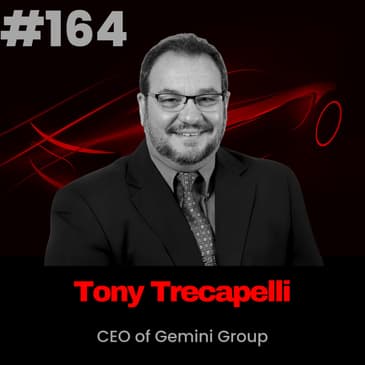
Featured guest: Tony Trecapelli
What he does: Anthony A. Trecapelli is the CEO of Gemini Group, where he leads operations across 18 locations and more than 1,400 employees. He joined the company in 2013, bringing with him over three decades of experience in the automotive industry.
His involvement in the field extends beyond Gemini. Anthony serves on the Ferris State Manufacturing Engineering Advisory Board and the GLBMA Board at Saginaw Valley State University. He is also a member of the Original Equipment Suppliers Association, contributing to broader conversations shaping the industry.
Anthony’s academic background includes a bachelor’s degree in Business Management from the University of Phoenix, a master’s in Manufacturing Operations from Kettering University, and a certificate in Lean Flexible Manufacturing Systems.
Outside of his professional roles, he has dedicated time to volunteer work with groups such as SAE Wheels in Motion, Rochester Community Schools, and Oakland Township Fire & Rescue, reflecting his commitment to community and industry.
On Leadership: “Who am I as a leader? No matter how hard I try to be something else at times, I'm a coach and I'm a servant. I love coaching. I love to help people become something they never thought they could be. I love to serve. I love to serve others. I love to serve my family. I love to serve the community—and I have. That's what turns my wheels. If I didn't have people to serve, I would not be the person who's sitting here in front of you today. That's for sure.”
Mentioned in this episode:
- Leading Through Change: The Culture Shift Automotive Leaders Need to Compete Today with Terry Woychowski
- Automotive Suppliers and the Revenue Acquisition Process – Then and Now: 2025 Update
Episode Highlights:
[03:34] Built on Saturn’s Culture: Tony reflects on how his time at Saturn shaped his identity as a leader and why he now sees himself first as a coach and a servant.
[05:20] Leading Without Losing Yourself: Despite years in traditional top-down environments, Tony explains how he stayed true to his servant-leader mindset and why it now thrives at Gemini.
[07:29] Courage in Authenticity: Tony shares how staying true to himself, even when misunderstood, built trust and proved that forgiveness and patience can be powerful tools in leadership.
[09:27] Culture in the Small Things: Tony explains how even the smallest gestures and habits from leaders set the tone for company culture.
[13:08] Business Is Personal: From early mentors to timeless reminders, Tony recalls the leadership wisdom that still guides him today.
[16:16] Choosing Gravitas First: Tony reveals why Gravitas stood out from the 21 traits, calling it the one quality that leaders can’t fake and the one that inspires people to give their all.
[19:46] A Better Way: Tony recalls how witnessing a supplier’s family-like culture taught him that even in a ruthless industry, companies can choose to operate differently.
[21:31] Teams Win Always: For Tony, real progress in automotive comes when companies value collective success over personal advancement, warning that without it, competition will win.
[23:58] More Upside Here: For Gemini, tariffs brought some costs but ultimately delivered more business back home than they took away.
[26:24] Reluctant Pessimist: Though naturally optimistic, Tony admits the chaos around EV programs and volatile production volumes leaves him pessimistic about the near future.
[30:56] Biggest Challenge Yet: Asked about leadership struggles, Tony doesn’t point to a single crisis—he says building a team is the hardest and most important work of all.
[32:01] Decisions That Haunt: Tony reflects on the hidden side of leadership, where every choice carries a personal cost because of how it impacts people’s lives.
[34:33] Why Not Us: Faced with impossible demands, Tony Trecapelli explains why his go-to mantra is simple: someone will win the business, so why not his team?
[41:38] Risk and Reward: Tony explains why the next decade requires a mindset shift—employees must get comfortable taking risks if they want lasting results.
[47:16] Best Move Made: Tony explains why leaving GM for Gemini was the best decision of his career, giving him the environment he had been missing.
[50:20] Leading by Living: Tony Trecapelli says the only way to sustain a coaching culture is to model it himself—living the behavior he expects from others.
Top Quotes:
[23:14] Tony: “Don't be afraid to be a team. You're competing against some people who are, by their very national culture, a team. And you're competing against those people, and we don't stand a chance if we don't get this.”
[35:39] Tony: “You have to constantly be improving yourself because you have to internalize the fact that your competition must also be, so if you're not, you're falling behind. You have to challenge yourself to be able to accomplish things you've never accomplished before, and you have to convince yourself that you're going to win. You're gonna find a way to win this because if you don't, someone else will win.”
[39:13] Tony: “You might get more action out of a meeting, 'cause it's got an agenda and so on and so forth. But I get more value out of a discussion because you don't know where it's going to go. And people tend to open up a little bit. You get to know each other a little better. There's no telling what you're going to work out. You might start whiteboarding something. You might start out talking about fishing and end up talking about some complex strategy around the company or our business. And you just don't know. If you don't have the discussion, I know what will happen: a whole lot of nothing.”
[41:56] Tony: “We need to be more comfortable taking risks, and we need to make a habit of winning. Losing is a habit, so is winning. We can't be afraid to make mistakes. We can't avoid risk.”
[Transcript]
[00:00:00] Jan Griffiths: Welcome to the Automotive Leaders Podcast, where we help you prepare for the future by sharing stories, insights, and skills from leading voices in the automotive world with a mission to transform this industry together. I'm your host, Jan Griffiths. That passionate, rebellious farmer's daughter from Wales with over 35 years of experience in our beloved auto industry and a commitment to empowering fellow leaders to be their best authentic selves.
[00:00:41] Stay true to yourself, be you and lead with gravitas, the hallmark of authentic leadership. Let's dive in.
[00:00:57] This episode is brought to you by Lockton. Rising benefit costs aren't inevitable for you or your employees when you break through the status quo. Independence matters, it means Lockton can bring you creative, tailored solutions that truly serve your business and your people. At Lockton, clients, associates, and communities come first, not margins and not mediocrity. Meet the moment with Lockton.
[00:01:26] So often, in our beloved automotive industry, we focus on the OEMs and the tier ones, and we don't give enough attention to the tier twos. And I can say that from experience. As you well know, I am a recovering leader of supply chain in a tier one supplier. And I know what it's like for those tier one supply chain guys to take all of those requirements for the OEMs and have to sort through them and filter all of that out to the tier two supplier.
[00:01:58] So it is time today for us to give the tier two some love. So, what better than a supplier that plays in both the tier one and the tier two space? And I am here today at the Gemini Group getting ready to interview their CEO, Tony Trecapelli. Tony, welcome to the show.
[00:02:19] Tony Trecapelli: Thanks, Jan. I'm glad to be here. Thanks for the opportunity.
[00:02:22] Jan Griffiths: It is great to have you. Now, I mentioned in the intro about the OEMs and the tier ones, but you yourself worked for an OEM early on in your career, didn't you? Tell us about that.
[00:02:33] Tony Trecapelli: I did. I worked at Saturn Corporation for nine years. And then, for the next 21 years at GM Tech Center in Warren, Michigan. Yeah.
[00:02:44] Jan Griffiths: And how long have you been here at Gemini?
[00:02:46] Tony Trecapelli: About 12 years. Coming up on 13.
[00:02:48] Jan Griffiths: Yeah. And what does Gemini do? What products do you produce?
[00:02:51] Tony Trecapelli: We are largely an automotive supplier—maybe 85% automotive. We also produce products for consumer product industry, very light aircraft, a little bit of lawn and garden.
[00:03:05] Brady: Yeah.
[00:03:06] Tony Trecapelli: And then, from a tooling perspective—part of our business is tooling—we provide for just about every industry.
[00:03:13] Jan Griffiths: Yeah, I can't wait to get into that discussion when we talk about tariffs. But first of all, Tony, let's talk about you as a leader. Who are you as a leader? You've got this background with Saturn, which is what a great background to have with General Motors. You've been here at Gemini for some time. Who are you as a leader, Tony?
[00:03:34] Tony Trecapelli: Just to give General Motors some feedback on the Saturn experience I probably would've done that job for free. It was absolutely a priceless experience to be involved in a greenfield, ground up, brand new automotive company, brand new people systems, as we called it. A brand new UAW agreement, a brand new plant with brand new processes.
[00:03:59] We sent 99 people around the world to try to find the best of the best, and then attempted to implement all that. It was absolutely priceless, so it was a big part of who I became. Without that experience, I would've been something less, most likely.
[00:04:15] Who I am as a leader? No matter how hard I try to be something else at times, I'm a coach and I'm a servant. I love coaching. I love to help people become something they never thought they could be. I love to serve. I love to serve others. I love to serve my family. I love to serve the community—and I have. That's what turns my wheels. If I didn't have people to serve, I would not be the person that's sitting here in front of you today. That's for sure.
[00:04:48] Jan Griffiths: If you had to pick one word to describe who you are as a leader, what would that be? One word: coach. But Tony, you and I both know, that in this industry, we operated with very much of a command and control culture for many years, and it's only recently that the idea of servant leadership and being a coach and supporting your team and not just yelling at people about making the numbers and moving on. That has changed. How have you seen that change and how have you evolved with that?
[00:05:20] Tony Trecapelli: As I pointed out, I had that Saturn experience, so that was a contrast to that—to the traditional. The self-directed work teams, the consensus decision making, the mission and vision, which was at the forefront, no offices, right? Very approachable leadership, so very team-based. Anyone could pull the end on cord for any reason and stop the line, so on and so forth. So that gave me a good backdrop.
[00:05:47] Of course, who I am is a big part of it. If I think about being the kind of person I am, the coach, the servant operating for 25 years in the command and control environment, I tend to look back on that as, of course, a learning experience, but a survival. I survived it.
[00:06:09] Jan Griffiths: Yes.
[00:06:11] Tony Trecapelli: Yeah. I was able to understand it and find ways to be effective, but not lose who I am and what I feel is important. So, it was a little easier to do at Saturn because they were after those kinds of things. Strategically, a little harder to do at other points in my career. It's like falling off a log, behaving that way at Gemini Group.
[00:06:38] Jan Griffiths: That's great to hear. And I feel much the same way, I survived command and control, too. I was taught in my early years in purchasing supply chain to beat the supplier over the head with a baseball bat, basically.
[00:06:50] Tony Trecapelli: And it's hard because you're given feedback on a regular basis that you're not being enough that way.
[00:06:56] Jan Griffiths: Yes.
[00:06:57] Tony Trecapelli: And that's the right way to be and you should be more that way and so on and so forth. And I listened, I adapted, did what I had to do, but I never bought in. I never bought in. Sorry, all my former leaders at GM, I love y'all, but I never bought in.
[00:07:14] Jan Griffiths: I know exactly what you're talking about, I felt so much the same way. My gut was telling me that this can't be the way to lead. This can't be the way to treat suppliers. It doesn't seem to be getting me anywhere, and it doesn't feel right.
[00:07:29] And I think, as a leader, once you embrace who you are as a human, as a person, and you are truly authentic and comfortable in your own skin. Once you do that, then the whole world changes and you actually bring people in closer to you, they trust you more, and you are able to really get that team around you that will go through walls for you. But it's a process, isn't it?
[00:07:54] Tony Trecapelli: It is a process. I couldn't agree more with your comments there. So as I was getting feedback or questions perhaps like, why aren't you angry? Why are you letting him or her say that or do that? Or why aren't you fighting back? I am not a flight person. I'm absolutely a fight person for what I believe in, but I just knew that there had to be a better way, and understanding and forgiveness was the best policy and allowing people to go full circle, and they always did.
[00:08:25] So it took a lot of time. As you say, it's a process. People watched it, were confused by it. But my side, if you will, never stopped being concerned. And if they were concerned, then they must have been somewhat intrigued by the fact that it can work if you have the courage to do it. So I live that. I absolutely live that.
[00:08:55] I don't have to do that anymore, Gemini group's not that way. It's like a family, so it's very natural, it's very easy, but was not. And I worked at some of the largest corporate America in its finest form. I worked for Siemens, I've worked for IBM, I've worked for General Motors, so I learned a lot and I learned how to translate it.
[00:09:16] Jan Griffiths: Yes.
[00:09:17] Tony Trecapelli: So, I try to help everyone better understand the translation.
[00:09:23] Jan Griffiths: And as CEO, you set the tone.
[00:09:26] Tony Trecapelli: Yes.
[00:09:27] Jan Griffiths: For the culture in this company. And all eyes are on you, I don't have to tell you that people are watching you every minute of the day,
[00:09:35] Tony Trecapelli: It can be lonely.
[00:09:36] Jan Griffiths: Yes, it can be lonely, but your actions, your behaviors, how you respond on email, how you respond to situations, how you respond to people. People are watching that, and they will emulate the behavior of the leader and the leadership team. I find that often leaders don't understand the impact that they have on people, the lives of people and culture.
[00:10:01] Tony Trecapelli: Couldn't agree more, Jan. I'm one of those people that I look like I'm not paying attention because my mind is typically going a hundred miles an hour, but I am. I'm deeply paying attention, so I notice what people say, how they say it. Not to be overly critical, just because I'm an auditory learner, so I learn through conversation.
[00:10:23] Typically, I'm not a big reader. And then, you also learn by listening. I'm a big listener. I'm very much into listening, even when it looks like I'm not. But you see how people's behavior changes based on your behavior. And I try my best to never forget the tiniest gestures, facial expression, words, writings from me are noticed.
[00:10:53] Jan Griffiths: Yes.
[00:10:54] Tony Trecapelli: And they alter others' behaviors, not only toward me, but toward each other. When you're talking, when you're engaging with people, when you're doing your job, when you're answering emails, whatever it is you're doing, you are shaping the culture of the company based on your behavior.
[00:11:09] I don't want this to sound the wrong way, but people tend to emulate the leader.
[00:11:14] Jan Griffiths: They do. They do.
[00:11:16] Tony Trecapelli: I don't know that I'm somebody worth emulating, but it's a natural behavior for people. And I'm leading a company that was born in a small town within a small town culture. And I know you've said in the past, you're from a small town, from a farm.
[00:11:35] Jan Griffiths: I am.
[00:11:36] Tony Trecapelli: You fit right in, in Bad Axe, Michigan. That's what's there, that they're a large agriculture community. They're also the county seat, so there is a lot of sophisticated businesses around there as well. But that culture of who you are is of utmost importance in a small town.
[00:11:52] Jan Griffiths: Yeah.
[00:11:53] Tony Trecapelli: 'Cause it tends to define you and it tends to define you for a long period of time. So the initial opinion that people form of you is lasting and you tend to find your place in the community. Whereas maybe in a larger town or city, your place is one of many, many, many individuals so it's not as magnified.
[00:12:18] But in a small town, it's magnified every move, the car you drive, where you go, who you associate with, all that has a lot of meaning. And I like that. It means a lot to me. I love that environment. I take to it very naturally because I'm a people person. I make friends with everybody I work with. I often get criticized by about that too. Like, why do you make friends with everybody? You have to — yes, you have to have tough conversations with those same individuals, but I think it helps if you know them well enough to be able to do that and come out the other side in the same place.
[00:12:56] And you've probably noticed that already this morning as my team here was trying to help me prepare. They weren't shy.
[00:13:04] Jan Griffiths: No, they're not shy.
[00:13:05] Tony Trecapelli: And I don't want them to be.
[00:13:06] Jan Griffiths: Yeah. Tony, what's the best piece of leadership advice that you ever got from somebody? Who influenced you in your career? And tell me about that.
[00:13:17] Tony Trecapelli: Because I'm a people person and I treasure conversation and dialogue. There's so many. There's so many and I wouldn't wanna forget about anybody, but there's certain quips that I guess stick in my head after all these years, one of which was from a woman by the name of Beth, and she said, "There's discussions and there's meetings, they're both necessary and they're different." That stuck with me and I practiced that. Another one I heard very early on in my career is, "Business is people." People do business with people they like.
[00:14:00] Jan Griffiths: Isn't that true?
[00:14:02] Tony Trecapelli: It's very true.
[00:14:03] Jan Griffiths: You know what bothers me, and you hear this a lot, people say, "It's not personal, it's business." Oh, business is personal.
[00:14:13] Tony Trecapelli: It's personal.
[00:14:13] Jan Griffiths: Whenever you have people involved.
[00:14:15] Tony Trecapelli: It's you and I.
[00:14:15] Jan Griffiths: It's personal. So when people say that to me, that drives me up the wall because that tells me that they have no clue really how business is done. Because business is all about relationships. It is all about getting people to understand your position. To get people on your side, not in a manipulative way, but to bring them in to your needs. And it's about people. And those relationships are critical, and you can cherish and nurture those relationships or you can trash them and you can trash 'em with one phone call, one word, and just with one incident, can't you?
[00:14:52] Tony Trecapelli: You sure can. Yeah. Sometimes, you don't even realize it's happening, but when it does happen, you have to correct it. Again, I couldn't agree with you more. That's why I'm here, 'cause I love your material.
[00:15:04] Jan Griffiths: Thank you.
[00:15:05] Tony Trecapelli: And I think you've found a very unique way to express all of the things that are near and dear to me in terms of how I go about my life and my job.
[00:15:14] Jan Griffiths: Thank you. You know, I have to share with you one piece of advice that somebody gave me a long time ago, and his name was Paul Tuszynski. He was a manufacturing guy. He'd been around forever in the break business. And he was teaching me how to be a program manager.
[00:15:27] I was a program manager on the shop floor for a manufacturing cell. And I was young, feisty, didn't know anything about anything really. And he said to me, "When people say to you they're gonna try to do something," he said, "You need to tell them," and I did this for a while — I don't do it anymore, but I did this for a while. "You can't ship effort." Oh, ouch. Because when people say to you, "I'm gonna try to do something." What does that mean? It means, it's not gonna happen. That's what it means. It means it's probably not gonna happen.
[00:16:01] Tony Trecapelli: Great intentions.
[00:16:02] Jan Griffiths: Yeah. But I don't really know how to tell you that it's not gonna happen, so I'm just gonna tell you that I'm gonna try, but it's not gonna happen. And then, when he told me that you can't ship effort, I thought, oh wow, ouch.
[00:16:12] Tony Trecapelli: It's a good one.
[00:16:13] Jan Griffiths: Ouch. That was a good one. That was a good one. Now, you've read the 21 Traits of Authentic Leadership. There's a lot in there because that's a culmination of my experience, plus guests I've interviewed to come up with the 21 and people often go, "Oh, 21, really?" Yeah, it's 21. What resonated with you the most, Tony?
[00:16:35] Tony Trecapelli: Number one.
[00:16:36] Jan Griffiths: Really?
[00:16:37] Tony Trecapelli: Yeah. And I thought long and hard about that. Number one embodies the other. And I liked them all so much. I just couldn't pick one in fear of discounting the others.
[00:16:49] Jan Griffiths: Yeah.
[00:16:49] Tony Trecapelli: So I just — it's a great set.
[00:16:52] Jan Griffiths: So you picked Gravitas?
[00:16:54] Tony Trecapelli: Yes.
[00:16:55] Jan Griffiths: Because it is — I've taken liberty with the definition of the word. Gravitas, to me, is the hallmark of authentic leadership. It's the umbrella that covers all of it, because it's much more than a word. It's a feeling. It's that feeling that you get.
[00:17:10] Tony Trecapelli: It's why I picked it.
[00:17:11] Jan Griffiths: Thank you.
[00:17:11] Tony Trecapelli: You can't fake it.
[00:17:13] Jan Griffiths: You can't.
[00:17:13] Tony Trecapelli: You can't.
[00:17:13] Jan Griffiths: You can't.
[00:17:15] Tony Trecapelli: You absolutely cannot.
[00:17:15] Jan Griffiths: You can't.
[00:17:16] Tony Trecapelli: You will not get away with it.
[00:17:17] Jan Griffiths: When that leader that you work for has your back, when they trust you, you know that you feel empowered. You wanna do absolutely everything in your power to make that leader successful. And that, to me, is Gravitas.
[00:17:32] Tony Trecapelli: Yeah. Couldn't agree more.
[00:17:34] Jan Griffiths: Yeah.
[00:17:36] Tony Trecapelli: I worked for a guy for a while at Saturn. He was a manufacturing engineering director, and I noticed this in my personal life and in my work life. He was one of those people — and I'm a young engineer. I'm late twenties, early thirties, and I'm trying to be a change agent. I would approach him on a very frequent basis — and as I said, at Saturn, there weren't any enclosed offices, so he sat out in a cubicle with everybody else — and I would go to him quite frequently and he would never turn me away. Never.
[00:18:11] Now that was not the norm at the time. It was talk to my admin, get some time on my calendar, make an appointment. Not him. He would greet you like he's never met you before, each and every time. Like that conversation was just yet another conversation that he couldn't wait to have and looked forward to. And I had a friend's father that was always that, that was also that way.
[00:18:38] So when we were teenagers, instead of going out and getting in trouble, we were there because he welcomed us.
[00:18:44] Jan Griffiths: You always know that leader, when you see,
[00:18:46] Tony Trecapelli: you do.
[00:18:46] Jan Griffiths: And you feel that.
[00:18:47] Tony Trecapelli: You feel it.
[00:18:48] Jan Griffiths: Often leaders say, "Oh, I put people first," and then like, yeah, no, you don't. No, you don't. You might say that, but you actually don't. Because when you put people first, that's how you behave.
[00:18:58] Tony Trecapelli: My biggest fear coming into this today.
[00:19:00] Jan Griffiths: What?
[00:19:02] Tony Trecapelli: That I was gonna talk about myself, I'm not comfortable doing that. But I'm dying to talk about my team.
[00:19:09] Jan Griffiths: Yeah, we're gonna get to that. We are gonna get to that. Thinking about the OEMs and the tier ones, Tony, they display a certain set of characteristics and behaviors in this industry. And I always felt, when I was in the tier one space, that you had to take on whatever the OEMs did — their kinds of behavior. So, if they were ruthless with the suppliers, you would be ruthless with the suppliers. You have to take on that set of behaviors. How do you handle that pressure? Because you've got it coming from multiple different customers.
[00:19:45] Tony Trecapelli: Yeah, you do. A couple of experiences that shaped how I do that. So, number one, I was there for 24, 25 years, so I understand it and I understand the difference and I'm pretty good at translating it.
[00:19:59] But I remember when I was there walking into a die shop that I had building some die cast eyes for me, and I remember their environment, and I noticed it — I couldn't help but notice it — they were proud, they were one team. They were like a family.
[00:20:19] They all wore, this company was Delaware Machinery, I don't think they're called that anymore. They all had company logoed jackets and shirts and so on and so forth. They had various articles of clothing and jewelry that represented service awards and things like that. You just felt like you know.
[00:20:42] And the owner was this bigger than life guy that was really at the helm of that culture, and it's a culture that his father had built that he continued. And it was just a really special environment, and I would contrast that, right? To the environment that I was in, myself.
[00:21:02] And I always cherished that, and would tell myself, regardless of the critics, that it could be that way. It could be that way anywhere. And if I ever had the opportunity, I'd make it that way.
[00:21:18] Jan Griffiths: Yeah.
[00:21:19] Tony Trecapelli: And at Gemini Group, I haven't had to make it that way, 'cause it already was. But I'm certainly preserving it.
[00:21:26] Jan Griffiths: Yeah. Yeah. It's not, it's not easy. If you had a message, if you could send a message to the OEMs in 10 seconds, one short thing, what would you say to them? Or what would you ask them to do?
[00:21:43] Tony Trecapelli: Without offending any of my customers?
[00:21:44] Jan Griffiths: Yeah, just one thing.
[00:21:46] Tony Trecapelli: Nothing negative. I mean, I was there. I get it. You can't be afraid to be a team. When you walk in the door in the morning, yet the person next to you has to be more important than you are. It just has to be that way.
[00:21:59] And if you're on a sports team and you do well, you'll realize that because it's only the teams that do well that do realize that. If it's going to be about you, your career, your advancement, looking smarter, better, more capable than the next person, the culture we're describing is not gonna take place.
[00:22:20] If you're okay with putting others first, taking pride in others advancing and others doing well, whether they're part of your responsibility or whether they're a peer or a leader. It's an uncomfortable place. When Saturn was very much that way, and when we hired people, it was a very extensive interview process where we would do role plays for that reason, because that environment is not for everybody.
[00:22:54] In recognizing that, we knew we were, I just wanna be told what to do, just tell me what you want me to do and forget all this, kumbaya, teamwork stuff. Just tell me what you want me to do. I get it. A lot of people are that way and they're just as valuable as everybody else, and you have to recognize that.
[00:23:13] But don't be afraid to be a team. You're competing against some people that are by their very national culture, a team. And you're competing against those people and we don't stand a chance, if we don't get this.
[00:23:27] Jan Griffiths: Yeah. And you're referring to the Chinese OEMs, and you're absolutely right. I know you've listened to my interview with Terry Woychowski, and the big threat to this industry is the Chinese OEMs.
[00:23:39] We talk all day long right now about tariffs because it's right there in front of our face and we're dealing with it. But the bigger issue is the Chinese OEMs. Now that I've mentioned the nasty T word that we're all talking about. Let's talk a little bit about tariffs. From your perspective, what have tariffs done to you in your business? What challenges have they presented to you?
[00:24:06] This episode is sponsored by UHY. UHY, and the Center for Automotive Research are digging into how suppliers quote and win with OEMs. The results drop at CAR MBS, September the 15th through the 17th at Michigan Central. Stay tuned.
[00:24:30] Tony Trecapelli: A mixed bag. Obviously we've had some — we have very little — but we have some purchased components that we buy from countries that were being heavily tariffed, so we had to deal with that. We got through it okay.
[00:24:44] Other situations where we're buying, for instance, foreign steel. I don't necessarily want to buy foreign steel, but I have to because I can't find anybody stateside that'll step up to that particular recipe. We're able to pass that along so we're all paying for it, I guess you could say.
[00:25:06] And then, lastly, the work that's being moved from places outside the US back to the US. We've taken advantage of that and we've taken on a number of projects in the last six to eight months of takeover work, if you will, of work that's being moved for reasons of tariffs.
[00:25:25] So, I think it can be a good thing over time. My fear is that it's so politically driven that it won't sustain itself through political administration changes.
[00:25:41] Jan Griffiths: So you've seen a definite upside of tariff with business coming into you.
[00:25:46] Tony Trecapelli: I'd say more upside than downside.
[00:25:48] Jan Griffiths: That's great. That's great to hear. Now, automotive news conducted a survey recently. They asked a number of OEMs and suppliers, and they asked this question. This is regarding the health of the overall auto industry for the next six months, and what they found was 62% of tier one and tier two suppliers feel pessimistic about the next six months, 24% are neutral and only 14% are optimistic. In one word, Tony, where do you stand? Optimistic, pessimistic, or neutral?
[00:26:28] Tony Trecapelli: Pessimistic.
[00:26:29] Jan Griffiths: Really?
[00:26:30] Tony Trecapelli: And you have no idea how hard that is for me because I'm an optimist.
[00:26:33] Jan Griffiths: Well, I can imagine. Yes.
[00:26:34] Tony Trecapelli: I'm an optimist. I get criticized for it. I can't help, but that's who I am. But because there's so many product programs that you used to be able to set your watch by, and they're all up in the air, everything was getting converted over to electrical.
[00:26:50] And now, again, a lot of political overreach in that space that's caused that to happen. And then, back again now to hybrid. So, a lot of these product programs are just topsy-turvy all over the place. Restarting, rescripting, redefining. Volumes look like an EKG. They're either super high or super low. Your business cases all go out the window because the volumes aren't where they were initially quoted or calculated. So, it's been very difficult and until that settles out, I can only be pessimistic until things stabilize.
[00:27:31] Jan Griffiths: So it's the uncertainty.
[00:27:32] Tony Trecapelli: Yeah.
[00:27:33] Jan Griffiths: And the volatility that we're seeing that is driving that.
[00:27:37] Tony Trecapelli: Same with tariffs.
[00:27:37] Jan Griffiths: That sentiment in you. Yeah.
[00:27:40] Tony Trecapelli: Very unpredictable at this point.
[00:27:41] Jan Griffiths: Yeah. Yeah, I agree. 'Cause if we knew what the tariffs were, we would all adjust. And we would all adjust our programs, plans, our volumes, our timing, our investment around it, and we'd move on. Because, let's face it, we're a tough industry. We've been through a lot and we'll get through this, but that's a very interesting response.
[00:27:59] Now, tell me about your tool and die business. I would have to believe, 'cause your tool and die business is here in the us correct?
[00:28:04] Tony Trecapelli: Yeah, it's in Bad Axe, Alabama, and Youngstown, Ohio.
[00:28:08] Jan Griffiths: So I gotta believe that you have to receive a tremendous amount of interest.
[00:28:12] Tony Trecapelli: We do. We build aluminum extrusion dyes for the aluminum extrusion industry, which was typically very low automotive content, and it's growing like gangbusters. The advent of EV created very unique and different body structure designs that use a lot higher percentage of extruded aluminum body structure and chassis. And it's carrying over into ICE and into hybrid. That industry was largely consumer products, transportation, so on and so forth. Window and door. Extruded aluminum products of various profile.
[00:28:56] What's unique about that business is it's highly engineered content, but it's not what I would say as highly engineered as it is when it's used as a part or a system or an assembly in a vehicle.
[00:29:13] Jan Griffiths: Okay.
[00:29:15] Tony Trecapelli: So, we are the subject matter experts. So we design. We're given a profile from a customer. It could be anything. It could be a piece of square tubing. It could be a highly complex extruded shape.
[00:29:28] We are the ones that figure out if that can be extruded. And then we build the die, we work with our customer. There's no prototypes, so we have to get it right the first time. And we work with our customers to successfully extrude that profile at some rate.
[00:29:45] With automotive, they're experimenting with what can be extruded, and there's a lot higher specification around how that profile performs, 'cause it could be a crash in safety. And we've embarked on that and we've had quite a bit of success there.
[00:30:01] When I worked at General Motors, I can't remember a single engineer that had the domain expertise on extruded product because it was running boards and luggage racks. That's about all we extruded.
[00:30:14] Jan Griffiths: Yeah.
[00:30:15] Tony Trecapelli: And now, it's the core crash and safety related body structure and chassis components. So, it's a very exciting space from that standpoint, and we feel good about it because we have so much domain expertise.
[00:30:27] Jan Griffiths: That's been good for you then?
[00:30:28] Tony Trecapelli: It's been great for us. Yeah, it's been great for us.
[00:30:30] Jan Griffiths: Both with the transition to EV and with tier ones and OEMs looking to near source and bring more business.
[00:30:40] Tony Trecapelli: Because in either case, they're lightweighting, right? It's either miles per gallon or miles per charge, so...
[00:30:45] Jan Griffiths: That's interesting.
[00:30:45] Tony Trecapelli: Yeah.
[00:30:46] Jan Griffiths: So, the tariffs, obviously, are a leadership challenge. Chip shortages, leadership challenge. We have, there's so many in the auto industry that we've been through. But in your time in the industry, Tony, what is the biggest leadership challenge you faced?
[00:31:02] Tony Trecapelli: Building a team.
[00:31:04] Jan Griffiths: Oh, do tell why?
[00:31:07] Tony Trecapelli: Because if you do that, the rest, it doesn't much matter. You can conquer anything. It's all tough. It's all valid. I could talk about all of it at nauseam, but at the end of the day, you have to overcome it. So you have to have the right environment to be able to overcome it, and you have to have the right mindset in your organization to be able to overcome it. And if you get there. You will.
[00:31:34] Jan Griffiths: I love that answer because I think so many people would've thought about a particular instance or event or something. And you are absolutely right, if you've got the right team of people around you, then it doesn't matter what comes at you, you'll find a way through it together.
[00:31:51] Tony Trecapelli: You will.
[00:31:52] Jan Griffiths: Yeah.
[00:31:53] Tony Trecapelli: You will.
[00:31:53] Jan Griffiths: That question actually came from our LinkedIn audience. And we have another one along those same lines, and this is from Daren Thornley, and he says, "What's the hardest leadership decision you've ever had to make?"
[00:32:11] Tony Trecapelli: Letting people go.
[00:32:12] Jan Griffiths: Yeah, it's always the toughest one, isn't it?
[00:32:15] Tony Trecapelli: It's tough for two reasons. So, I try to communicate to my team that you have to be sized for your actual demand, not your historical demand. Not your hopeful demand, not your forecasted demand, your actual demand. And if you do that on a regular basis and you measure it and you run your business that way, you may be in a position where you have to adjust your staff very minimally, but you'll never be in a position where you have to go execute a very bad thing and let a bunch of people go.
[00:32:52] Jan Griffiths: Yeah.
[00:32:53] Tony Trecapelli: And it brings me to another memorable quip from Jay Wetzel, he was our product development chief at Saturn and had a number of other senior executive assignments at GM. I think he was the father of the GTO and things of that nature, but we were talking, I don't even remember what we were talking about at the time, but he said something, "People think that having this job is glorious. What they don't know is that you go home every night, thinking about nothing more than the way your decisions have affected so many lives on a daily basis. It's a tremendous responsibility."
[00:33:36] Jan Griffiths: Yeah.
[00:33:37] Tony Trecapelli: Easy to ignore, just do your job. It's like you say, it's business.
[00:33:42] Jan Griffiths: Yeah. It's not personal.
[00:33:43] Tony Trecapelli: It's not personal. It's business. You understand. I had to downsize at General Motors with people from other cultures and other countries that took that event very differently than an American would. It was horrific having to do that. So I try to avoid it, I try to run the business so that we never have to do that. It's unavoidable at times. If you have a recession or a COVID or whatever the case may be it, but when nothing's happening to you, shame on you if you have to do that.
[00:34:16] Jan Griffiths: Yeah. And it's you have to maintain profitability. It's a business.
[00:34:20] Tony Trecapelli: You do.
[00:34:21] Jan Griffiths: You have to do that. But the people lever has to be the last one.
[00:34:26] Tony Trecapelli: It gotta be the last one.
[00:34:27] Jan Griffiths: Or lever, I guess. My American. The people lever is the last one that you pull. And that's interesting because here's a question that came from the LinkedIn audience and there's quite a bit to this, but this question is from my good friend Phil Ideson, who also has a podcast called Art of Procurement, and Brian Pospy, and I kind of merge these two together.
[00:34:50] But this is the question: how do you balance the demands of your customer when you have very little leverage, tremendous focus on price, and yet you still have to be profitable? It's a lot of things to balance and manage.
[00:35:06] Tony Trecapelli: It's really tough. And you can talk yourself out of it. You can just say to yourself, "We can't do this. How does anybody expect us to make money at this?" But you know what? Someone will. Someone's gonna do it. They're not gonna source it to nobody. So somebody is gonna do it, and you can tell yourself, "Oh, they'll probably be outta business next week." No, they won't.
[00:35:32] Jan Griffiths: I've heard that so many times in conference rooms.
[00:35:35] Tony Trecapelli: So have I. So you have to step up to it. You have to constantly be improving yourself because you have to internalize the fact that your competition must also be, so if you're not, you're falling behind. You have to challenge yourself to be able to accomplish things you've never accomplished before, and you have to convince yourself that you're going to win. You're gonna find a way to win this because if you don't, someone else win. Will.
[00:36:01] I have a adage that I use called, Why Not Us? Why Not us? I know that Cincinnati Bengals used that a couple years ago. It's a common one. I certainly didn't make it up, but it's a good one. You gotta ask yourself that sometimes. Why not us? Somebody is going to do this project, so why can't that somebody be us?
[00:36:24] Jan Griffiths: I love that because it comes back to mindset in leadership and culture because when you set the tone, when that request comes in from the OEM and it's seemingly ridiculous, instead of looking at it and bitching about it and complaining about it, which maybe you are allowed to do for a second, but then you have to say, "Okay, let's lock in. What are we gonna do? How are we gonna make this happen?" That's a great answer. Thank you.
[00:36:53] Okay, let's see. Let's take a turn into the personal realm. Are you ready? And I'm gonna ask you a few personal questions and then we're gonna go to our live studio audience. What gets you fired up in the morning? See, people used to ask this question: what keeps you up at night? And that's so nineties. It's, oh, really? That's not the question.
[00:37:17] Tony Trecapelli: Eating too much before I go to bed is about the only thing that's kept me up at night.
[00:37:22] Jan Griffiths: It's what gets you up in the morning? What are you excited about when you come to work in the morning?
[00:37:27] Tony Trecapelli: Because I am a coach by nature, I like to bring out the best in people and I like to accomplish things that have never been accomplished before. Maybe not Novel things, but better performance than has ever been demonstrated before. Even if it's on the same thing. That's what drives me. My service to others, to the company I work for, drives me. First thing I do in the morning is pray.
[00:37:58] Jan Griffiths: That sets you up for the day.
[00:37:59] Tony Trecapelli: That sets me up for the day, gets me back to ground zero. Allows me to have the strength that I need to keep going. Gives me the right attitude to be able to hopefully inspire others.
[00:38:11] Jan Griffiths: That's a great answer. Now, what's the very first thing you do when you walk through the door at work, whether it's at a plant...
[00:38:16] Tony Trecapelli: I go talk to everybody.
[00:38:17] Jan Griffiths: I had a feeling...
[00:38:18] Tony Trecapelli: you knew that, didn't you?
[00:38:18] Jan Griffiths: You were gonna say that.
[00:38:20] Tony Trecapelli: I go check in with everybody. I make the rounds for whatever reason. How was your weekend? What are you up to? How you doing?
[00:38:29] Jan Griffiths: Not only is that critical to establish the relationship and show that yes, people are.
[00:38:35] Tony Trecapelli: I can't not do it. I can't.
[00:38:38] Jan Griffiths: What you're doing is you are also setting up their day for success.
[00:38:43] Tony Trecapelli: I hope so.
[00:38:43] Jan Griffiths: That little conversation, that little touch point in the morning, whether you say, "Hey, how was Johnny's football game last night?" Or whether you say, "Wow, great job on that GM quote." Whatever it is, it's that little thing that binds you to people. That's what leadership is.
[00:39:03] Tony Trecapelli: Discussion and meetings are two separate things, and they're both important, but they're different.
[00:39:07] Jan Griffiths: Yes..
[00:39:07] Tony Trecapelli: So, I get off very often. I'll get more value. You might get more action out of a meeting, 'cause it's got an agenda and so on and so forth. But I get more value out of a discussion because you don't know where it's gonna go. And people tend to open up a little bit. You get to know each other a little better. There's no telling what you're gonna work out. You might start whiteboarding something. You might start out talking about fishing and end up talking about some complex strategy around the company or our business. And you just don't know. If you don't have the discussion, I know what will happen, whole lot of nothing.
[00:39:47] Jan Griffiths: Yeah, so true. What's downtime look like for you? What do you do outside of work?
[00:39:53] Tony Trecapelli: You said it: outside. I like being outside. I never pictured myself working inside. I still don't. I just, I love being outside. I like physical labor. I'm an outdoors man. I love anything out there, so I try to spend as much time out there as I can.
[00:40:15] Jan Griffiths: Now, you already said you're more auditory, you're not a reader.
[00:40:20] Tony Trecapelli: No.
[00:40:21] Jan Griffiths: Are you a podcast listener?
[00:40:22] Tony Trecapelli: Yep.
[00:40:23] Jan Griffiths: What's one podcast that you think that leaders should listen to in the auto industry apart from mine?
[00:40:29] Tony Trecapelli: Yours is a good one. There's a lot of 'em I listen to that are very industry specific to this, that, or the other thing.
[00:40:36] Jan Griffiths: What do you like? Which one do you like?
[00:40:36] Tony Trecapelli: There's one called Making Chips that I like a lot. It gets to our metals and machining business.
[00:40:41] Jan Griffiths: Oh, I don't know that one.
[00:40:42] Tony Trecapelli: Yeah, it's pretty good. It gets down and dirty. It's pretty technical.
[00:40:47] Jan Griffiths: Yeah, but that's good to know.
[00:40:48] Tony Trecapelli: Prior to this job, I was the Vice President of Metals, so I was pretty focused on that. But nowadays, I like yours a lot, I like Rogan, I guess a lot of people do these days. But I like the Rogan format, so I typically search his to see who he is talking to. Because they typically get down to something that feels to me a little more genuine.
[00:41:09] Jan Griffiths: Yes.
[00:41:11] Tony Trecapelli: He gets people to be genuine and talk about some things that maybe they otherwise wouldn't.
[00:41:16] Jan Griffiths: He gets them to do all kinds of stuff. If you remember what he got Elon Musk to do. That was interesting. But we won't be doing that today. You'll be pleased to know.
[00:41:22] Tony Trecapelli: And there's a whole litany of pastors that I listen to.
[00:41:25] Jan Griffiths: Yeah, yeah. No, that's good to know. That's good to know. Are we ready to open this up to our live audience?
[00:41:31] Tony Trecapelli: I'm ready if you are.
[00:41:32] Jan Griffiths: Are we ready? Okay. So live studio audience, what questions do you have for Tony?
[00:41:38] Stephanie: I'm Stephanie Speck. My question for you, Tony, is what is one mindset or behavior that you think our company needs to continue to be successful in the next five to 10 years?
[00:41:51] Jan Griffiths: Ooh, that's a good one. One mindset and behavior.
[00:41:56] Tony Trecapelli: We need to be more comfortable taking risks and we need to make a habit of winning. Losing is a habit, so is winning. We can't be afraid to make mistakes. We can't avoid risk. You understand our culture as well as I do, and it's a lot of very well-intentioned people, many of which who have worked for us for a very long time, maybe many of which, who are second and third generation employees, and they care a lot. And because they care a lot, they think that the ultimate demonstration of caring is to never make a mistake. I would never wanna put the company in a bad place, right? To make us have to fix something. And I would say to everybody, don't be afraid of that.
[00:42:44] Jan Griffiths: That's a good one. Yeah, that's a good one.
[00:42:46] Tony Trecapelli: Engineering is about solving problems. Manufacturing is about solving problems. That's all it is. So you have to embrace those problems.
[00:42:54] Jan Griffiths: Because I see that a lot in the auto industry where people, it's all about being safe. It's all about, "I'll just stay in my lane, stay in my little box, and I won't make it any ripples and I'm good." But if we don't challenge each other and we don't step out and take risks, we are not gonna get the innovation that we need to compete with the Chinese OEMs.
[00:43:16] Tony Trecapelli: And the results aren't always immediately present. So, is it comfortable? Explaining to the board that we didn't realize the financial benefit yet. But trust me, there's a lot of good things going on. That's not easy to do up until the day that we realize it. And then it's a great lesson learned.
[00:43:35] But I'm willing to do that every day, twice on Sunday. It's making money as a result. It's a result of doing a whole bunch of things, right? You can't just wake up in the morning and click your heels together and say you wanna make money and just go to work and it's gonna happen.
[00:43:51] It's a whole bunch of things you did right. So if you don't focus on those whole bunch of things, you're probably not gonna make money.
[00:43:58] Jan Griffiths: It's good. Good answer. Next question.
[00:44:01] Brady: Brady Schlesener. Tony, you've spent a bunch of your career in the auto space and previously in IT. When you think about leaders who have made a big impact on you, and you've seen them make the right moves in their career and with their teams and their companies, is there one in particular in manufacturing, in automotive that stands out to you?
[00:44:22] Tony Trecapelli: There are many, if I had to pick one without forgetting about anybody else, I'd say Beth, whom I worked with at Saturn. As I said before, we were doing a lot of things that hopefully made us reinvent the culture at GM. And everyone took part and everyone did their part, and we all supported what it is we were trying to accomplish there.
[00:44:48] But you could tell when you talked to Beth, it was just who she was. And she did not continue on with a long, illustrious career at GM. She followed her dreams many times over. She did very different things after leaving GM, but she would always take the time to dissect the discussion with her, and you always felt better when you walked away. She helped me a lot.
[00:45:13] Eric: Erik Rood. So, looking over your career progression, can you identify one event or book or something that would've changed the way that you lead.
[00:45:27] Tony Trecapelli: Again, there's so much stuff. I'm not a big reader, but I have read some things. We used to have some mandatory reading at GM, so Who Moved My Cheese and things like that.
[00:45:36] Jan Griffiths: Oh yeah.
[00:45:37] Tony Trecapelli: Oh, good stuff. Glad I read it. But I read a book that was given to me by a team member. It was called, Who You Are When No One's Looking by Reverend James — correct me if I'm wrong — Hybels. Great book, very well written, helped you commit to being the best version of yourself all the time. And it's probably most important when no one's looking. It's easy when someone's looking.
[00:46:03] Jan Griffiths: That reminds me of a quote, somebody told me this once, and they said, 'cause if you ask anybody, are you authentic? Are you who you say you are, everybody's...
[00:46:11] Tony Trecapelli: That's what it's all about.
[00:46:12] Jan Griffiths: Everybody's gonna say yes, but they said, if you're really authentic, you can measure it by the amount of daylight between your personal self and your professional self. And I thought, wow, that's powerful.
[00:46:25] Tony Trecapelli: That is very powerful. And I get criticized for that on a regular basis.
[00:46:29] Jan Griffiths: I have, over my career, I've got criticized countless times.
[00:46:33] Tony Trecapelli: Do you do that when you go to work? Do you say that when you go to work? Yep.
[00:46:39] Jan Griffiths: But it's who you are.
[00:46:40] Tony Trecapelli: It's who you are.
[00:46:41] Jan Griffiths: It's who you are.
[00:46:41] Tony Trecapelli: You can't fake it.
[00:46:42] Jan Griffiths: And people respond to that level of authenticity.
[00:46:46] Tony Trecapelli: They do.
[00:46:46] Jan Griffiths: You try to be a different person at work than you really are at home. And I'm not suggesting that you tell everybody in the office every sorted personal detail of your life. That's not what it's about. But it is about being human and not being afraid to show your humanity. So, I love that recommendation. That was a great question, 'cause now I'm gonna get that book. I've seen it, but I'm definitely gonna buy it, 'cause I think it's all about being authentic. Next question.
[00:47:16] Dave Fital: Why did you accept this position and what is your five year goal?
[00:47:21] Tony Trecapelli: Why did I accept this position? Boy, it couldn't have been a bigger departure than what I was doing. I'm not sure I know why. I knew I wanted to get back to a better environment that I was used to from Saturn.
[00:47:38] At the time, GM wasn't a whole lot of fun. We had just gone through bankruptcy and all that comes with it. So I wasn't having a thrilling time there at the time, had no reason to leave, but I got a phone call from a work associate and a friend that made the move from GM to Gemini Group, and he asked me if I wanted to join him. And I enjoyed working with him when we worked together at GM, so I was willing to do that again, and I did. That's probably the best decision I ever made.
[00:48:12] So, I was ready for a change. I was certainly ready for a change, and I was this person at GM that I was a change agent. So, it's not like I tried to do this, but I ended up in this pigeonhole stereotype whatever reputation of being this guy that could make large scale change happen for whatever reason.
[00:48:39] I always got these big projects, where I had to go and you know, I would ask myself a lot, you know, why do you do it? Why do you do this? Why don't you be like everybody else and just do your job and go home? Why do you gotta go around and make everybody change what they're doing and make 'em uncomfortable and seemingly criticize what they're doing today and try to convince them that there's a better way and all that. And you're always this person that everybody's probably cringing when you walk in their direction, right? Oh geez. What's he doing?
[00:49:08] But I felt a responsibility from senior management to keep being that person, so I did. And we worked on a lot of big, high level — a very big change that changed how we do cars and trucks and the whole vehicle development process and all that. And it's a big team of people that do that, I was working with a big team. But being one of those people, so I was a little tired of that, to be honest with you. I got a little burnout. I got a little tired of that, 'cause that's hard to do at a big enterprise like a GM, you're going after some big sacred cows. So, I got a little tired of that.
[00:49:45] In fact, there was a time that I made my boss promise that if I got this big project done, that she would let me go back to the Milford Proving Grounds and just work on the product again and just drive cars around and make 'em better and feel it in the seed of your pants.
[00:50:01] And I never got to that, but I left before that happened. But, yeah, so I guess it was a few things aligning, but the best decision I ever made, I can tell you that. Not because I was asked to be the CEO, I loved it there from day one.
[00:50:16] Jan Griffiths: That's a great answer. All right, last question.
[00:50:20] Bob: Yeah. Bob Kokenos. So, you talk about culture and family and coaching. How do you keep that coaching advice and bring that new culture that we have? And you coach that on to newcomers and other companies taking on culture and keeping that as a family.
[00:50:37] Tony Trecapelli: First of all, I gotta live it. I gotta demonstrate it. I can't be any less than what I'm asking someone else to do. And then, it might sound weird, but you gotta let people vent. You gotta let people yell at you. You gotta let 'em get through it, get past it, make the switch, get it all out. And I do. Another criticism. Why'd you let that person do that? That's not very smart. They just grouse at you for 45 minutes. You're the CEO. It doesn't bother me at all. Everybody's human, they gotta get it off their chest. If you really want somebody to buy in, it's a significant emotional event. It is. Unless they're already kinda living where you are. It's an easy one, but not everybody's there. So it's a significant emotional event for people. And you see this play out sometimes in movies, right? If you've watched like The Miracle and all that with what that coach did with those guys and he changed the whole style of hockey over to the Russian style and that was a big thing. Or if you've watched this Ted Lasso miniseries, which I absolutely love. You watched how he worked on everybody.
[00:51:51] Jan Griffiths: We believe.
[00:51:51] Tony Trecapelli: Knowing nothing about soccer. Believe.
[00:51:53] Jan Griffiths: We believe.
[00:51:54] Tony Trecapelli: I was given a presentation one time at GM and one of the senior executives looked at me and he says, and you know, I was always presenting all this technical stuff, right? 'Cause I was trying to do the virtual engineering, right? Replace all the prototypes with analytical testing and whatnot, and he said, "I have no idea what you just said, but I'd vote for you."
[00:52:16] Jan Griffiths: That's gravitas in action.
[00:52:17] Tony Trecapelli: And I remembered that one.
[00:52:18] Jan Griffiths: That's right there. I think often people think that come into leadership early on in their careers, they think that you just tell people what to do and they just do it right. Think about how you deal with your kids, how's that work? You tell your kids to do something, right? Do they do what you want 'em to do? Every single time, no.
[00:52:42] You cannot control another human being. Just telling people, this is the culture, or telling people, this is how we do things. It's not that easy. They've got to go through the emotional journey. They gotta get there themselves, and you have to give them the space to do it. You have to make them feel safe. And clearly that is an environment that you have here at the Gemini Group. And Tony, it has been an absolute pleasure having you on the mic today. Thank you.
[00:53:10] Tony Trecapelli: Thank you, Jan. Privilege to be here.
[00:53:12] Jan Griffiths: Thank you.
[00:53:13] Thank you for listening to the Automotive Leaders Podcast. Click the listen link in the show notes to subscribe for free on your platform of choice, and don't forget to download the 21 Traits of Authentic Leadership PDF by clicking on the link below and remember. Stay true to yourself, be you, and lead with gravitas, the hallmark of authentic leadership.