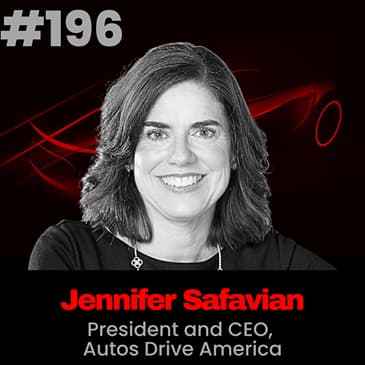
Put Toyota, Honda, Hyundai, BMW, Volkswagen, and seven more automakers in one room. They fight each other over every sale, and somebody has to get them to agree on a single position and carry it into Washington. That somebody is Jennifer Safavian.
Jennifer is the first President and CEO of Autos Drive America, the trade association that 12 international automakers created to speak for their U.S. operations. She got the job offer about a week before COVID shut the country down. She built the organization from the ground up, and then the auto tariffs landed. Her members build almost half the vehicles made in this country, and this year they’ve passed 50% of U.S. production. If you supply any of them, what they agree on matters to your business.
We talk a lot on this show about collaboration, and lately, the conversation keeps coming back to OEMs working together. Jennifer does this for a living. She explains how a room of rivals with Japanese, Korean, and German roots finds common ground, and why a trade association whose members can’t agree loses its voice in DC. She also shares how she brought automakers, suppliers, and dealers together into a coalition for the USMCA renewal. She’s direct about why Chinese OEMs aren’t on U.S. roads right now and what’s keeping them out.
Her leadership approach would make plenty of legacy automotive executives uncomfortable. She doesn’t claim to have the answers. She listens, she leans on the experts on her team, and she makes the call once every voice has been heard. That’s a different way to lead in an industry trained to play win or lose.
Her message to Washington is one every automotive leader will recognize. You can’t build a plant or change a model overnight. This industry runs on years of planning, and right now, companies are holding back investment until they can see what the rules will look like next year.
Themes Discussed in this Episode
- Getting 12 competitors to speak with one voice
- Building an organization in the middle of a pandemic
- How auto tariffs hit the entire industry
- One industry voice on the USMCA renewal
- Chinese OEMs and the level playing field
- Listening as a leadership skill
- Leading across Japanese, Korean, and German cultures
- Why the industry needs policy certainty
This episode is sponsored by Lockton, click here to learn more
🎥 Watch the full episode on YouTube:
https://www.youtube.com/@jangriffithsautomotiveleaders
Featured Guest: Jennifer Safavian, President and CEO at Autos Drive America
Jennifer is the President and CEO of Autos Drive America, the Washington, DC trade association representing the U.S. operations of the world’s international automakers. She’s spent two decades in policy, most of it on Capitol Hill, where she served as Staff Director and General Counsel on the House Ways and Means Committee and held senior roles on the Energy and Commerce and Oversight and Government Reform committees. Before Autos Drive America, she led government affairs as Executive Vice President at the Retail Industry Leaders Association. The Hill has named her one of the “Top Trade Association Lobbyists” seven times since 2017, and she’s been recognized by the National Law Journal and Roll Call as one of the most influential people on the Hill. She started her career practicing law in Detroit, and she brings a rare mix of trade, tax, and supply chain experience to the table where the industry’s biggest competitors meet.
About Your Host – Jan Griffiths
Jan Griffiths is the champion for culture change and the host of the Automotive Leaders Podcast. A former automotive executive with a rebellious spirit, Jan is known for challenging outdated norms and inspiring leaders to ditch command and control. She brings honesty, energy, and courage to every conversation, proving that authentic, human-centered leadership is the future of the automotive industry.
Mentioned in this Episode:
Episode Highlights
[01:08] Twelve rivals at one table: Jan sets up the challenge of getting Toyota, Honda, Hyundai, BMW, Volkswagen, and more to land on one position, and why every supplier should care what they agree on.
[02:32] Why international automakers wanted their own voice: Jennifer explains how 12 OEMs created Autos Drive America in early 2020 because they knew there’d be times they wouldn’t agree with the Detroit automakers.
[03:50] Starting up as the world shut down: Her offer came about a week before COVID closed everything, and her members were shutting down plants while she built an association from scratch.
[06:23] Tariffs hit autos first: Autos and auto parts were tariffed before Liberation Day, and Jennifer explains why the impact landed on the whole industry, Detroit automakers and suppliers included.
[07:58] What holds competitors together: Stronger U.S. manufacturing, a level playing field, workforce, and community are the shared priorities that keep 12 rivals pulling in the same direction.
[10:58] One voice on USMCA: International automakers, Detroit automakers, suppliers, and dealers formed an ad hoc coalition to push for USMCA renewal, a rare moment of total industry alignment.
[13:14] Why Chinese OEMs aren’t here yet: Jennifer lays out the case on state subsidies, the missing supplier base, and national security concerns tied to vehicle software and hardware.
[15:31] Only a matter of time: Jan raises President Trump’s comments about welcoming Chinese plants in the U.S., and Jennifer explains what stands in the way today.
[16:58] Almost half of U.S. production: International automakers build 49% of the vehicles produced in the U.S. and passed 50% this year, a number that still surprises policymakers and Jan.
[18:56] Listening is the leadership skill: Jennifer shares why she’s never claimed to have all the answers and how relying on her team helps her find common ground.
[23:00] Data that changes the conversation: The annual economic impact report gives members of Congress state-by-state numbers on what international automakers mean to their districts.
[24:40] Resilient, but planning in the dark: Jennifer explains why policy whiplash is causing automakers and suppliers to hold back on investment, and why the industry needs certainty.
Top Quotes
[08:13] Jennifer Safavian: “They are all competitors, but at the end of the day, they really do have kind of a core set of beliefs, or common priorities.”
[19:29] Jennifer Safavian: “So that’s the only way you’re gonna be able to really bring them together and find that collaboration, that commonality among everybody, is if you can listen to everybody.”
[20:20] Jennifer Safavian: “Ultimately, yes, I’m gonna have to make a decision about the path that we take. But I do so, with certainly the input from all of my members and my team as well.”
If this episode resonated, share it with a fellow automotive leader and subscribe to The Automotive Leaders Podcast, where we’re shaping the future of authentic leadership in the automotive industry.
This podcast episode is also available on YouTube. Check out our YouTube channel at Jangriffithsautomotiveleaders
Send us your feedback or questions — email Jan at Jan@Gravitasdetroit.com.
[Transcript]
[00:00:00] Jan Griffiths: This is the Automotive Leaders Podcast. Straight talk from the CEOs and innovators who cut through the noise, create clarity, and drive transformation across this industry. The old command and control playbook is dead. Culture is the operating system. Authentic leadership is the edge. We're rewiring it, starting now. I'm your host, Jan Griffiths, that passionate, rebellious farmer's daughter from Wales and the champion for culture change. Let's dive in.
[00:00:39] This episode is brought to you by Lockton. Rising benefit costs aren't inevitable for you or your employees when you break through the status quo. Independence matters, it means Lockton can bring you creative, tailored solutions that truly serve your business and your people. At Lockton, clients, associates, and communities come first, not margins and not mediocrity. Meet the moment with Lockton.
[00:01:08] My guest today runs a room full of direct OEM competitors. Imagine that.
[00:01:14] Yeah, it's true. Imagine Toyota, Honda, Hyundai, BMW, Volkswagen, and more all at one table. Her job is to get them to one position. What?!
[00:01:30] Jennifer Safavian is the first president and CEO of Autos Drive America. She built it from the ground up, and her members build, wait for it, almost half the vehicles made in this country. And if you supply any of them, and I'm sure you do, what they agree on matters to you.
[00:01:54] We talk a lot about collaboration on this show, and lately that subject's been coming up time and time again, particularly about OEMs collaborating together. Jennifer does this for a living. This is what she does. And 12 automakers, imagine that, they fight for every sale, but getting them to speak with one voice. Let's find out who she is and how she does it.
[00:02:21] Jennifer, welcome to the show.
[00:02:23] Jennifer Safavian: Thank you so much, Jan, and pleasure to be with you.
[00:02:25] Jan Griffiths: It's great to have you. So tell us a little bit about this organization. What do you do?
[00:02:31] Jennifer Safavian: Sure.
[00:02:31] So, Autos Drive America, we are a trade association in Washington, DC, and like you said, represent international automakers. So that is who our membership is. We have a couple of associate members who are suppliers, but really we were created by 12 OEMs, the international automakers. And so you mentioned some of them, right?
[00:02:49] So, of course we've got BMW, we've got Honda, we've got Hyundai, Kia. We've got Mitsubishi, Mazda, Mercedes, Nissan, Toyota, Subaru, Volkswagen and Volvo. I think I named all 12. So that's who my core OEM members are, and they're the ones who actually created us as a trade, as a standalone trade association.
[00:03:10] And they did so really at the beginning of 2020, there was an opportunity where there were already existing two other associations that represented the industry, the OEMs, that they decided to merge and become one organization. At that time, my members, the international automakers, felt like that was, that was a terrific move, but there would probably be times where maybe they don't always agree with perhaps the domestic automakers, the Detroit automakers.
[00:03:33] And so they really felt like they needed their own kind of voice, and that's when they created Autos Drive America. So really, we were formed in the very beginning of 2020. I was hired shortly thereafter to kind of come in and create this organization. And I will tell you, it was... Think back to 2020, right?
[00:03:49] Beginning of 2020, COVID. We had the pandemic that we were all dealing with. In fact, I think my offer was made to me, maybe a week before literally everything was shutting down here in the US. And for my members, like they did, they had to shut down their manufacturing facilities for a couple weeks, right?
[00:04:05] As everybody was trying to get their arms around what this pandemic meant and how they could keep their workers safe and, and, and how they could bring things back up online. And so that's when I started. And I often joke with people, I don't recommend starting a new trade association in the middle of a pandemic.
[00:04:22] It's not ideal. But we got through it, and got to the other end. So really, we were created really with the focus on really educating policymakers about international automakers, their footprint, their investment here in the United States, and making sure really that there's a level playing field for all automakers here in the US, making sure that the entire US auto industry is able to thrive.
[00:04:44] Jan Griffiths: Wow, that's a pretty big mandate. Now, what makes you qualified to do this job? I'm curious.
[00:04:50] Jennifer Safavian: Well, I did spend a good number of years up on Capitol Hill. So, prior to that I actually practiced law in Detroit. And when I moved to DC, I often joke about how I got kinda bit by the political bug, as one often does here in DC, and I ended up going to Capitol Hill. And I spent about 16, 17 years up on the House side of Capitol Hill and worked on various different committees.
[00:05:11] And I will say I ended my career on the House Committee on Ways and Means, which has jurisdiction over trade and tax and kind of all those big, meaty issues. And when I left the Hill, I went to my first trade association. We were dealing with retail issues, and from there, I was asked to come over and lead this association.
[00:05:28] So I'd already kinda had a lot. Some policy background, already was familiar with trade association work, and I did have a background in supply chain because of the retail industry. And so I think that helped me certainly understand this industry a little bit more.
[00:05:40] Jan Griffiths: Yeah, what a great background. Tremendous background to have for this type of position in this organization. So I have to imagine you start the organization during COVID, like you said, and everything is, you know, you're building it and everything's fine, and then all of a sudden Liberation Day hits. I got to imagine your world turned inside out and upside down.
[00:06:02] Tell us about that.
[00:06:03] This episode is powered by Seraph. When manufacturing leaders need to launch scale, relocate production, or navigate supply chain disruption, they call Seraph. Hands-on operators. Measurable results. Learn more @seraph.com.
[00:06:23] Jennifer Safavian: Yeah. Well, even prior to Liberation Day, because President Trump started with putting tariffs on autos and auto parts. Even before his tariffs on all the other countries. And so, that was hugely impactful for the auto industry, continues to be impactful to the auto industry.
[00:06:39] There are reports out there that the industry has paid over thirty-five billion last year in tariffs alone. I mean, that's a significant amount of money being paid in tariffs. And so, the theory was that autos and auto parts were a national security threat.
[00:06:53] And that's why the president, put these tariffs on, on that. And, he was trying to obviously increase manufacturing here in the U.S. Well, my members have been doing that for well over, four decades, over, right? They've been producing here in the U.S. That is what their goal is to manufacture and produce more here in the U.S.
[00:07:11] and to export American-made vehicles to other countries. And so it really was impactful overall for the entire industry. So not just the international automakers, but the Detroit automakers as well. And the, electric ma-manufacturers, right, suppliers, really everybody, it impacted the entire industry.
[00:07:27] Jan Griffiths: Yeah. So the pressure on you to keep everybody informed had to be tremendous. Tell me about how does that communication process work? And, we said in the opening, your job is to keep this group together, but yet they're competitors. So tell us a little bit about the challenges around doing that, 'cause I can't imagine getting a group of competitors together in legacy automotive and trying to work on a common agenda.
[00:07:55] Tell us about some of the challenges around that.
[00:07:58] Jennifer Safavian: Sure. Well, listen, let me start by saying, first of all, my members are fantastic. They are the ones who decided we need an organization like Autos Drive America to represent us, right, and to speak our behalf with one voice. So they were the ones behind creating this organization.
[00:08:12] So they have been, from the get-go, fully supportive of our efforts, and that's important, right? You need that kind of member support in order for a trade association to be successful. And you're right, they are all competitors, but at the end of the day, they really do have kind of a core set of beliefs, or common priorities, I guess, is maybe a better way of putting it.
[00:08:31] And those really focus around strengthening US manufacturing, right, and making sure that there is a level playing field, like I said earlier for the entire US auto industry. So regardless of what kind of OEM you are or supplier, that it's a level playing field for everybody. So really strengthening, manufacturing in the US.
[00:08:48] Economic growth for the industry as well. Not only here in the US, but again, as I mentioned previously being able to export these American-made vehicles to a lot of different countries, which only creates jobs here in the US, more production here in the US. A career stability.
[00:09:03] They're really focused, my members are really focused on that, that workforce, and that pipeline of workforce, workers, the talent that they need in order to produce here in the US. So they have a heavy focus on that. And then I would say their commitment to their communities. There's no question about it.
[00:09:20] When they started building here in the US, many, many years ago, I mean, they went to communities that maybe other manufacturing had left, and so it was like kind of a devastated community. They came in and rebuilt a lot of these communities, and they're now thriving, because of my members' manufacturing footprint.
[00:09:36] Jan Griffiths: That's fascinating. Now, some of the Japanese OEMs, specifically Toyota and Nissan, have spoken publicly in the last several months about the need for more collaboration at the OEM level. What do you think is driving this, and will they be successful? Will we as an industry be successful in driving more collaboration?
[00:09:58] Jennifer Safavian: I think it is important that there is the collaboration. Like I said, I am thankful that even within my organization, while my members may have different priorities, certainly, you know, they have different goals and different priorities, overall, their common core belief and priority is that there's success, right?
[00:10:15] That the US auto industry is successful. And so I think that is what drives a lot of it. So even if we're talking about an issue, a policy issue that may not be of the utmost, importance to one of my other members, or even they may have a different opinion about it, if the majority of my members are kind of on one side of it, we're able to still work on that issue, which is really important because you hear all the time in DC trade associations where their members, they can't reach agreement.
[00:10:39] There's no collaboration, or coordination. And what that means is that trade association is really ineffective. They're unable to speak on behalf of their members and have a voice in the, in the policy discussions here in DC. And so you want to avoid that if you can. So I will say my members have been very good about making sure that everybody, all the membership is successful.
[00:10:57] And I'll give you another example since you talked about kind of the difficulties and the need for this collaboration. Something that you might find very interesting is that when it comes to the renewal of USMCA, which right now is, is being renegotiated, among the US, Mexico, and Canada, you might be surprised to learn that we have been able to bring together the entire industry and have one voice on the need to renew USMCA.
[00:11:22] So that means my members, the international automakers, the Detroit automakers, the suppliers, the dealers, right? We have been able to pull everybody together, kind of under one umbrella, this ad hoc kind of coalition, and we have been speaking with one voice on the need to renew it, and kind of working together on that.
[00:11:40] Which again, you might find kind of unusual, and it might be a little bit, but we do feel like we have a stronger voice when we can speak with as one.
[00:11:47] Jan Griffiths: Brought to you by UHY.
[00:11:50] Everyone wants AI in quoting. UHY's benchmark study says fix governance and data first, then scale AI.
[00:12:01] Check out the white paper. The link is in the show notes.
[00:12:05] Tariffs, disruption, uncertainty. Your supply chain has answers. Tradeverifyd helps you ask why and what to do about it. Visit Tradeverifyd, that's verifyd with a yd.com
[00:12:22] well, maybe that's a start, Jennifer. Maybe that's a start. I mean, we hear all the time about the Chinese OEMs collaborating together, working together, and particularly when it comes to components that are underneath the hood, components that are not something that, the consumer touches, sees, feels, and they work together to collaborate together.
[00:12:46] It's a whole different subject and idea of collaboration, but we hear a lot about that. And question to you is this: Your is very clear that you represent international automakers. A Chinese OEM is an international automaker. What are your thoughts about the Chinese OEMs coming into the US?
[00:13:13] Jennifer Safavian: Well, so first of all, let me be clear. I represent the US interests of my members. So yes, they are international, but I focus on their US operations. So you're right. We do not have a Chinese OEM, operating in the country right now. We don't have Chinese electric vehicles or vehicles being allowed in the country right now because of tariffs and other requirements that are gonna make it more difficult for that to happen.
[00:13:35] And that's a good thing. And the reason for that is actually multifold, I would say. And you've seen this in Europe, for instance. We've seen it kind of play out in what's happening in Europe. The OEMs have been bringing in a lot of different vehicles, right?
[00:13:48] And it's overwhelming, their kind of domestic auto market. And that is because it's not a level playing field. It really isn't. The Chinese OEMs are heavily state-subsidized by their government. You can't compete with somebody like that because of course, that's not how we do things in this country or other countries for that matter.
[00:14:05] And so they're able to subsidize and bring in vehicles at a price way below market value that, that, you know, other competitors just can't compete with. So it's just not a level playing field to start with. It's unlikely to expect that they would come into the country, and bring a supplier base with them, like my members did.
[00:14:23] When they came into this country, they brought their suppliers with them. They built out a supplier base. And of course, they hired American workers and trained American workers, right? That is, that is part of their dedication to the US. And I don't know that we can firmly believe that the Chinese OEMs would do something similar like that.
[00:14:39] And then of course, there's national security concerns that you hear a lot about when it comes to Chinese vehicles, the Chinese OEM and what they would do, what they would bring into the US. And that's why there's all these limitations on these vehicles, currently because of the software and the hardware concerns, national security concerns.
[00:14:57] And unless they're gonna make a lot of significant changes that's not gonna allow them to be able to be brought into the country.
[00:15:02] Jan Griffiths: There's a few quotes out there President Trump has said on a number of occasions, and I'll go back to September 11th. He actually said that he'd be okay with China coming in and opening a plant to build cars here. He said Japan does it, but they hire our people. And there's a lot of commentary amongst the automotive analysts that the Chinese are coming. It's just a matter of time.
[00:15:26] Do you think that's the case?
[00:15:28] Jennifer Safavian: So there is a lot of talk about that, and there's a lot of people who believe that you cannot keep them out, forever. I don't know. I can't predict the future. I wish I could. But I'm not able to. I know that as we see things today, right? There are definitely not only the tariffs, but like I said, there's the, the connected vehicles rule that is out there.
[00:15:46] There are a lot of things in place that make it, impossible for them to be able to come into the U.S. right now. And I think that that's really important, right? Because again, it's not a level playing field. The way they would come into the U.S. is not how my members came into the U.S many, many years ago and made a commitment to the U.S. and to their workers and to the, their communities. We're not seeing that in other countries where they're coming in. They are really trying to come in and to take over that market without putting the time and the resources and the dedication into it that, say "My members did when they came into the United States."
[00:16:19] So it's very, very different.
[00:16:21] Jan Griffiths: Jennifer, you've got these international OEMs. You're representing the US interests. And I got to imagine, I mean, you've got Japanese, Korean, German, very, very different cultures all sitting at the table. are some of the challenges trying to bring all that together?
[00:16:48] I mean, I've sat in meeting rooms before trying to bring different cultures together. It's not easy. Tell us, how do you do that?
[00:16:55] Jennifer Safavian: Well, you know, again, I think it really comes down to the fact that while they are certainly different, and like I said, they're competitors with each other, they ultimately are all trying to move forward in the same space. And they want to make sure that we, as an organization are able to speak on their behalf and, and highlight all their investments here in the US.
[00:17:13] As a whole, their workers, right? I mean, that is what's really, I think important and core to them, is that we get that education out there, right? Because I think, and I still find today, that there are a lot of policymakers and the public who maybe don't fully understand and recognize just how much, the international automakers, how big a piece of the US auto industry that they are today, right?
[00:17:34] So when you talk about the US auto industry, you can't talk about it without talking about the participation and the role that international automakers have had in its success. So like brand members, for instance, have invested $125 billion into the US operations, right?
[00:17:49] That is significant. They produce, like I think you said earlier, like 49% of all production in the US, right? So that's, you know, almost half. And I think this year.
[00:17:58] Jan Griffiths: That number shocked me. I didn't know that.
[00:17:59] Jennifer Safavian: Right? That's what I mean. People don't really realize that. And in fact, this year, they've actually produced over 50% of the production here in the US.
[00:18:07] So they are truly committed to the US, right? And to their communities and to producing here and making the US auto industry successful and competitive, right? We want to make sure that we are competitive, as a region against other regions. And so they are all aligned with that focus.
[00:18:24] So you're right. They will have different policy priorities. They are competitors at the end of the day. But ultimately, they do come together, and try to see what's best overall for the industry, right? And for them to be able to promote, I think, and educate policymakers on just again, who they are and how relevant they are to this discussion when we talk about the US auto industry.
[00:18:45] Jan Griffiths: Yeah. No, well said.
[00:18:47] What's the most important leadership trait, Jennifer, to drive a collaborative agenda the way that you do?
[00:18:53] Jennifer Safavian: So, you know, I think it really, it comes down to bringing people together. So you've got different voices, people have different priorities, and I think it is really important that you're able to bring people together, and that requires really listening, hearing everybody out, right?
[00:19:07] Listening to everyone's opinion, their perspective on things, right? And trying to fully understand, right? Listen, I don't have the answers. I don't have all the answers. I never claim to have all the answers. So I think it's really important to fully understand kind of what everybody can bring to the table and, and, and better understand where they're coming from, right?
[00:19:26] So that's the only way you're gonna be able to really bring them together and find that collaboration, that commonality among everybody, is if you can listen to everybody. And I will tell you, I have a terrific team here who really truly are more of the experts and dive deep on the issues.
[00:19:41] And so they really can better understand kinda how something might impact one member over another member or ask the questions, so we can kinda find some commonality, among everybody. That is something that I think has been important for me in my career all along.
[00:19:55] I've never claimed to know everything. When I was staff director on Ways and Means, I did not know trade or tax policy in depth like my team did. I had people who worked for me who, who've been doing it for so many years. I mean, they really knew the intricacies of very technical, policy areas, and I relied heavily on them to explain it to me, sometimes more than once, what we were talking about.
[00:20:17] But that's really what you need to do. You just need to listen have an openness to listening to everybody. And that's how you can kinda create, I think, the collaboration that's needed. I mean, ultimately, yes, I'm gonna have to make a decision about the path that we take. But I do so, with certainly the input from all of my members and my team as well.
[00:20:34] Jan Griffiths: Yeah, I would agree with you. I think that to drive a collaborative agenda is all about listening, and as you said, it's driving for that common thread. It's finding that common thread and driving towards that. And that's very different to the way that we typically operate in the auto industry, which is very much it's win or lose.
[00:20:55] It's black or white. It's a different leadership skill set, and one which I'm sure tests you a lot with all those different cultures and all those different interests. But, then the other thing, too, is dealing with Washington. I don't think I ever looked at the White House website, ever, in my entire 30-something years in automotive until the last several years.
[00:21:20] And now we have to keep an eye out for executive orders and what's happening. I have the tab open all the time on my browser. I never would've had to do that before. So, not only do you have to drive this common agenda, but you also have to speak the language of Washington.
[00:21:37] You have to speak the language of automotive into Washington and the language of Washington back out into your members. And that's a whole skill set into itself, too.
[00:21:47] Jennifer Safavian: Yeah, there's no question. There certainly has been... There's always a lot going on in Washington, DC. There's never a dull moment. Whether it be executive orders, Congress, passing laws, right? Or regulatory, the admin, the different branches and agencies passing regulations that we need to comply with.
[00:22:04] There's always something, and there's always something that's happening that's impacting, certainly the industry as a whole, or my members individually. And so it really is on us as an association to try to help our members work through that. And so we, my team and I really do work on trying to understand what's happening, right?
[00:22:21] What the environment looks like, what this bill is trying to do and again, advocating on their behalf with policymakers, whether it's beneficial or harmful changes that need to be made. And then also providing the resource to our members about If something does pass or something happens, what does that mean for them, right?
[00:22:38] How do they comply with it? And there's been a lot of questions about that, right? With all these, these new changes and the tariffs and all that. And there's a lot of compliance and how do they comply with it? And so we do kind of all work together, honestly, to try to figure it all out, 'cause there's a lot happening, and there's a lot that's constantly changing.
[00:22:55] So it's an environment that is ever-moving, I would say, ever-evolving. The other thing we do is, here at my team, we do a data analysis. We try to kind of put forth analysis that not only helps our members, but policymakers, the public as well, on things that are helpful for them to understand the US auto industry, right?
[00:23:13] Or the international automakers in particular. I'll give you an example, something that we do, every year along with the international dealers. We put out an economic impact report every year, and we get that data from mostly from our members with some other studies that are done. And it's the only, thing out there that's got this resource, where it really fully shows the impact that international automakers have on the US.
[00:23:35] So the production, their investment, their workers, right? Exports, so it shows national numbers as well as state-by-state economic impact numbers. So when we're going into, a member of Congress, we can actually pull up and show them, "This is the international automakers and dealers. This is the impact that they're having on your state or your district. And this is why it really matters that you pay attention to the challenges or the opportunities that the industry is facing, because you want them to be successful."
[00:24:05] And so it really has been beneficial. And your listeners can find this information on our website at, autosdriveamerica.org.
[00:24:11] And they can play around with it. They can go different states, and they can learn a lot of stuff about it. But we do other data analysis as well. So we find that to be a good resource, not only for our members, but also for policymakers and the public.
[00:24:22] Jan Griffiths: Yeah, that's great. We'll put a link to your website in the show notes so listeners can access it. Now I'm gonna ask you to look into the future, Jennifer. Are you ready?
[00:24:29] Jennifer Safavian: Great.
[00:24:31] Jan Griffiths: Where do you see this auto industry 5 to 10 years from now?
[00:24:35] Jennifer Safavian: You know, I will say this, the auto industry is resilient, right? I mean, thank goodness, right? They deal with a lot of different issues, a lot of different things coming their way, but they remain resilient, right? So even with the changes that we've been faced with since last year, or even before that, right?
[00:24:53] Think about the under President Biden, there was a push towards electrification, right? And then, but there's been a pullback from that. And now, we're dealing with all these tariffs. So they are constantly, having to kind of, you know, be prepared, and to change, not only be based on what policymakers are doing, but also what consumers want, right?
[00:25:11] And so they have found a way to be resilient and to just get through it and to make it through. Now, there are challenges, and we try to help them with those challenges as best we can. But ultimately, I think the industry is gonna continue to weather all of these different changes.
[00:25:24] It would be wonderful, if there were less changes, 'cause I will say, they're businesses, right? They have to plan. And you know, as well as your listeners, that for the auto industry, they can't change things overnight. They can't suddenly build a new facility overnight. They can't change a direction they're going, a model, right?
[00:25:40] I mean, these take years. This is years of planning and development and costs that go into these, what they're producing. And so they can't change overnight. And so we really try to educate policymakers on, on how difficult it is for the industry to be able to weather these dramatic changes, right?
[00:25:57] When we have, like, one administration coming after another and change, policies so dramatically. It has an impact and it is currently having an impact on the industry. There are probably many of members of mine, as well as suppliers, right, who are holding back on investments that they might be able to make because they just want to get a better sense of what the policy environment is gonna look like a year from now or a couple years from now, to the best, to the best of their ability, right?
[00:26:23] Nobody can really predict the future. I wish I could, Jan. But nobody can. And so they have to somehow just kinda work through it to the best that they can. But we would love a little bit more certainty, and predictability.
[00:26:35] Jan Griffiths: Yes. But you're gonna continue to drive the US interests of your international members, and we're glad that you're there in the role that you're at.
[00:26:44] So thank you, Jennifer, and it's been great having you on the show today.
[00:26:48] Jennifer Safavian: Thank you so much, Jan. I really appreciate the opportunity.
[00:26:51] Jan Griffiths: Thank you for listening. You can watch the full conversation on our YouTube channel. Search for Jan Griffiths Automotive Leaders, and download the 21 Traits of Authentic Leadership. It's a free PDF and the link is in the show notes. And remember, stay true to yourself, be you, and lead with Gravitas, the hallmark of authentic leadership.