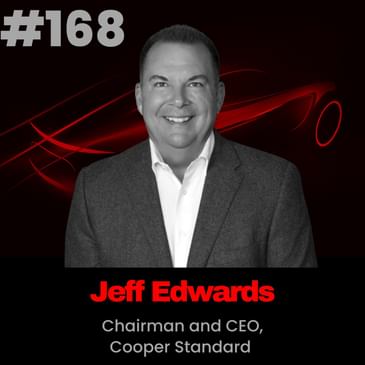
How does a 65-year-old automotive supplier reinvent itself for the future? That’s the question Jeff Edwards, Chairman and CEO of Cooper Standard, answers in this episode.
With 22,000 employees across 20 countries, Cooper Standard is navigating one of the fastest periods of change in its history; not by clinging to the past, but by transforming how it leads, operates, and builds culture.
Jeff explains that the company’s strength begins with its people. Of the ~22,000 employees, 18,000 work in plants every day. They are the heartbeat of the business, and their mindset defines how the company performs.
Culture once lived within HR, but today, that’s no longer the case. And at Cooper Standard, every leader owns it. The values and purpose that guide the business aren’t just words in a handbook; they shape decisions, behavior, and priorities across the organization.
Jeff reinforces them in quarterly meetings with employees worldwide, making sure new hires understand how the company operates and what it stands for.
Jeff explains how Cooper Standard continues to invest in better tools and infrastructure to support faster, more informed decisions — and sees AI as a future opportunity to help teams work smarter.
However, Jeff points out that no system works without the right mindset. Change only happens when people are willing to adopt new ways of working together.
Jeff also describes how Cooper Standard restructured its organization two years ago into three business units: Fluids, Sealing, and Industrial Specialty. Each has its own president who is responsible for performance. The new setup flattened decision-making and pushed authority closer to the work.
Instead of questioning the change, employees embraced it. They wanted to understand how it would improve them, not why it was happening. That response, Jeff says, is the product of a healthy culture built on trust and shared purpose.
The conversation closes where every great company story should — with its people. At Cooper Standard, leadership isn’t a title or a process; it’s the daily act of listening, learning, and helping others grow. Decisions are made through conversation, not command. Ideas come from every corner of the company, shaped by the experience of those who build, design, and lead on the floor each day.
That shared approach to leadership is what keeps Cooper Standard moving; steady, united, and ready for whatever the next chapter demands.
Watch the full video on YouTube - click here
This episode is sponsored by Lockton, click here to learn more
Themes discussed in this episode:
- The transformation of Cooper Standard from a legacy automotive supplier into a future-focused global manufacturer
- The link between company culture and faster decision-making in today’s competitive automotive industry
- How Cooper Standard is strengthening its digital infrastructure to improve decision-making speed
- The structural transformation that created three focused business units and improved Cooper Standard’s responsiveness to customers
- Why collaboration and teamwork between leaders and teams matter more than hierarchy in a modern organization
- The importance of maintaining zero-incident safety standards as a reflection of company culture and care for employees
- The connection between trust, open communication, and long-term success in a global automotive supply chain
Featured guest: Jeff Edwards
What he does: Jeff Edwards, Chairman and CEO of Cooper Standard, brings nearly four decades of experience in the automotive industry. Since joining the company as CEO and Board member in 2012, and later assuming the role of Chairman in 2013, he has focused on driving long-term value through culture, innovation, and results. Before Cooper Standard, he spent 28 years at Johnson Controls, where he rose through a series of leadership roles to become Corporate Vice President and Group Vice President and General Manager of the Automotive Experience Asia Group. He also serves on the Board of Directors of Standex International Corp., contributing to its Compensation and Nominating & Corporate Governance Committees.
On Leadership: “When you're responsible for as many folks as our plant managers are, you find that courage to act or courage to not act is the way you ultimately define success. So, it isn't always about the decision you made. You may decide to not do something and that might be the best one you've ever made. I think, to be willing to open up and think differently and listen for answers around the world, at least within the automotive industry, is important.”
Episode Highlights:
[02:23] Built by People, Not Walls: Culture isn’t defined by logos or buildings—it’s shaped every day by the 18,000 people on the plant floor who own problems, fix them, and keep getting better.
[03:39] From Command to Connection: Leadership at Cooper Standard starts on the shop floor, where accountability, collaboration, and shared purpose have replaced the old command-and-control mindset.
[05:36] Culture Isn’t an HR Project: Cooper Standard’s culture works because every leader and employee takes responsibility for it, keeping the company focused on people, performance, and progress.
[07:48] Culture Drives Speed: A strong culture keeps people aligned, decisions quick, and innovation moving as the industry shifts faster than ever.
[11:19] The Heart of Leadership: Great leadership, Jeff says, comes from resilience in tough times, empathy that sees through others’ eyes, and the integrity to do what’s right when it’s hardest.
[15:52] The Cooper Standard DNA: The people who thrive at Cooper Standard work hard, stay genuine, care about others, and never stop learning—because being a great teammate matters as much as being a great leader.
[17:26] Redefining the Structure: Cooper Standard rebuilt its organization around three business units, giving each leader full ownership and creating a flatter, faster model focused on performance and people.
[24:45] The Excitement of Change: Jeff sees the rise of hybrid and electric vehicles as a turning point for the industry, where the right culture and strong relationships will decide who wins.
[26:37] Partnership Through Innovation: By mastering the basics and focusing on innovation, Cooper Standard turns supplier relationships into true partnerships that drive smarter, more efficient solutions for the hybrid and electric future.
[32:52] The Power of Conversation: Jeff values learning through real conversations, asking questions, and listening to different perspectives to uncover better answers and stronger decisions.
Top Quotes:
[02:35] Jeff: “We've got 65 years and counting in the automotive industry, and you kinda have to earn your way every day. And you have to be very convinced that you love a fast-paced environment. You also have to be convinced that every day has gotta be better than what you just did and be okay with that. So, to me, it always starts with the folks that come to work for us in our plants. You mentioned we're in 20 countries, we have 22,000 employees, and about 18,000 of those show up in our factories every single day. And so, if you don't have something that kind of ties that all together, what do you have?”
[04:08] Jeff: “We really spend an awful lot of time talking about leadership. We talk about what's important and what isn't. We also talk about what's acceptable and what isn't from a leadership point of view. And I've found it's not only about educating those that are in leadership positions; if you educate everyone that comes to work, then they know what it looks like, but they know what it doesn't look like. And so, it holds us all accountable. And I think it's a lot better than one person shouting orders rooftop, especially when your rooftop has to span 20 countries and a lot more languages than just that.”
[11:59] Jeff: “I think that companies that can figure out how to stay focused, to do things the right way for the right reasons, and have a resolve to get it done are the ones that are gonna be successful. And those also usually are led by people in all leadership roles that are approachable, that have empathy, that have the ability to see things through the eyes of others.”
[15:59] Jeff: “You have to have the right work ethic. You have to be real. You have to care. You have to be a teammate, in addition to a leader. There isn't a leader in the company, me included, that doesn't have to be a good teammate, and so, you got to be both.”
[25:56] Jeff: “We talked about speed. We talked about accuracy. We talked about having people that really care and want to build relationships with their customers and the supply base. These are all things that are gonna be required to win, to be competitive, and to make sure the customer feels that you're worthy of the next purchase order. And I think they always prefer to give it to somebody they like versus somebody they don't like.”
[Transcript]
[00:00:00] Jan Griffiths: Welcome to the Automotive Leaders Podcast, where we help you prepare for the future by sharing stories, insights, and skills from leading voices in the automotive world with a mission to transform this industry together. I'm your host, Jan Griffiths. That passionate, rebellious farmer's daughter from Wales with over 35 years of experience in our beloved auto industry and a commitment to empowering fellow leaders to be their best authentic selves.
[00:00:41] Stay true to yourself, be you and lead with gravitas, the hallmark of authentic leadership. Let's dive in.
[00:00:57] This episode is brought to you by Lockton. Lockton redefines business insurance and people solutions with a personal touch. Their global team of 11, 000 is driven by independence, not quarters. To tailor success for your business, discover the Lockton difference, where your goals become their mission.
[00:01:21] Independence. It's not just how you think, but how you act.
[00:01:26] In an industry obsessed with the future, what does it take to transform a 65-year-old company? So many companies clinging to the past. They cling to their legacy systems, their old ways of doing things. But not here, not at Cooper Standard, no. This $2.7 billion company with 22,000 employees operating in 20 different countries is preparing itself for the future.
[00:01:58] Joining me at the mic today is the Chairman and CEO of Cooper Standard, Jeff Edwards, and we are gonna be diving into leadership and culture and looking at what makes not only the past but the future exciting.
[00:02:16] Jeff, welcome to the show.
[00:02:18] Jeff Edwards: Hey, thanks, Jan. I appreciate it. Look forward to the conversation.
[00:02:20] Jan Griffiths: It's great to have you here.
[00:02:22] Jeff Edwards: Thank you. Thank you.
[00:02:23] Jan Griffiths: Jeff, I know that culture is important to you, but why?
[00:02:29] Jeff Edwards: I think the company, at the end of the day, it's not the sign on the building, right? It's the people within it. And I think Cooper Standard, we've got 65 years and counting in the automotive industry, and you kinda have to earn your way every day. And you have to be very convinced that you love a fast-paced environment. You also have to be convinced that every day has gotta be better than what you just did and be okay with that. So, to me, always starts with the folks that come to work for us in our plants, You mentioned we're in 20 countries. We have 22,000 employees, about 18,000 of those show up in our factories every single day. And so, if you don't have something that kind of ties that all together, what do you have? And so, our customers have become very accustomed to how our people deliver, how they keep getting better. If they have a problem, they own it and fix it. That's how I would describe cultures in successful companies, right? You speak the truth, you say what you mean, you do what you say. And that's us.
[00:03:29] Jan Griffiths: Yeah, it's not rocket science is it? But yet it's very difficult really understanding culture and getting at the root of culture. Because, Jeff, you and I both know, in this industry, decades ago, we all ran with a strong command and control culture. The orders came from the top and they went down the ranks and down to the shop floor, and there really wasn't a lot of discussion or empowerment. And now, that's evolving. We're talking about more of an authentic leadership, servant leadership type of model. That transformation, how have you seen that transformation here at Cooper Standard?
[00:04:08] Jeff Edwards: We really spend an awful lot of time talking about leadership. We talk about what's important and what isn't. We also talk about what's acceptable and what isn't from a leadership point of view. And I've found it's not only about educating those that are in leadership positions, if you educate everyone that comes to work, then they know what it looks like, but they know what it doesn't look like. And so, it holds us all accountable. And I think it's a lot better than one person shouting orders rooftop, especially when your rooftop has to span 20 countries and a lot more languages just that. The culture is certainly, in my opinion, built from shop floor. And then understood in the boardroom and supported. And that's where it comes together, in my opinion, is on the shop floor, and talked a lot about what the shop floor is.
[00:04:57] So, for us, it's not a way to the parking lot, it's where our passion and our performance to support the customer is actually delivered by all fronts. Whether you're our supply base, whether you're employees in the factory, whether you're the engineers, whether you're the leadership team, whether you're the community we enjoy being part of — all show up there. And so how did you do? And do the customers enjoy that interaction and do they continue to vote with the purchase orders? Because, ultimately, they need to. And the culture within our factories really is a reflection of our entire company, and it should be. And if it isn't, then that's probably something that needs improved.
[00:05:35] Jan Griffiths: Yeah. years ago, I remember sitting in executive conference rooms when culture was just that thing that HR did. Remember those days, years ago, nobody really understood the significance of it, how it binds all of your people together. It's how you make decisions, it's how you operate, it's all of that. It's the glue that holds it all together. So, tell me a little bit about how that works at Cooper Standard, 'cause clearly it's not an HR thing.
[00:06:05] Jeff Edwards: No, it's not. And I think our global leadership team really owns the approach that we use to run the business. I think we're probably like most, right? We have a vision statement, we have a purpose, we have our values, but that isn't a paper that hangs on the wall. that's what's in the hearts and minds of our leadership team because they own it. It's in the hearts and minds of our employees because they understood it when they accepted at a job within our company, and every day, is something that we work on. we don't change it a lot. I will tell you over a 13 year period, I can speak to that, we've adjusted a couple things. We've tweaked some language, but overall it's still about delivering for the five stakeholders that we And when you think about our customers and you think about our shareholders, our employees, the communities that we live and work, and our supply bases. That's the five folks that, that if they're all receiving what they need, not everybody gets everything that they need, but if they're receiving what they need and they believe that every day is better than the previous one, then I think it's working.
[00:07:07] If it isn't, then you probably should figure out what you want to tweak and adjust make it better. But it really has to be in the hearts and minds of employees. That's the most important thing I could use to answer the question.
[00:07:16] Jan Griffiths: Yeah. I agree with you. And I think that culture is directly related to the speed that we so desperately crave in this industry. We're always talking about now speed. It's speed of product design, it's speed of producing the product, it's speed of making decisions. No longer can we stay in the dark ages with all the silo decision making type processes that take forever. You've got to embrace empowerment, and believe that culture is something that can either strangle that. If you've got a bad culture, you are not gonna have the speed that you so desperately want and need in this industry. But if you have a good culture, then that's gonna allow decisions and processes and information to flow much faster. Would you agree with that?
[00:08:02] Jeff Edwards: I think culture's a big part of it. I think speed, I think accuracy is important. But clearly, those definitions continue to evolve and change. And now, we're changing rapidly, because depending on which customer we're talking about and which powertrain we're talking about, and which market we're talking about, speed is defined much different today. timeline that we used to discuss were three or four or five years, right? You had to develop. Now we're talking about months that you have to develop product and get it into the market. And so, again, I would say the mindset of the organization has to be lined up there, right? This isn't something you can just ultimately say, we're going to go do this." It has to be part of your process. I would say this, our tools are also much better. If you think about the investments that we've made in our business, both on the engineering, the manufacturing, finance, program management, we've spent literally hundreds of millions of dollars within our infrastructure — IT infrastructure, financial infrastructure — to really provide our employees with what you just said: information that's available real time and much faster.
[00:09:13] What's really gonna be cool about that, and in my opinion, is as we go forward and AI becomes part of our daily work habit and becomes a tool that we use to make our company better, faster, more accurate. Now that we have the data and our employees are using that data in ways, we're no longer Excel spreadsheets and napkins, I think is also part of the cultural evolution and revolution now that's going to take place.
[00:09:39] So that requires people to really buy in to how they're gonna do things differently forward. if you don't have a culture and if folks aren't willing to do that, you can conquer any mountain, but when you turn around and nobody's there with you, it makes for a pretty long day.
[00:09:54] So I think culture can be part of virtually everything that you do, especially this continuous improvement, lightning speed changes. The evolution that's occurring in the industry I know everybody says the next 10 years are going to be more changed than we've experienced in the past hundred. agree with that. I would say maybe it's the next five years,
[00:10:14] Five, I was gonna say. I think it's the next five.
[00:10:16] Are faster than anything that we've seen in the last a hundred. But anyway, think the key is your folks, right? It doesn't matter what country you come from, it doesn't matter where you've worked in the past. If you can buy into what we're doing here, think that's part of a winning team.
[00:10:35] We're a competitive group, in the auto industry, you're not into competition, you're not into speed, you probably ought to get into greeting cards or something. I dunno. But it starts with that. You can't hire folks that don't want to be part of the environment that you and I are talking about. think it goes without saying though that plant managers, I think in every automotive company and the engineers that support them, they're really the backbone. they have to be part of that cultural understanding and belief, or it doesn't just show up when you want it. It has to be really designed and manufactured in and supported by your leadership, and in our case, by a board of directors that buy into this stuff, right? That's how it happens. You can't go forward and wish for it. You have to do it the right way.
[00:11:19] Jan Griffiths: Talking about leadership and leadership traits, you've taken a look at the 21 traits of authentic leadership. Give me some of those traits that really resonate with the culture here at Cooper Standard. What would they be?
[00:11:31] Jeff Edwards: Yeah. would tell you that we all talk about character and transparency. We also talk about integrity we discuss those a lot. I would tell you here, resiliency.
[00:11:41] Jan Griffiths: Yeah.
[00:11:41] Jeff Edwards: If you think about the last, I don't know, half a decade or maybe even a decade now, probably a half a decade. It's required, think, a sense of resiliency at all levels from the boardroom lunchroom, we say. But at the end of the day, also like winning, and I think that companies that can figure out how stay focused, to do things the right way for the right reasons, and have a resolve get it done are the ones that are gonna be successful. And those also usually are led by people in all leadership roles that are approachable, that have empathy, that have the ability to see things through the eyes of others. Because when you're going through the type of crisis that the world and the industry been faced with, not simple, and it's probably not something that most people have ever walked through.
[00:12:27] Jan Griffiths: Yeah.
[00:12:28] Jeff Edwards: And so, you don't necessarily need to pretend to have all the answers when you're doing that, but you better be resilient and you better have resolve, and you better have integrity and character to behave in those tough times in even better ways than you did when things were a little bit easier.
[00:12:42] Jan Griffiths: I like what you just said about the ability to see things through the eyes of others. I think that's an area that we've struggled with in this industry in the past, and that empathy goes right along with that. Instead of, again, command and control, taking control, barking out orders, saying, no, this way or the highway. But really taking time to understand all stakeholders that are involved in a decision. And seeing things through other people's eyes and then making a good qualified decision quickly. That's really an important characteristic that we need from leaders in this industry.
[00:13:21] Jeff Edwards: I think if you're gonna be followed as a leader in the industry, you certainly better have that skill.
[00:13:27] Jan Griffiths: Yeah.
[00:13:28] Jeff Edwards: And I call it a skill because some people say you're born with it. think that if you were lucky enough, okay. But most people acquire it over time and through experience. And I've always found that whether meeting with folks in New York City talking about bank deals or whether you're talking to your employees that happen to come to work in your plants or whether you're managing on a quarterly basis board of directors, the ability to be approachable, the ability to listen, the ability to be transparent in those conversations and to be consistent regardless of what's flying around you. I think is how you get people to trust and buy in then, ultimately, line up. And in this industry, if it were as easy to line everybody up and march in a certain direction, many people could probably do that.
[00:14:13] Jan Griffiths: Yes.
[00:14:14] Jeff Edwards: But what you find is that things change on a regular basis and your ability to change quickly. When you're talking about tens of thousands of employees around the world, that probably a little more of the secret sauce, That has to exist within four walls as a company and within the framework and the trust that the leadership has built, not only with each other, but employees that have to take the orders if you will and go do something about it and make it happen. will tell you there isn't an earnings call that goes by where I don't shout out to our plant managers. These guys come to work every day and they're responsible for managing 85% of the employee base. so if you really want to talk about leadership, the room isn't big enough for us to bring them here and have this conversation, but they're truly the ones are on the front line of leadership and are doing such a fantastic job inside Cooper Standard. And then, you talk about the directors of our engineering group and the directors within our functions, these are the people that are really doing the work and really we owe a lot to. you don't survive 65 years in the automotive industry. You don't even survive the last six or seven years has been our industry and our world without what I just described. You have to have people are willing to commit and are willing and go make it happen gonna run for cover things get difficult, and I'm really proud of that aspect. We have people that have been here a long time. Not 65 years of it, but a long time. And clearly, that sets us apart. People want to work here. People enjoy working here. And when we need folks to come join us, we usually have a line around the building. And that's not because of the sign.
[00:15:51] Jan Griffiths: It's because of the culture. What do you look for in people that you hire? What's the DNA of a Cooper Standard Associate? What's that look like?
[00:15:58] Jeff Edwards: Yeah, I think you have to have right work ethic. You have to be real. You have to care. You have to be a teammate in addition to a leader. There isn't leader in the company, me included, that doesn't have to be a good teammate. And so gotta be both. And I think, within the industry, we tend to bring people in and help them and teach them and provide them access to skills that comes with, as they experience what we're talking about. We really put tools in their hands help them and make them better, ultimately, the company better. And I think when you invest in your employees the way we do, whether we're talking about China or Colorado, we tend provide each of them an opportunity to do that. The other thing, and I always say this, spend a lot of time talking about our vision and our values and our mission. Every quarter, I do an all employee meeting that gets archived so you don't have to be awake at 11:00 PM in Asia to listen to it live. You can listen to it at your convenience, but we always start with that. folks will say to me all the time, I notICE that you use that in every meeting. Are you worried about it being redundant? And I always say no, because we have new folks that are joining us because that's the way the world works. And then, we also want to continue to make sure that heard and it's emphasized. truly, we make car parts. We're privileged to be part of that industry, but that isn't who we are.
[00:17:21] Jan Griffiths: That's really quite a statement around culture. Let's switch gears and talk about organization structure. I've been in this industry a long time and I've worked for every possible conceivable type of org structure there is. You'll see it go from decentralized to centralized functions to regional leadership. All different kinds of matrix structures, product structures. You've gone through quite a transformation at Cooper Standard. Tell me a little bit about that transformation and the drivers behind that.
[00:17:55] Jeff Edwards: Yeah, think in most companies, one agreement you'll find for most senior leadership teams CEO is that, you probably pick one for the particular period of time that you're in, whatever that is. And what you know, is that about as fast as you put that one out, there probably is another one coming in two or three years that's gonna obsolete that and be what's needed.
[00:18:18] Jan Griffiths: So true.
[00:18:19] Jeff Edwards: So don't get too hung up on what that X's and O's, if you will, happened to be. But I will, in this case, talk about what we did in January two years ago. We went to P and L, really, strong P and L business for our fluid business and for our sealing business. And then we have a smaller, industrial specialty group that we have a president.
[00:18:38] So we have three presidents that are in charge of the P and L for those three particular businesses. And then basically put lineups or rosters in place to support what they do a regular basis. So call them the mini CEOs of those three product organizations and those three P and Ls.
[00:18:55] So they're in front of the board talking about their three year business plans. They're talking about what, how it's gonna grow. They're talking about the level of profitability. They're talking about capital required to support the growth. really an empowering organization model. It's also very flat.
[00:19:12] Jan Griffiths: This episode is sponsored by UHY.
[00:19:16] Did you know suppliers now spend 157 hours on an average RFQ and still face the same roadblocks as 20 years ago? UHY and the Center for Automotive Research, break it all down in their new white paper. Get the insights and see what's really changed in 2025.
[00:19:37] Download your copy. There's a link in the show notes.
[00:19:51] Jeff Edwards: And it's probably the most cost effective model that we've used.
[00:19:54] And so, if you think about what I just said, there's an obvious reason why the last four or five years, the industry required whatever was flat and whatever was low cost and whatever would get decisions done quick. And so that's why we find ourselves in this particular model.
[00:20:10] I'm really proud of team. And that's another example, right? You have 20,000 employees that Christmas two years ago. We're walking to an organization that they had been walking to probably for about three years, then up goes an announcement that we're gonna change that. When you come back from holiday, this is the new organization structure. And in some companies, people would be like, okay, what did we do wrong? In this company, it's about, okay, how's that gonna help us do better? that's basically what they did. just took it ran with it. And here we we're back performing financially and otherwise the way we should be.
[00:20:45] Our customers proud of that fact as well because ultimately a stronger Cooper Standard is a stronger automaker, and we all believe that, and I think the entire supply base believes it. But again, we have to be careful when we talk about an org chart. It's the names in the boxes that really are difference makers. I will say we pay particular attention to the names in the boxes, especially at the top of the charts, because ultimately, we want people that get this right. have to understand the culture and the values and what we expect. We know what you make, but how you do it and who you are as you do it here is equally important to the results. It's not just the results, it's how you get the results.
[00:21:23] Jan Griffiths: Yeah. And I think in any organization doesn't matter whatever way you draw the matrix, because I'm sure there's some shared functions that go across these businesses, procurement, maybe, supply chain. All that. HR, right?
[00:21:37] Jeff Edwards: You're looking for scale, of course.
[00:21:38] Jan Griffiths: So you've got some people that say the sealing systems person wants this and the fluid person wants this and my functional boss wants this. But at the end of the day, it's about people figuring it out together, what is best for the business? And so many times I see people fighting whether it's a dotted line or a solid line in a matrix organization, it doesn't matter. It's about the team coming together to understand what the business needs and solving that issue. And are you gonna have a perfect job description or a perfect org structure that will help you do that? No, you're not. You're gonna have to work together and figure it out. And I think that's something that a lot of companies miss. Again, it comes back to culture, doesn't it?
[00:22:20] Jeff Edwards: It does, and it's leadership. At the end of the day, there are certain cultures that don't do well dotted lines. That's what you hear a lot, right? And I've always found that if you have the right leaders, then they can explain that.
[00:22:32] Jan Griffiths: And make it work
[00:22:33] Jeff Edwards: And they can make it work. If you don't have the right leaders, then typically there's always reasons why something doesn't work. We tend to talk about our global leadership team as the group that comes together, each and every day, and then each and every month, and each and every quarter, and each and every year. And they're ultimately held accountable and they're responsible. We don't have scholarships for that group. You earn your way in and you earn your way to stay. We all are that way. There are no guarantees. And so, what's gonna help you be the most successful?
[00:23:03] In my opinion, it's culture and the glue and the fit that team has. And if they fit well together and they're getting results and they're winning, they tend to be together a long time. They can get results and if they don't fit, then they tend not to be together for a longer period of time. And you also tend to have more of the discussions that you mentioned, right? Why things don't work rather than how are we gonna make it work?
[00:23:28] And we're really proud of that group. It's the smallest it's ever been inside our company as we sit here today. The smallest global leadership team we've had because the organization is the flattest and the P and Ls are very streamlined. That's serving us well. The plants within Cooper Standard also are pretty lined up to that P and L structure. So we don't have a lot of complexity associated with cross lines so forth. And we hire adults, so when you go into the room they tend to behave like adults and I'm really
[00:23:59] Jan Griffiths: Really? They don't play games?
[00:24:01] Jeff Edwards: Proud of that, proud of that aspect.
[00:24:02] Jan Griffiths: They don't backstop each other and play games with each other?
[00:24:04] Jeff Edwards: I never used the word never in anything that I do, but I do think that it's probably one of the things that most proud of. That they care about each other, they care about the company, they care about the results, and they care about how we get those results. And I think that's a consistent approach that we've had a long time and it really is a culture that I believe will be here long after the current leadership team hands the baton off to the next one. I think how I always think about building it. I try to think about leaving it better than we found it, but even more than that, building it so that it'll ultimately have foundations to continue to build on for the next 65 years.
[00:24:44] Jan Griffiths: Yeah. Well, this is a point in time where you are celebrating 65 years and it's clear that you've been able to retain the good parts of the DNA of the Legacy company and also transform for the future, which is not easy to do. But, Jeff, as you look into the future, what excites you about the future?
[00:25:05] Jeff Edwards: I think, first of all, the auto industry itself exciting. You think about the evolution that we're in the middle of right now, right? With powertrain, so we're talking about ICE vehicles, hybrid vehicles, electric vehicles. And probably in 10 years, 50% of them will be ICE, the other 50% are gonna be hybrid and electric. I don't know what percentage hybrid and what percentage of electric, but I think 50% of the entire market will be one or the other.
[00:25:32] That's exciting. That's change. That's an evolution that requires amazing communication from the customer expectations through our factories. But change can be exciting, too. Some people are afraid of it. I think in the right company and in the right culture, it's exciting because you can actually differentiate yourself as a supplier in an environment that has that type of rapid change.
[00:25:56] We talked about speed. We talked about accuracy. We talked about having people that really care and want to build relationships with their customers and the supply base. These are all things that are gonna be required to win, to be competitive, and to make sure the customer feels that you're worthy of the next purchase order. And I think they always prefer to give it to somebody they like versus somebody they don't like.
[00:26:19] Jan Griffiths: As a former purchasing person, I couldn't agree with you more. Absolutely. Those relationships are so critical in our industry, and my background as is a lot of supply chain and purchasing in my background. And I was brought up to basically beat the supplier over the head.
[00:26:37] So, it's wonderful to hear you talk about the relationships with the suppliers, and we have to nurture those relationships because they're not just suppliers anymore, are they? They have to contribute to what our products look like in the future. They really are partners. A word that we've used and abused over the years, but we have to recognize how important and critical those relationships are.
[00:26:59] Jeff Edwards: I think for us it starts with being able to do basic things. And so, we really pride ourselves how we run our factories and the safety record in our factories. And how day in and day out, from a quality performance, we're doing what the customer expects us to do. And that we don't create issues with those basic things.
[00:27:20] And then we quickly pivot and say, "Okay, how are we gonna differentiate ourselves?" And that's typically where innovation comes into play. And when you think about the transformation that's occurring now within the powertrain, that's our space, right? So our fluid business has an opportunity to really innovate in ways that nobody has ever innovated, because all of a sudden you need a hybrid electric vehicle. And nobody talked about hybrids other than small volumes. Now we're talking about potentially 50% of the market being either electric or hybrid.
[00:27:53] And so, with us, how do we innovate for our customers? How do we do a much better job of providing them an overall system that's a lot lower cost, but a lot more efficient? Probably, they spend a lot less money procuring all those parts. But our purchase order is probably higher than it's ever been as a result of how we've integrated and how we've developed product for them.
[00:28:14] That's what's exciting. I think our teams are very excited about it. The fact that we've had people that been here for decades, engineering things one way and now are being asked to think about it differently and provide answers in a way that our customers expect us to. That's pretty cool. And think all of us feel that way and are excited about future of the business.
[00:28:35] And of course, you have the geopolitical challenges, the macroeconomic backdrops that, but that's always existed. And so, we tend to focus on the things that we can control and not worry about the things we can't. And then adjust to whatever it is going to change. And that's what we've been doing the last six or seven years, of course. And we've probably never been stronger than we are today. It can be done, it just has to be done together.
[00:28:58] Jan Griffiths: Yes. Yeah. So the future is bright and the whole industry is going through a massive period of reinvention. And it isn't just about the product, it isn't just about how we make the product, it is about our operating system. How we make decisions, how we work together. And that all comes back to culture.
[00:29:19] Jeff Edwards: It does every day. And I think that, again, you're measured by your performance, right? Our plants are measured every day by our customers in terms of how you're performing. It doesn't matter whether it's the spring, the summer, the winter, the fall, the variations that the climate has on product and on your process. It really is up to you as the point of reference here with our customers to make sure everything is the way it's supposed to be.
[00:29:46] And we have the same thing on the safety front. You talk about culture. There's no better way to me to invest in your employees than to send them home at night in the same condition they arrived at work that morning.
[00:29:57] And so, our focus is zero accidents in every facility. We achieved that probably in over half our plants last year. We're even ahead of that pace this year. The total incident rates that we measure, our safety performance in each plant is better than the world class hurdle rate that's out there for manufacturers in our space.
[00:30:17] That's what we care and that's we do. That's, I think, critical to making sure the employees, the culture see results that do make sense. This isn't about the P and L, which is critical in any company. It's about other things. And the safety performance is one of those areas that we tend to talk about.
[00:30:36] It's a total safety culture. It exists from the boardroom to the shop floor and everywhere in between. It doesn't matter the country. The expectation is exactly the same, and the way we measure it, the way we teach it, the skills that we provide, the tools that we provide, the maintenance that we do, the equipment that we procure, the capital that we deploy in our factories. It isn't done without safety being the number one priority when we do it.
[00:31:01] So if you're an employee here, those aren't hollow words. That's exactly what they see happening on a day-to-day basis. I suppose our plant managers probably go through at least a pair of sneakers a week because the amount of time that they have to spend on our floor, making sure that all of this stuff comes together the way it's supposed to, right? So you gotta have the passion for performance shows up on the factory floor every single day. That's, to me the most important part of defining what the culture is at Cooper Standard.
[00:31:31] Jan Griffiths: Yeah. Let's take a turn into the personal realm, shall we?
[00:31:35] Jeff Edwards: Sure. Why not.
[00:31:35] Jan Griffiths: What's the last book you read, Jeff?
[00:31:38] Jeff Edwards: The 21 Traits of Leadership probably was the last one that I read because I was preparing for your show. I will tell you that personally learning and doing is something that believe in wholeheartedly. I tend use reading more as a pastime that I do. Reading about leadership. Early in my career, I probably read one a week, and I guess that kind of changes as you go forward, but it doesn't mean that I'm not looking better and smarter ways to think and to do. One of the biggest parts of my job is looking around corners, right?
[00:32:10] Jan Griffiths: Yes, exactly.
[00:32:11] Jeff Edwards: And ultimately, we talked about some things today that are like that. When you have an organization that's running fairly well and then you decide you're gonna change it, people look at you and say, "What did we do wrong?" Well, you didn't do anything wrong, but what we have to accomplish in the next three years, this won't allow us to do that. So we have to do it differently.
[00:32:30] And so that's how what makes me tick. I spend an awful lot of time thinking about what's out there, what's coming, maybe what isn't as obvious to those that are involved in the day-to-day aspects of our business. But between our board, and they're a great board, and what my experience has provided me at this stage of life I tend to think about it that way.
[00:32:52] Jan Griffiths: How do you consume information? What's your preferred way to consume it? Are you a YouTube person? Are you a podcast person? Do you like to read books, blogs?
[00:33:01] Jeff Edwards: Yeah, I tend to really enjoy the human element of conversation.
[00:33:06] Jan Griffiths: Me too. Me too. And that's probably why I'm a podcaster.
[00:33:07] Jeff Edwards: Yeah. I think that's, for me, how it works. I like I guess, what's it called? Thinking out loud. I enjoy that aspect of. It. I try not to walk into an issue or an environment, at least in this job with the answers. I tend to walk in with more questions. And so, I think that's how you learn.
[00:33:26] And usually, you find that there might not be one answer to the question, but there may have been 10 answers to a question. And within those 10 answers, you find the answer, and it probably isn't the same sentence. And so, I think that's probably how I learn.
[00:33:42] Look, the job is a decision making job, so there isn't a way you really delegate the biggest decisions. But what you do delegate is the responsibility on a day-to-day basis for the leadership team to do their jobs and stay out of the way of that. And so I pride myself on being with them enough, but not too much. And providing some direction, but not all the answers. And you don't do that by writing memos and you don't do that by hoping you got it right. You have to talk and you have to have conversation with folks.
[00:34:15] And so, I use the board for that. I sit on a board outside of Cooper Standard. So I enjoy the aspects of having conversations with folks that aren't necessarily part of my day job, if you will. There's many ways, and certainly, reading a lot things that are out there about the world we are living in and the challenges associated with that. Quote unquote, the what the financial experts, think I should think. I don't know, I get it from all points.
[00:34:42] But I also tell you that I enjoy the cultural diversity of our company and really the world. So I tend to think probably outside of most boxes. So I'm looking at it from whether it's in Asia, I'm thinking that day, or Europe, I'm thinking that day, or here.
[00:35:00] I think the answer isn't always where you were born, right? The answer has to be looked for, you have to be willing to hear things that may not necessarily be what you think.
[00:35:10] Jan Griffiths: That's right.
[00:35:10] Jeff Edwards: And it may not necessarily be what you even wish for, but ultimately, you job is to find the right one or at least one that works close enough.
[00:35:19] Jan Griffiths: Yeah.
[00:35:19] Jeff Edwards: Then have courage to go do it. And we talk about courage a lot within our company, right? And usually, when you're responsible for as many folks as our plant managers are, you find that courage to act or courage to not act is the way you ultimately define success. So it isn't always about the decision you made. You may decide to not do something and that might be the best one you've ever made. I think, to be willing to open up and think differently and listen for answers around the world, at least within the automotive industry, is important.
[00:35:52] Jan Griffiths: Yes. Listening skills critical.
[00:35:54] Jeff Edwards: Yeah.
[00:35:54] Jan Griffiths: Tell us something personal, Jeff. What do you do for fun? What do you do to relax outside of work?
[00:36:00] Jeff Edwards: Probably doesn't sound like relaxed, but I guess chasing my grandkids around has to be at the top of the list. They're at that age where you can go watch ball games, and I don't care if the ball went between their legs, their father has to worry about that stuff anymore. I can cheer for all of it. So I enjoy that aspect. I grew up in a big family that was always together on Sunday afternoons. And so, I suppose that for me that's relaxing. I continue enjoy that.
[00:36:26] I play some golf with my son from time to time, I enjoy that. I don't get to play as much as I once did, and probably not as well as I did either, but I still enjoy the social interaction and work you spend four hours with somebody you care that much about.
[00:36:41] Jan Griffiths: Yeah. That's beautiful. And that's a beautiful way to close today, and I wish you all the very best in the next 65 years. Thank you for joining us.
[00:36:49] Jeff Edwards: Thanks, Jan. I appreciate the conversation.
[00:36:51] Jan Griffiths: Thank you.