Automotive built the procurement playbook. Structure, process, category management, sourcing discipline. Compressed margins forced it, and every penny had to be defended. The problem is that the same discipline that made automotive procurement world-class is now the thing slowing it down.
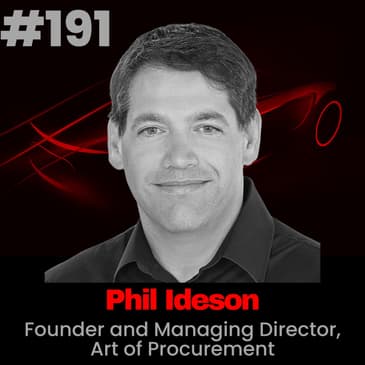
Phil Ideson, Founder and Managing Director of Art of Procurement, has seen both sides of that. He started his career in automotive purchasing at Vauxhall, moved through Ford's graduate scheme, went to Visteon, and then left for pharma, consumer products, technology, and financial services. Today, he runs Art of Procurement, home of the number one procurement podcast in the world, and he spends his days with procurement leaders across every industry you can name. Jan has known him for years, and she has never met anyone who cares more about elevating this function.
In this episode, Phil names something the industry rarely says out loud. Many automotive processes exist to maintain control, not to drive an outcome. Purchasing teams waved the process in people's faces because that is where the power came from, and the whole function ended up measured on cost savings because that is the business case procurement built for itself. Then comes the part about AI. Phil argues it is an operating model question, not a technology purchase, and he lays out what happens when you free up capacity with AI and your team is not ready to use it.
There is also a preview of Catalyst coming to Detroit on September 22nd, and Phil designed it as a small room for 30 to 50 senior leaders rather than another hall full of exhibitors.
The mindset shift here is bigger than procurement. It is about whether legacy automotive can stop protecting what works long enough to build what is next.
Themes Discussed in this Episode
- What automotive procurement does well and where it lags
- Process built for control instead of outcomes
- The cost savings trap inside procurement's own business case
- Why the "seat at the table" mindset keeps the function small
- Power dynamics and early supplier engagement
- AI as an operating model question, not a technology purchase
- Making sense of a market of 500-plus procurement tech providers
- Driving change with confidence
🎥 Watch the full episode on YouTube:
https://www.youtube.com/@jangriffithsautomotiveleaders
Featured Guest: Phil Ideson, Founder and Managing Director, Art of Procurement
Phil is the founder and managing director of Art of Procurement, a media, events, and advisory business built to help procurement leaders raise their impact. What began in 2015 as a podcast has grown into a media-led company with a global community of procurement and supply chain executives. Before Art of Procurement, Philip worked inside the function, leading procurement transformation, shared services, category management, and sourcing programs for Ally Financial, Chiquita, Pfizer, and Visteon. He started his career in automotive purchasing and has lived in the United States for more than twenty years, including seven or eight of them in Detroit.
About Your Host – Jan Griffiths
Jan Griffiths is the champion for culture change and the host of the Automotive Leaders Podcast. A former automotive executive with a rebellious spirit, Jan is known for challenging outdated norms and inspiring leaders to ditch command and control. She brings honesty, energy, and courage to every conversation, proving that authentic, human-centered leadership is the future of the automotive industry.
Mentioned in this Episode:
- 21 Traits of Authentic Leadership
- Catalyst | Detroit September 22nd: When AI Meets Manufacturing Reality
Episode Highlights
[02:05] How an accident became a career: Phil never planned on procurement. An internship at Vauxhall, Ford's graduate scheme, and a spin-off to Visteon put him in purchasing, and he never left.
[04:29] What automotive gets right, and what it misses: Structure, process, and sourcing discipline are world-class here. Where other industries pull ahead is in how they measure value and how quickly they adopt new technology.
[07:40] Process for control or process for outcome: Phil asks the question most teams skip. What is this process trying to produce, and could a different process produce something better?
[09:36] The cost savings trap: Procurement built its business case on saving a dollar for every dollar invested, so that is how the rest of the business decided to measure it. The behaviors followed the metric.
[10:43] The seat at the table: Phil wants to throw that table off the top of the Ren Cen. He explains how the need to prove worth turns into paperwork, control, and a function that never gets invited in as a partner.
[14:21] ProcureTech100 and a market that exploded: When Phil started, there were maybe ten or twenty procurement technology providers. His team now tracks five or six hundred, and a panel of CPOs and heads of digital procurement votes on the hundred their peers should know.
[19:55] Why Catalyst is built small: Thirty to fifty senior practitioners, pre-work, and a mastermind format. Phil explains why the room is deliberately limited and what he wants people to do differently on Monday morning.
[24:16] Power dynamics and early supplier involvement: Jan takes it back to a concurrent engineering team in the '80s that designed a torque converter with suppliers in the room. Phil connects it to the habit of finding power and then using it, and why that habit costs you the best innovation.
[26:46] AI is an operating model issue: The heart of the work is not the tool. Phil explains what happens after AI clears the tactical work, leaving the freed capacity with nowhere useful to go.
[30:53] Driving change with confidence: Learning from each other's experience de-risks the decision. That is the whole point, and it is a good place to close.
Top Quotes
[25:35] Philip Ideson: "The leaders who I admire the most are those who are the most curious, and their answer to what's happening and what the impact is going to be is they don't know."
[26:46] Philip Ideson: "AI is an operating model issue, not a technology issue."
[27:45] Philip Ideson: "If the team isn't there in the position to take advantage of that time that's now been freed up, what happens is you probably lose those people, and then you go back to the same old problem of, I've got too much to do and not enough people, and the capacity that I freed has now just been taken up by an AI budget instead."
If this episode resonated, share it with a fellow automotive leader and subscribe to The Automotive Leaders Podcast, where we’re shaping the future of authentic leadership in the automotive industry.
This podcast episode is also available on YouTube. Check out our YouTube channel at Jangriffithsautomotiveleaders
Send us your feedback or questions — email Jan at Jan@Gravitasdetroit.com.
[Transcript]
[00:00:00] Jan Griffiths: This is the Automotive Leaders Podcast. Straight talk from the CEOs and innovators who cut through the noise, create clarity, and drive transformation across this industry. The old command and control playbook is dead. Culture is the operating system. Authentic leadership is the edge. We're rewiring it, starting now. I'm your host, Jan Griffiths, that passionate, rebellious farmer's daughter from Wales and the champion for culture change. Let's dive in.
This episode is brought to you by Lockton. Rising benefit costs aren't inevitable for you or your employees when you break through the status quo. Independence matters, it means Lockton can bring you creative, tailored solutions that truly serve your business and your people. At Lockton, clients, associates, and communities come first, not margins and not mediocrity. Meet the moment with Lockton.
Today we have a very special episode of the Automotive Leaders Podcast. We are gonna be diving deep into the world of procurement. And you might think, well, automotive procurement, that's nothing new, but wait, because today we're gonna be talking to Phil Ideson.
Phil is the founder and he is the host of The Art of Procurement. Now, The Art of Procurement has the number one procurement podcast in the world, the number one, and it gives me a chill that because I have known Phil for several years, and his passion for the function of procurement so that procurement professionals can elevate their impact is unmatched.
I've never met anybody that cares about the function as much as Phil. Phil Ideson, welcome to the show.
[00:02:05] Philip Ideson: Thank you so much, Jan. It's a pleasure to be here. And that's not something that a passion that I thought I would have when I was a teenager thinking what I'm gonna do with my career. But I actually started in the automotive business in purchasing, got the book, and never looked back.
[00:02:18] Jan Griffiths: Yeah, so you started in auto. You've actually spent a little bit of time in Detroit?
[00:02:22] Philip Ideson: Yes, so, I started in, did my internship in the UK, so obviously from the UK originally, but I've lived in the States 20 plus years now. Did my internship for Vauxhall, which was, GM in the UK. Material production and control was the department which I think was really counting widgets in boxes, sending faxes to suppliers, and eating bacon sandwiches on the shop floor was the majority of that year.
But turned that then into a role on Ford's graduate scheme. So joined Ford Motor Company, went straight in purchasing. It was one of those schemes where you have the opportunity of going into operations or, manufacturing or HR or marketing or purchasing and like, "Okay, hopefully I get the marketing," or something like that, and they put me in purchasing.
Had no clue what it was, and I've been in procurement since. So I was in Ford. I was there for the spin off to Visteon, so then I went to Visteon. Spent a few years with Visteon both in the UK and the US and also, running a captive shared service center for them in India, in Chennai. So, kind of touched a lot of the different parts of automotive procurement or purchasing.
[00:03:23] Jan Griffiths: Yeah. Now you know procurement as a function, and what I love about the work that you do is that you're focused on the function, and that takes you across multiple industries. And you dive deep into all of it. You dive deep into the software, the processes, the leadership, the mindset. Every single facet of procurement you go deep into, and wide and broad 'cause you're going across multiple industries. And I think sometimes in automotive think we're special, and we're very special 'cause it is my beloved industry. But there's a lot that we can learn from other industries, and that's why I wanted to bring you on the show today, Phil, to share some of the things that you're seeing out there in other industries that automotive can really learn from. So with that as a very broad subject, what are some of the things that really come to mind that you see that other industries do really, really well that automotive should think about and adopt?
[00:04:29] Philip Ideson: Yeah. And I actually want to start by saying there are lots of things, as you said, that automotive does really well and I count it as a blessing that I started in automotive and purchasing because you don't necessarily realize until you step out, how advanced some of the things that you're doing.
You always look and think, "Well, the grass is greener on the other side." And then you leave automotive as I did, and I left. I actually left automotive, came back, and then left again. When I left the first time, I went from automotive into pharma. So very different industries. Industries that went from being extremely cost-focused to ones that were truly all about relationships, and anything you tried to save money was, meant that somebody's budget was harder to spend, and they didn't really like that.
So completely different environments. I think automotive is great at structure, at process, and at some of the best practices in procurement around sourcing and category management. And that's because automotive has to because margins are so compressed and every penny really does count.
On the flip side, my experience in other industries, and I've worked in consumer products, I've worked in technology, I've worked in financial services, and a number of others just through consulting engagements, is from a procurement perspective, it's probably level setting on how value is measured.
When I say that, it's not all about cost. I know in automotive, it was basically on time delivery, cost, quality, and we'd look at those three and say, "Well, you can't have all three at the same time, so what are you going to be giving up on?" I think in other industries, th-there's a lot more kind of a balanced scorecard around, how do you make decisions and how do you evaluate potential decision-making, especially around supplier selection, for example.
I also think that other industries are probably have been more advanced in how they think about leveraging, utilizing technology. I think there's a good reason for that, because you don't necessarily want to rip out something in an automotive purchasing technology that you've used for twenty years that works and the risks of ripping that out and all of a sudden it's shutting down a plant because you missed something.
The risk is so big that you have to be a lot more careful than when you're not dealing with those kind of that level of such an interconnected supply chain. But there's probably been a lot more hesitancy that I've seen in automotive in adapting new technologies than I have in other industries.
And so I think that's starting to change, and I'm starting to see whether it's more entrants into the technology, the procurement technology industry focusing on automotive, that's definitely grown exponentially over the last few years because there's becoming more of a demand. But I think automotive is still a little bit behind the eight ball in terms of their risk aversion potentially to looking at new technologies to use.
[00:07:04] Jan Griffiths: This episode is powered by Seraph. When manufacturing leaders need to launch scale, relocate production, or navigate supply chain disruption, they call Seraph. Hands-on operators. Measurable results. Learn more @seraph.com.
Yeah, that's a really interesting perspective. I wanna go back to something that you said, that you said automotive has really strong, robust processes.
[00:07:31] Philip Ideson: Yeah
[00:07:31] Jan Griffiths: And I would agree, but that's hurting us now because it's slowing us down. How do we get through that, Phil?
[00:07:40] Philip Ideson: You have to think about what's a process for? Like, why is a process in place? And what is it trying to do? What's the output it's trying to drive? Can you change the process and get the same output or a better output, for example? So kind of looking at why you've done something. 'Cause when I was in automotive, and granted this is a number of years ago now, it felt a lot of processes were in place to drive control. And, I see other industries probably doing more effective jobs and not feeling like, there's silos kind of across a business where control is held or owned and that the, the self-worth is driven by what is under control.
Or in procurement we'd say what spend under management or, how much of what is spent are we involved in and are we contracting for? And more kind of thinking about what are we trying to achieve as a business and how can we play our role in it, and how can we kind of be a little bit less focused on, on explicit processes in achieving it.
I always kind of remember that we would live as a purchasing team within automotive by the process, and we would wave the process in people's faces, when it wasn't followed as to, "Well, you didn't follow the process, so that's a fireable offense."
That's how we get our power. And it was this whole power dynamic at play versus, what are we trying to achieve and how do we build the relationships internally to make it happen? And actually, that's something that technology can help you with, but it also needs a mindset shift as well.
[00:08:58] Jan Griffiths: I think you hit the nail right on the head. And it's really fascinating talking to you, having been in automotive and, now spent so much time outside of it. Looking at it, and you're exactly right, 'cause you know I talk all day long about moving from command and control to a more authentic leadership model, and I talk about the operating playbook, and that means empowering your people to make decisions and really think about exactly what you said.
What are we trying to achieve as a business? We're not trying to control and micromanage every little thing and every little penny. Because when we do that, and we tend to optimize within the silo.
[00:09:36] Philip Ideson: So procurement for folks who are listening to this that aren't in procurement, there's probably a couple of things I want to say. One is, we, and when I say we, I mean us as procurement, have kind of built the business case for investment in procurement based on cost savings.
So, invest, invest a dollar in procurement, get $10 back in, in cost savings. And so because that's the message that we've gone and built a business case for investment in procurement based upon, that's how everybody in the rest of the business knows how to measure our success or otherwise. So that drives the behaviors which then push us to look sometimes at cost savings, for all sakes, that being kind of the primary focus because that's how we're measured.
There's obviously lots of other different ways that you can measure procurement and look at the value that procurement can bring, because we've made the business case based on that, that's where it kind of defaults to. The other thing I think is that, the psychology of a lot of us in procurement, at least I can only speak for myself, but when I was working in procurement, and this is not unique to automotive, this is across many businesses as well. We're always trying to prove our worth, and prove like why we deserve this, and I hate the term, but why we deserve the seat at the table.
[00:10:42] Jan Griffiths: Oh gosh, Phil, we talked about that for decades.
[00:10:43] Philip Ideson: You know, I want to throw that table off the top floor of the Ren Cen, because I hate it so much.
There's this thing about us which makes us feel as though we're not valued by our business, and therefore that's where the control comes from, and the process comes from. So it's like, okay, if we're not valued by the business, we're gonna use paper to show that we have to be involved in the process as opposed to, how can we be brought into, and this has to be earned, so I'm not saying that it has to be given, but it has to be earned by procurement.
How can we be brought into discussions as a partner where sometimes we're not, or we don't feel like, like we are?
[00:11:17] Jan Griffiths: What industry does that really well?
Brought to you by UHY.
Everyone wants AI in quoting. UHY's benchmark study says fix governance and data first, then scale AI.
Check out the white paper. The link is in the show notes.
Tariffs, disruption, uncertainty. Your supply chain has answers. Tradeverifyd helps you ask why and what to do about it. Visit Tradeverifyd, that's verifyd with a yd.com.
[00:11:55] Philip Ideson: It's a really great question. The industries that I see leading in the procurement space are probably pharma and consumer products. And it's interesting when you look at each industry has, there's a different reason for procurement existing. Even though we like to, on one hand we say we're all unique, and on the other hand we say that, it's the same process across industries.
It shouldn't matter what industry you have. I also think about technology as well, but when I look at the, like high growth tech firms, what are they trying to optimize for? They're trying to optimize for increasing their capacity as much as they can, as quickly as they can, because they can't sell fast enough.
The cost side of it isn't as important as just making sure that as a business we can scale as quickly as we can possibly scale. When you look at pharma, it's interesting because there's not as much margin pressure, although there is more margin pressure than there used to be.
But you still have regulatory, regulatory requirements. So when you bring regulatory requirements in, that's actually some things that, I see that some businesses do that automotive can probably learn from, but it's actually because they're driven by regulators, not necessarily because an industry wanted to do it.
I think about financial services, which I was in. In financial services is great at risk management and risk mitigation, but they're great at it because they have to be. Because, the financial regulations, especially here in the US, essentially put the board of directors on the hook personally liable for things that might happen across their supply base.
And so from a regulatory perspective, they kind of force the issue, and therefore procurement has to be really strong at risk management and risk mitigation.
[00:13:29] Jan Griffiths: That's interesting. Pharma. I think, there's probably something to be learned from every industry out there, right? The idea is just to figure it out and to be open-minded and to accept it.
Now, when we talk about technology, one of the things that you spearhead is ProcureTech 100. And let me see if I understand it properly.
So basically, you're doing the work, so all the procurement professionals, and I can imagine if I was still in the role, having to figure out all these different companies with AI and software and tools for this and tools for that. I mean, even now I get hit up every other day with somebody trying to sell something. There's a lot. You couldn't possibly... If you're currently in a procurement leadership role in automotive, how on earth do you keep on top of that? And that's what ProcureTech 100 does. Is that right?
[00:14:21] Philip Ideson: Yeah, essentially, you think when I started the podcast, which was eleven years ago, was when I kind of jumped off the cliff and started out at procurement. There was probably a world of ten, maybe twenty technology providers that supported procurement. And so the decisions were relatively straightforward.
The shortlist that you were gonna use was relatively straightforward. The things that you had available to you to buy from a technology perspective was pretty straightforward. You know, there's been just an exponential growth in the number of technology companies that are out there, and that's just accelerating now with AI, when it's a lot easier to set up a company.
You don't need the funding that you used to need to set up a company. So that's going even further. So, so we have a program called the ProcureTech 100, and at its high level, the intention of the ProcureTech 100 is really just to try and make sense of the procurement technology market. We track probably, at this point, five or six hundred different procurement technology providers or providers that could reasonably be, used for something that procurement needs technology to buy.
And so we have a taxonomy of ten different kinda categories within procurement, and it can range from direct materials procurement to risk management to sourcing to spend intelligence, and there's a variety of different categories within it. And we were wanting to really help you, help the procurement leadership community understand these are the ones that I should really start to look at to perhaps build my shortlists from.
What we're not trying to do is say, "This is the number one procurement technology company," or, "This is the number two," or, "This is the number ninety-nine." And there's ones off there that will get missed that, that people can make a case for should be included. What we're doing is, the other part of it is we as out of procurement, we're not making any decisions.
It's not our list. We don't say, "Here's the hundred that we think that are the most important procurement technology companies you should be following right now." What we do is we convene a panel of judges from around the world who are all chief procurement officers or heads of digital procurement or heads of procurement transformation.
So we want the people that are in the room using technologies every single day or are making decisions about technologies that they wanna use. They're hearing the demos and the pitches. They're downloading the white papers. They're watching the webinars. They're building a perspective on a lot of different providers.
They're using them in the real world. They're the ones that are coming together and voting on who they believe should be in the, the hundred. So it's really, we're just doing the curating. It's procurement leaders and CPOs themselves essentially under our guidance, bringing together a hundred companies that they think their peers should know about, and that's what the program is.
[00:16:51] Jan Griffiths: And how often do you publish it? Do you update the list every so often, or how does that work?
[00:16:56] Philip Ideson: It's annual. So, we are looking at ways that we can make it a lot more accessible, both from the intelligence we collect around helping our judges vote, 'cause there's a lot of intelligence that goes behind the scenes and signals and things like that we gather. So one, how can we make that available to people as they're making their own decisions across whatever it might be that they need to buy?
And doing deeper dives into a lot of providers that are across that 100, and also ones that didn't make the 100. But right now it's an annual yearbook published every beginning of December. So right now we're working on the 2027 version, which will be published in, December of 2026.
[00:17:30] Jan Griffiths: Okay. And is that something that you will share with the world at Catalyst?
[00:17:34] Philip Ideson: Yes. So, what we'll do at Catalyst, so we have an event coming up in Detroit, on September 22nd, I think it is, that's dedicated to direct materials. We use the ProcureTech100 to help guide some of the conversations and to help inform some of the conversations that we have at Catalyst, and to have discussions around who were picked, why they were picked what we were looking for, some of the perspectives that came out during the judging panels.
That's honestly to us, the biggest insight in doing this process is the judging panels that come together to talk about these providers and talk about these different categories. And then that informs a lot of what we do then throughout the year and the content we create, the sessions we create at events, because that's really where the gold is.
[00:18:16] Jan Griffiths: Yeah. Now, you run three Catalyst events per year
[00:18:22] Philip Ideson: Yes
[00:18:22] Jan Griffiths: And I have been fortunate enough to be the emcee for two of them so far, one in New York and one in San Francisco. And I can't even begin to tell you how much I have craved for that event to come to Detroit, and it is, it's coming, and don't worry, the audience, we'll stick a link in the show notes. But what I love about it, Phil, is you are so mission-driven with the work that you do, and it comes out in this Catalyst event. It is a group of people, of senior level procurement leaders, and it's not just a bunch of presentations and then a whole tables and tables of exhibitors and people trying to sell you stuff left and right. That's not what it is. In a lot of conferences these days, I'm gonna be honest, there's a lot of pay to play, and I don't like that. Do you need sponsors for conferences? Yes. But how they participate and how they play is very, very important. And what I love about Catalyst is it's an opportunity, it's more of a mastermind.
And you would actually have a mastermind session where people, there's pre-work, so don't think you're just gonna show up for this conference and you're gonna sit there and have some nice food and talk to some people and listen to some interesting speakers. It's much more than that. You're gonna have to roll up your sleeves and bring your issue, and you're gonna get into some meaningful discussions with peers.
Now, the one in Detroit, of course, will have a strong automotive presence, but there are people that will be in that room that are non-automotive, and that I am tremendously excited about.
[00:19:55] Philip Ideson: Yeah, I think, one, thank you for all your support of Catalyst so far, Jan, because really when we set out to create the Catalyst event, I have the fortune to go to a lot of events around the world, a lot of procurement events around the world. And where I felt there was a gap was, something where a small group of senior executive leaders within procurement can come together to share their problems, to talk through their problems, to be in a room where they felt was a safe space, where they can go back and actually when they go back to their desk on Monday morning, they're actually gonna go and do something and take something away, and they can think about their operating model in a different way or a challenge that they brought.
You know, really that's what we're trying to create in Catalyst events. And so, they are small in numbers. Typically, from a practitioner senior leader perspective, between thirty and fifty. There may be seventy, sixty, seventy people tops in the room, and that's deliberate because we want it to, we want to limit the number of seats that are available to maximize the experience for everybody that's involved.
And we'll bring some, you know, some external speakers who are coming to bring external perspectives on, what they're seeing from a macroeconomics perspective or what they're seeing, you know, outside of an industry to just give us some food for thought to help then generate some of the discussions that, that happen later in the day.
And so we started it, we've done them in New York and in San Francisco so far, aimed at what in the procurement world we talk about as being indirect procurement, but that's really everything related to SG&A. And we wanted to do something, because, one, my heritage in automotive and my love for automotive.
Two, I've also lived in Detroit for a good seven or eight years, so I've always wanted to bring something to Detroit. But three, I think it's just, and probably more important for this audience is it's just criminally underserved, I feel in events like this that are actually dedicated to manufacturing and dedicated to automotive.
And some of that may be because other conference providers have thought, well, is there a market there for something in Detroit that's of this size and scale, with the goals that we have? And so we wanna prove that yes, there is. And so we're really excited to bring it to Detroit.
[00:21:54] Jan Griffiths: Yeah. Well, I'm beyond excited. I can't wait. And our listening audience, if you're a CEO, please forward this podcast, to your head of procurement. If you're head of procurement and you want an invite, just email me or message me on LinkedIn, and we'll make sure that we get you on the list. It is focused on senior level procurement leaders, so I would say, VP, CPO level. Sometimes the titles in auto get a little bit messed up.
[00:22:22] Philip Ideson: Yeah, they do in any industry.
[00:22:24] Jan Griffiths: Yeah. You might be a senior leader, and you might have an executive director title, and that's okay. But we wanna make sure that you're comfortable in the room with your peer group, and it's magic.
It really is. I've seen it happen twice now, and I can't wait to see this in Detroit 'cause I think the industry needs it. And the one thing that we talk about, Phil, in this industry a lot is China speed, and how do we match China speed? And one of the things that we will be talking about in the conference, in Catalyst, is this idea of, when you think about... I'm gonna go back to in the '80s I was part of a concurrent engineering team where we brought in..talk about early supplier involvement. We brought in suppliers early on. They were part of the design process. We designed for what the customer wanted, not for something that happened years ago. We designed specifically for the function of what the customer needed, we did it, and that was in the '80s. And we all sat together as a team, and we represented our own functions or silos so we knew what we had to do, and we did it, and we took time out of the process, and we designed... Actually, it was a torque converter. We designed a torque converter that was easier to manufacture 'cause all the bugs were already worked early on. But you had to pre-select the suppliers because you can't bring a supplier early on in that process, and then at the end of the day go, Oh, yeah, sorry. You know what? I put it out. I got four bids.
[00:23:56] Philip Ideson: Leverage the heck out of them.
[00:23:58] Jan Griffiths: I can save two cents with these guys. So, thanks for that. You can't do that. But that is a huge, huge mindset shift in the way procurement interacts during the design phase in this industry and we're gonna get into some of that, aren't we?
[00:24:16] Philip Ideson: Yeah, I'm looking forward to kind of getting into those because you talk about what automotive does well, and automotive does things like value engineering, value analysis. Like, I try and push that on all kinds of different in industries because I think that tools like that are super impactful.
But, I think that other industries have probably, be more effective at driving early supplier engagement and something you said there triggered something for me because one of the challenges I always had was this idea of power dynamics, and I felt that power dynamics was something that things may likely have changed since I was last in automotive.
But certainly the roles that I was in automotive, a lot of the jobs were about finding power and then using power. And that just wasn't the way to build really strong supplier relationships where you're gonna get the best innovations that come to you. And then we would put in place supplier relationship management programs, but all they were, were dressed up ways of basically going to suppliers we knew we had no leverage with and being nice to them to try and get some leverage with them, rather than actually, what a supplier relationship management program should drive.
So we want to bring some of the, some practices that we see outside coming in, but we also just... I look at so much change on the horizon right now, and we haven't even really touched on AI. With everything that's happening all around us, the leaders that we get to talk to, and I'm sure you see the same, but what we see from a procurement perspective, the leaders who I admire the most are those that are the most curious, and, and their answer to what's happening and what the impact is gonna be is they don't know.
So we're all on this kind of journey of discovery together. And so bringing together a lot of like minds who are on this journey of discovery together, is just where a lot of the these conversations go and where the nuggets come out of.
[00:25:54] Jan Griffiths: Yes, and I know that you do a lot of work with AI, and when you had Catalyst in New York in November of last year, and I saw the presentation where they were talking about AI transformation, moving from where we at today to procurement leaders managing an army of agents.
But it wasn't just a nice little image of here's the future. It was a thought process and really a maturity map, if you will of how we're gonna get there, and those are the kinds of things that we need. We can't just throw out, "Oh yeah, AI for everybody." We gotta be very intentional and think, where does it work? How do we make this happen? How do we evolve? What does transformation really look like instead of just being this word that we love to throw out?
And that's what I love about these Catalyst events is that we really get into that.
[00:26:46] Philip Ideson: Well, to me, AI is an operating model issue, not a technology issue. And even though we talked a lot about technology today, the heart of what we do is all around operating model. Like, how are you thinking about your operating model? And technology is a part of that and an increasing part of it, but it's still only a part of it.
And the other side I would say to this, and this has been a big, message from a lot of our content this year, we set out at the start of the year to really focus on this conversation, is that you may look at technology like, how AI is embedded into different tools and systems now.
And you may be able to do things faster and more efficient than you did before, and that gives us some relief from work that we don't necessarily... that's lower value work. But what I really want to leave, procurement leaders thinking about is, like what happens when you've used AI to get rid of the low-hanging fruit and to get some of the tactical and transactional work you don't wanna do, and you now have this pool of resources that you've freed up, and that's a lot of what the sales pitch is with implementing a lot of tools and technology.
It's like, what now? And if you have this freed resource, but you don't necessarily... that resource isn't trained in how to actually think strategically or how to build relationships or how to influence or, you know, how to be better business partners and more connected with, a larger ecosystem, or how to more effectively manage supplier risk or all these different things.
If the team isn't there in the position to take advantage of that ta- that time that's now been freed up, what happens is you probably lose those people, and then you go back to the same old problem of, I've got too much to do and not enough people, and the capacity that I freed has now just been taken up by an AI budget instead.
And so you need to be thinking about those things before you even really start implementing a lot of these, so you have a path rather than running in on AI, making yourself a bit more efficient and then, "Okay, what do I do now?" Because at that point, it's probably too late.
[00:28:38] Jan Griffiths: No, you're absolutely right. And I think in automotive, we struggle. We talk about legacy automotive, and you know, Phil, a lot of these companies, OEMs, but tier ones specifically, have been around for over 100 years. They've got processes, and maybe they've grown through acquisition, and these are big companies.
These are 10 billion, 15 billion, 17 billion in revenue. These are enormous companies with many different, multiple, over sites globally, different brands, all kinds of complexity. And what I'm very excited about is that we are actually gonna have extremely large tier one automotive procurement leader who led the procurement transformation for this tier one, and she's gonna be on stage, and she's gonna be talking about that journey. And this company doubled EBITDA in less than three years, so you wanna talk about impact, and procurement was a big part of that, and she's gonna be talking about that process. And I can't wait until she takes the stage, Phil.
[00:29:44] Philip Ideson: Yeah. I mean, I think the mindset kind of has to change from, how do I make sure I don't break anything? Because I think that's one of the challenges that you always face, which is, as these companies grow and as you say, you get acquisition, the number one is like, I don't wanna break what's not broke, what's, what's working because of all the downstream effects of that.
But it's, you know, how can I, how can I look at what others have done to actually move away from that to, to look at, change as an opportunity for growth. And to understand as well, like taking some measured risks along the way, and trying to assess the risk profile of taking certain decisions.
And that's where, all the way back to when I started out as procurement 11 years ago, and there really wasn't at that point podcasts out there like, there wasn't really any effective ways of getting insights from peers other than calling them up or going to a conference.
And there's obviously lots of different ways you can do that now. But it's really all about how can we learn from each other's experiences.
and that's where again, you kinda get ideas that de-risks an idea. We talk about driving change with confidence, and that's what we want people to leave the room is confidence to make some decisions that help them drive change that they may not have had before, or insights into things they hadn't even thought about.
[00:30:53] Jan Griffiths: I love that. Driving change with confidence. There it is. And that's a beautiful way to close today.
Now, on a personal note, the audience may not know that Phil has helped me enormously in my entrepreneurial journey, and specifically with my podcast, and I cannot wait to see you in Detroit and take the stage with you on September 22nd at Catalyst.
Phil, thank you for your time today
[00:31:20] Philip Ideson: Thank you so much, Jan.
It's been a pleasure to talk, and I can't wait for September 22nd.
[00:31:24] Jan Griffiths: Let's do it.
Thank you for listening. You can watch the full conversation on our YouTube channel. Search for Jan Griffiths Automotive Leaders, and download the 21 Traits of Authentic Leadership. It's a free PDF and the link is in the show notes. And remember, stay true to yourself, be you, and lead with Gravitas, the hallmark of authentic leadership