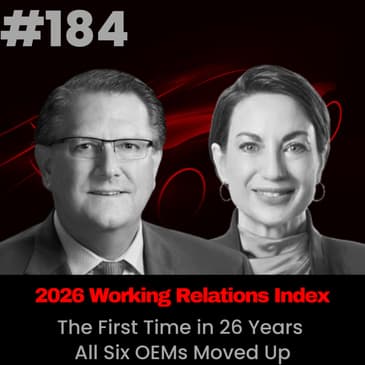
For the first time in 26 years of the Working Relations Index, every single North American OEM moved up the chart. Ford, Toyota, Stellantis, Honda, GM, and Nissan all scored higher than the year before. That has never happened. Not once.
In this special episode, Jan sits down with Dr. Angela Johnson, principal at Plante Moran responsible for the WRI, along with Sig Huber, Chief Commercial Officer of Elm Analytics and former supplier risk leader at Toyota and Fiat Chrysler. Three sharp voices. One story the industry needs to hear.
Tariffs. EV cost recovery. Permacrisis fatigue. Return-to-office mandates. Four undercurrents shaped this year's results, and they all point to the same place. When OEMs can't control the macro, they lean into what they can control. Communication. Accessibility. Buyer responsiveness. Taking the meeting. Listening. Acting. That's what moved the needle, and the suppliers noticed.
Ford's 32-point jump is the second-largest gain in WRI history, and Liz Door led that charge from the top. Stellantis is showing the early signs of a real turnaround under Filosa. GM's still working through cultural inertia, but the relationship side keeps moving in the right direction. And Toyota and Honda aren't slowing down.
Angela also unpacks her new 6C framework. It's the bridge between transactional and relational. Commercial fairness, consistency, clear expectations, communication, continuity, and collaboration. It's the structure the industry's been missing.
But here's the harder truth. The next 18 to 24 months will test every relationship in this industry. Cost of goods sold is climbing. Supplier financial distress is creeping back. Cross-functional alignment inside the OEMs is slipping. The playbook's changing. The question isn't whether we can do this together. It's whether we will.
Here's the link to the WRI 2026 Study
Themes Discussed in this Episode
- First-time-ever WRI result: all six OEMs scored up
- Permacrisis fatigue and the shift toward collaboration
- Tariffs, EV cost recovery, and commercial fairness
- The 6C framework: bridging transactional and relational
- Ford's record-setting jump and Liz Door's leadership
- Stellantis's rebound under Filosa
- GM's ongoing culture change
- Top 50 suppliers, organizational memory, and cultural inertia
- Return-to-office mandates and buyer performance
- Cross-functional decline inside the OEMs
- From cost reduction to resilience: the playbook is changing
🎥 Watch the full episode on YouTube:
https://www.youtube.com/@jangriffithsautomotiveleaders
This episode is sponsored by Lockton, click here to learn more
Featured Guest: Dr. Angela Johnson – Principal, Plante Moran
Dr. Angela Johnson leads Plante Moran's supplier relations analytics and oversees the team that runs the annual Working Relations Index (WRI) Study. She brings more than 30 years of automotive experience at General Motors across multiple functions, paired with a doctorate in Industrial Engineering from Wayne State University.
Angela helps organizations understand how trust, governance, and day-to-day commercial behaviors shape performance across large manufacturing ecosystems. She is also the architect of the 6C framework introduced in the 2026 WRI Study.
Featured Guest: Sig Huber – Chief Commercial Officer, Elm Analytics
Sig is the Chief Commercial Officer of Elm Analytics, a leading source of supplier financial health and risk data. Before Elm, Sig ran supplier risk management for Toyota and global supplier risk management for Fiat Chrysler, giving him a rare view from both the top and the bottom of the WRI scale.
He is a frequent voice on the show when the conversation turns to supplier resiliency, financial distress, and the operational realities of managing risk across a global supply network.
About Your Host – Jan Griffiths
Jan Griffiths is the champion for culture change and the host of the Automotive Leaders Podcast. A former automotive executive with a rebellious spirit, Jan is known for challenging outdated norms and inspiring leaders to ditch command and control. She brings honesty, energy, and courage to every conversation, proving that authentic, human-centered leadership is the future of the automotive industry.
Mentioned in this Episode:
- Plante Moran 2026 OEM-Supplier Working Relations Index (WRI) Study
- Kumar Galhotra (COO, Ford) – John McElroy interview on the Ford reorganization [Autoline AfterHours]
Episode Highlights
[01:21] A first in 26 years: Every single North American OEM moved up the WRI chart this year. That's never happened before. Jan sets the table for why this result matters.
[03:43] 10,000 supplier comments and a real tone shift: Angela describes more than three times as many comments as in prior years, with less frustration and finger-pointing. Suppliers are putting real thought into it because they believe the OEMs are listening.
[06:21] The four undercurrents: EV, tariffs, return-to-office, and permacrisis fatigue. Angela breaks down the forces driving this year's results and why suppliers are giving OEMs credit for leaning into what they can control.
[09:36] The 6Cs: the bridge between transactional and relational: Angela introduces her new framework. Think of it as a Maslow's hierarchy of supplier relationships. Commercial fairness, consistency, clear expectations, communication, continuity, and collaboration.
[12:00] Ford's 32-point jump and Liz Door's leadership: The biggest OEM gain this year and the second-largest in WRI history. Angela credits Liz Door for engaging the supply base, taking meetings, and driving those behaviors all the way down to the buyer level.
[14:12] Stellantis's strong rebound: A 22-point jump under new leadership. Sig shares what he's seen working with Filosa in Brazil and why consistency and continuity will determine whether this turnaround sticks.
[18:57] GM's culture change keeps moving: GM hit its highest-ever WRI score. The relationship side keeps trending up even as suppliers pushed back on some resiliency initiatives.
[25:38] Cross-functional alignment is slipping: A fascinating data point. Across the board, suppliers reported a decline in OEM cross-functional integration. Angela and Sig dig into why uncertainty inside the OEMs may be the cause.
[29:14] The 100-pound backpack: organizational memory and cultural inertia: Top 50 suppliers still rate the Detroit Three below their average and Nissan, Honda, and Toyota above. Angela's analogy lands hard. The Detroit Three are walking uphill with a 100-pound backpack, while Toyota, Honda, and Nissan cruise by on e-bikes with turbo boost.
[34:13] Return-to-office is showing up in the data: Buyer accessibility, responsiveness, and issue resolution all improved. Angela makes the call: getting people back in the office is helping supplier relationships. The data backs it up.
Top Quotes
[01:21] Jan Griffiths: “Never, ever in 26 years have all six OEMs shown an increase, and that's hard to imagine with everything that we've had to deal with in 2025 and the early part of 2026.”
[12:40] Dr. Angela Johnson: “Liz led this charge. She engaged for the supply base, took meetings with the supply base, communicated more with the supply base, and she drove those behaviors down through her organization.”
[32:08] Dr. Angela Johnson: “There's a bit of Stellantis, GM, and Ford are walking up a hill carrying a 100-pound backpack. They have to put in more effort. Meanwhile, Nissan, Toyota, and Honda go cruising by them on an e-bike with a turbo boost.”
[36:00] Dr. Angela Johnson: “I am convinced there are enough indicators in the data to say getting everybody back in the office more, definitely beneficial to your supplier relationships.”
[32:49] Sig Huber: “What's happening with all of these disruptions that are coming one after the other after the other, you can't deal with that on a brute force basis.”
If this episode resonated, share it with a fellow automotive leader and subscribe to The Automotive Leaders Podcast, where we’re shaping the future of authentic leadership in the automotive industry.
This podcast episode is also available on YouTube. Check out our YouTube channel at Jangriffithsautomotiveleaders
Send us your feedback or questions — email Jan at Jan@Gravitasdetroit.com.
[Transcript]
[00:00:00] Jan Griffiths: Welcome to the Automotive Leaders Podcast, where we help you prepare for the future by sharing stories, insights, and skills from leading voices in the automotive world with a mission to transform this industry together. I'm your host, Jan Griffiths. That passionate, rebellious farmer's daughter from Wales with over 35 years of experience in our beloved auto industry and a commitment to empowering fellow leaders to be their best authentic selves.
Stay true to yourself, be you and lead with gravitas, the hallmark of authentic leadership. Let's dive in.
This episode is brought to you by Lockton. Rising benefit costs aren't inevitable for you or your employees when you break through the status quo. Independence matters, it means Lockton can bring you creative, tailored solutions that truly serve your business and your people. At Lockton, clients, associates, and communities come first, not margins and not mediocrity. Meet the moment with Lockton.
This is a special episode of the Automotive Leaders Podcast. We are gonna dive deep into the WRI. That's right, the Working Relations Index. That's the study that measures the relationship between the OEMs and the suppliers. The study has been running for 26 years. Never, ever in 26 years have all six OEMs showed an increase, and that's kind of hard to imagine with everything that we've had to deal with in 2025 and the early part of 2026.
But yet, all six OEMs have shown an increase, and we're gonna get right into that study and find out what's going on.
And so I am thrilled to bring on the show Dr. Angela Johnson. She is the principal at Plante Moran. She is responsible for the team leading the study. She is also the architect of the new 6C Structure that we're gonna learn more about today.
Angela, welcome to the show.
[00:02:34] Dr. Angela Johnson: Thank you, Jan. Thank you for having me.
[00:02:36] Jan Griffiths: And also joining us at the mic is Sig Huber. Sig is no stranger to the microphone on the Automotive Leaders Podcast. He is the Chief Commercial Officer of Elm Analytics. But I think for this discussion, it's important to note that Sig previously ran supplier risk management for Toyota, and also global supplier risk management for Fiat Chrysler.
So he brings a unique perspective for OEMs both at the top and the bottom of the chart.
Sig, welcome back.
[00:03:09] Sig Huber: Thank you very much for having me. We have a lot of interesting content today we go through.
[00:03:12] Jan Griffiths: Don't we? Don't we? Let's start off with an overall look at the study.
Angela, how did the responses come in? Tell us a little bit about that.
[00:03:21] Dr. Angela Johnson: Absolutely.
So we ran the study for two weeks shorter this year and received more responses. We heard a lot from the supply base. In particular, we had over 10,000 supplier comments. That is more than three times the comments we had last year. Suppliers had a lot to say.
[00:03:43] Jan Griffiths: What about the quality of those comments? I mean, I gotta imagine some of those comments are people just complaining, but I'd also imagine that there's some more thoughtful comments.
Can you speak to the quality of the comments?
[00:03:58] Dr. Angela Johnson: Overall, I felt the comments improved their quality. I have been working with this study for many, many years, and what I saw this year was a genuine turn in the tone of the supplier comments. I saw less frustration, less angst, less finger-pointing.
I saw very thoughtful comments from the suppliers that are going to be very valuable to the OEMs as they plan the next steps.
[00:04:30] Jan Griffiths: Do you think the suppliers feel that the OEMs are listening, and that's why they may be taking more time to put more thoughtful comments?
[00:04:37] Dr. Angela Johnson: I do. I hear that a lot from our supply base. They take the study very seriously. And we have a lot of events, a lot of rollouts, meetings. They know that the OEMs value this study.
The OEMs have been direct with their suppliers that they value the study and the outcome, and they use those outcome to plan the next year's supplier priorities.
[00:04:59] Jan Griffiths: Wow.
Now, Sig, as somebody who's lived at the top and the bottom of the scale. What do you think is going on here with all six OEMs increasing in their scores?
[00:05:10] Sig Huber: I think that this was a very unusual year, right? So I was on your show in April, right after the tariff day announcement, Liberation Day, and it was a real shock to the industry.
The industry has always been very resilient in its ability to work through unexpected problems, and this, of course, was a huge unexpected problem with very, very significant both financial but operational impacts as well. And I think it forced a level of collaboration that was required to solve the problem, and I'm interested to see if it's the problem that caused the collaboration or whether all of them have really kind of turned over a new leaf and understand that we're in a new normal now with all the disruptions that we've seen in the supply chain.
[00:06:00] Jan Griffiths: What do you think, Angela? You think were we forced to come together as an industry and improve collaboration because of the level of volatility in the industry with the EV pivot, with the tariffs, with all the black swan events that we have going on? Do you think it was forced due to the environment, or are we really turning the corner as an industry?
[00:06:21] Dr. Angela Johnson: Perhaps a little bit of both.
I saw in the data four main undercurrents. So EV and tariffs, right off the bat, that's what everybody expected. I saw a recognition from the suppliers that while they might not be getting the outcome they wanted, they were acknowledging that the OEMs were leaning into things that they could control, that they were listening, that they were taking the meetings, that they were trying to be proactive in tariff recovery, that they were trying to put in efficient solutions and processes. I called it permacrisis fatigue.
[00:07:00] Sig Huber: I think this issue of permacrisis is very, very interesting because if you think back to COVID, right?
Ever since COVID, it seems like it's been one crisis after another, right? The ship got stuck in the Suez Canal, shipping container shortages, microchip shortages. It's been one thing after another, and it's been so dramatic in the pace of these disruptions that it compounds the effects because you can never recover from one before the next one starts.
Yes. So true. It seems like before, there have always been disruptions, and the industry's always dealt with them, but they've always been more episodic. So you deal with a supplier bankruptcy this year. The next year it's something else, and then there's a big fire, and you can recover from one and then get to the next one, and you always wanted to be better at it, but it was episodic, whereas now it's just one after the other, after the other, and there's no time to recover.
And I think the organizations are starting to figure out that the collaborative relationships have less friction when you're dealing with this type of compounding of disruptions on a more recurring basis. Yeah. And I think that there is maybe that glimmer of understanding that the collaboration is going to be helpful in those situations, and so we'll see if that stays.
But certainly some green shoots were showing this year. And I love to see that.
[00:08:23] Dr. Angela Johnson: I think it's a little twofold too. Everybody's tired. Like you said, it's non-ending. We get up in the morning, we look at our phone, and we wonder what we have to deal with today that wasn't there yesterday.
And that ongoing we are overworked supply chains, we are all trying to get through. There's recognition that there's a human on the other side of the negotiating table.
[00:08:45] Jan Griffiths: Yeah.
[00:08:46] Dr. Angela Johnson: I think we also have to give a little consideration, though. Because we have been in this permacrisis mode, every time there's a new crisis, the OEMs get a little better at responding.
They're figuring out what works. They're figuring out what doesn't work. Suppliers are figuring out how to navigate each OEM. So somehow, with each crisis on top of the other, we're becoming more efficient in managing them.
[00:09:14] Sig Huber: It's interesting to me because the uncertainty level has been high. Have we just gotten more comfortable dealing with uncertainty?
And has that created maybe a change in behaviors when there is no certain solution and you just need to work through the issues as they develop and morph over time?
[00:09:36] Jan Griffiths: Yeah.
[00:09:36] Dr. Angela Johnson: That's a really interesting thought. So what I see in the data when we look at commercial relationships, I kind of draw it out like a pyramid A lot of people talk about relationships on you're either transactional or you're relational.
It's one or the other. Historically, the Detroit Three have been over here. Nissan, Toyota, and Honda have been over here. I don't see it that way through my research. I see it more like a Maslow's hierarchy of needs. At the very bottom is commercial efficiency. We wanna get to the top, which is relational, and in the middle are all of these great behaviors.
What do these behaviors do? Well, they're things like communication, accessibility, engagement, responsiveness. They help suppliers navigate uncertainty. They help them navigate the OEM's processes. They help them understand how to work with efficiency when we don't really know what's coming next.
[00:10:37] Jan Griffiths: So really, what you've done with your 6C approach is you've built a bridge between transactional and relational.
[00:10:45] Dr. Angela Johnson: Absolutely. I didn't build it. I think it was there. I perhaps pinned it.
[00:10:49] Jan Griffiths: But you put some structure to it, which I think is always helpful. Because we hear about all these topics and all these things that we talk about, and communication and relationships and how important it is, and trust and the speed of trust, but it's nice to have it in a structure.
Now, Sig, I have to ask you, when you read the study, what was your, the first thought, the first reaction? Now, don't sugarcoat it, 'cause I'm gonna share mine, and I'm not gonna sugarcoat it. So tell me your first reaction.
[00:11:15] Sig Huber: My first reaction is I was surprised that all the OEMs went up in the same year.
I think you mentioned in your opening that that hasn't happened before. I certainly haven't seen it before, and it just made me wonder what caused all of them to go up. Because they have different leadership teams, different stages in each company's evolution of their understanding of supplier relationship management and resilience and all that, and yet they all had some common updraft
Yes
That lifted them all. Yeah. Which I thought was interesting, but intriguing at the same time. I was wondering, what was that that precipitated that reaction?
[00:11:54] Jan Griffiths: Yeah.
[00:11:55] Dr. Angela Johnson: I promise you, we triple-checked our math when we first saw that. Yes, I bet you did.
[00:12:00] Jan Griffiths: I bet you did.
Well, when I first saw the study, my first reaction was, Ford improved?
I was, quite frankly, surprised. Now, I know they've been doing a lot of work, and Angela, you specifically called out Liz Door.
[00:12:17] Dr. Angela Johnson: I did.
[00:12:18] Jan Griffiths: So tell us about that.
This episode is powered by Seraph. When manufacturing leaders need to launch scale, relocate production, or navigate supply chain disruption, they call Seraph. Hands-on operators. Measurable results. Learn more @seraph.com.
[00:12:40] Dr. Angela Johnson: Last year, what we saw from Ford was a continued decline. But what I pointed out to them is it was like death by a thousand cuts. I remember you saying that last year, yes.
It was no big overwhelming thing. Lots of little things stacked here and there. What did we see from Ford this year? Improvements from all directions. They got out there, number one. Liz led this charge. She engaged for the supply base, took meetings with the supply base, communicated more with the supply base, and she drove those behaviors down through her organization.
So we see it all the way to the buyer level on accessible, engaged, answering my emails, taking the calls, helping me solve problems. When you do that, suppliers all of a sudden start to navigate you better. They can serve you with less cost. They see you as being more fair, more equitable, more accountable.
Yes. And their trust goes up.
[00:13:47] Jan Griffiths: Yeah. Well, that was my first reaction, but I am thrilled to see it. I'm thrilled to see all of them move up because that says as an industry we're getting better at, first of all, recognizing the importance of supplier relationships, but secondly, actually doing something about it.
Now, tell me about Stellantis, Angela. What did you find about Stellantis? 'Cause Stellantis definitely showed improvement, and now we have new leadership at Stellantis.
[00:14:12] Dr. Angela Johnson: Absolutely. So I personally think this is a very, I want to say heartwarming, but I don't know if that's the right word. What's a better word than heartwarming?
It was a feel-good result for Stellantis. Because Stellantis and Nissan are both undergoing massive amounts of change, top levels all the way through complete restructure. And what you see in Stellantis is an organization that's trying to do right by their supply base. They recognize they have a long, long way to go.
They recognize that this is a beginning, and it's gonna take consistency and predictability to continue this up, but they started.
[00:14:56] Jan Griffiths: Yeah.
[00:14:57] Dr. Angela Johnson: They were engaging more, communicating more, very similar to Ford, working with their supply base, how do we get waste out? How do we do a fair approach to cost recovery?
It's a great start to a turnaround for Stellantis. Yeah. Yeah, I like that. Yeah. What do you think, Sig?
[00:15:13] Sig Huber: I love that word consistency because Stellantis in particular has been through so much change. Not only in the last year, but going back 15 years, 20 years, it has been a constant carousel with ownership and leadership, and it's been hard if you're a supplier to Stellantis to understand what's the direction And it feels now under Filosa, who really is a good guy, and I know, and I worked together a lot in Brazil.
The suppliers really enjoyed working him- with him. The people were engaged and enthusiastic working for him. And I think that's starting to permeate with the extended stakeholders of Stellantis, with the dealers, with the suppliers, with the investment community. And it's starting to permeate, and I think it's gonna have some very interesting and meaningful results if they can stay consistent and keep the continuity of that messaging and direction the same. Then people can start to believe it, and that's how you start to build the trust.
[00:16:16] Jan Griffiths: Yes. Did you get a sense of that, Angela, in the comments as to whether or not people believe, the supply base believe that it will sustain?
Because obviously all six now have risen in the score. Do you get a sense of that, or is it too soon to tell? Or is it the next year results it will tell us so?
This episode is sponsored by UHY.
Did you know suppliers now spend 157 hours on an average RFQ and still face the same roadblocks as 20 years ago? UHY and the Center for Automotive Research, break it all down in their new white paper. Get the insights and see what's really changed in 2025.
Download your copy. There's a link in the show notes.
[00:17:14] Dr. Angela Johnson: No, I think there are indicators in the data.
Number one indicator that I looked at was how do suppliers perceive their long-term opportunity to make a good return on investment?
That went up across the board. You had Ford, Stellantis, and Toyota leading that, but really everybody went up. Nissan went up. And this was my indication that the suppliers are really seeing, whether it's the environment and the industry, and we're all in it together, whatever it might be, whether it's new leadership, suppliers are seeing an improved perspective on their future business with those OEMs.
That plays into the continuity in that 6C framework. There's another thing that we look at that you might find interesting that told me this is real. We look at the very end of the survey, ask an off-the-cuff question. And the question is, how do you see your overall relationship?
Is it adversarial? Is it collaborative? What that does is it's a little test over, we've asked you about all the components. We know our validated math that this is gonna calculate out a certain way, but do you just feel the same way that you just responded?
For Ford and Stellantis, the answer was a resounding yes. Absolutely the increases that we see in their scores come across in their off-the-cuff this relationship is better.
[00:18:50] Jan Griffiths: That is great to hear. Wow.
Now let's talk about GM. What's going on with GM?
[00:18:57] Dr. Angela Johnson: Last year we talked about GM, if you remember, about their culture change, and we talked about how their data was showing us a true shift in the culture.
Big thing, because the Detroit Three carry a lot of historical weight. Yes. I still see it. It's still there. You continue to see suppliers talk more and more favorably about General Motors relationships, about the behaviors they encounter, about the partnerships, the openness, the transparency. GM took a lot of pushback this year in their suppliers from some of their resiliency initiatives, but on the relationship side, they are absolutely moving in the direction they want to move.
[00:19:46] Sig Huber: And you know, GM is doing really well, as a business.
[00:19:50] Dr. Angela Johnson: Yes.
[00:19:50] Sig Huber: They are really doing a good job, right now. Their leadership is, has been, I think, clear in their messaging and in their strategy, and I just think GM's got it going on right now, in a good way. Yeah. And it seems like it's really, permeating everything in the organization and even the suppliers are feeling that and feel like maybe they want to be part of that.
[00:20:11] Jan Griffiths: Yeah. Now Sig, we talk about supplier resiliency. We talk about that a lot, and Angela, you said they got some pushback on that in the survey.
Sig, from your work in the industry, how do you see the supply base overall from a resiliency standpoint, financial health standpoint? What's the data telling you? Not just the WRI data, but the data that you have.
[00:20:35] Sig Huber: Yeah, so we have some interesting data that actually corroborates some of the results from this year, which is if you look at the end of 2025, we have a database of thousands of both private and public companies global, so this is a global look at the entire supply chain if you look at financial health as an example.
And what we see is that overall in 2025, profitability was down. Which seems to be like, well, how can these suppliers come back in the survey and say, we, we think we can make a profit with these guys when profit was down? But what happened is they got paid faster, right? They were past due on their accounts receivables, and during the second half of 2025, the average days payables went from 75 to 60.
So they got caught up on their payables at the same time that they were getting this commercial relief for the tariff stuff, so all that good news was sort of coming into play at once. Yes. And that's I think, the environment that the survey was launched in, which is a good, positive environment.
[00:21:33] Jan Griffiths: Yeah.
[00:21:34] Sig Huber: Now, the problem is profitability is low, cost of goods sold is going up. Before Iran, we had a concern about cost of goods sold and tariffs, aluminum, steel, other things, starting to really squeeze on the supply base. Now with the Iran situation, with oil, transportation costs, and other disruptions, 'cause, the byproducts of oil go into all the resins and so many different things that we live in our everyday life and use in vehicles and everything, and, that's coming. And they're already at a time where it's really precarious.
So this is going to be a time to really test that collaboration. If this new spirit of collaboration to decrease the friction in the relationships is gonna take hold, now is gonna be an interesting time to see it because we're gonna start to see a ramp up, unfortunately, in supplier financial distress.
[00:22:28] Jan Griffiths: Yeah, I noticed a few articles coming out of the large consulting firms talking about delayed effect of tariffs. Yeah. And that's starting to hit. We really have to keep a close eye on it. I mean, we can certainly say that the WRI is a good result overall for everyone, but will it sustain, and will it sustain in an environment that's about to test us maybe even more than the environment that we've just come out of?
[00:22:53] Sig Huber: I think that this environment coming up in the next, say, 18 months to 24 months is going to be one that is really gonna be challenging. And in addition to the financial challenges, you have still this huge uncertainty with all the geopolitical stuff.
I mean, Trump is meeting with President Xi, in China this week. We don't know what's gonna happen there. We still don't know what's happening in Iran. You have sort of this transition from a kind of a pure globalism in supply chains now to more of a nationalistic type of approach, so that, for 30 years plus, purchasing and supply chain organizations have been focused on creating cost efficiency, low-cost country sourcing.
Let's save money, right? So they spent 30, 30 years doing that at the cost of resilience, and now we're gonna have to spend a bunch of time on resilience because that's gone down significantly as companies were changing the cost optimization.
[00:23:47] Dr. Angela Johnson: I was gonna say, we see that in the comments.
We've seen suppliers mention in the comments for multiple suppliers on,
hey, you are the ones that told us to go source globally for cost purposes in the first place. So we did it, and now you're telling us we need to look at different locations to manufacture.
[00:24:09] Jan Griffiths: It is a massive change in the way that we do business, and where they, I use the term playbook a lot 'cause I think it describes a lot.
But it's more about how we behave, the value system that we have, how we act, and how we make decisions. And this switch from pure cost reduction to resilience, is a classic example of that, 'cause now you've got a whole crew of buyers that have been told that they're gonna be measured by purchase price variance.
[00:24:36] Sig Huber: That's right.
[00:24:37] Jan Griffiths: And now you're gonna say, well, yeah, but, you know, that's important, but we want this resilience thing, as well.
Well, okay, what do you want? And those are gonna be very, very difficult discussions, and I know we're in the middle of all of that right now, but that's a huge change to the playbook.
And then let's add into that the business model change that we're seeing going on right now. And, John McElroy recently interviewed Kumar, the COO of Ford Motor Company, talking about the reorganization at Ford Motor Company, and they're talking about getting away from silos.
Wait a minute. I mean, I totally agree with it, but what does that mean?
And what's that gonna mean to the supply base, and what is that, what's that gonna mean to the WRI? So I think we've got a lot of question marks and what-ifs in front of us that we have to change this industry. We have to change the playbook. But what is that gonna mean? And we're gonna need these solid relationships in order to manage that transformation.
[00:25:38] Dr. Angela Johnson: You know what's interesting, is that we saw pretty much across the board declines in cross-functional integration and alignment. So we saw an uptick, in many cases, of dissatisfaction with how suppliers are being engaged early and effectively with product development, with alignment between purchasing initiatives, engineering quality, with different interfaces in the OEMs where the functions have to come together.
[00:26:13] Jan Griffiths: Now, that is absolutely fascinating. A decline in cross-functional work across the OEMs.
[00:26:21] Dr. Angela Johnson: A decline in their cross-functional perspective. I would say.
[00:26:26] Jan Griffiths: Okay. What do you think about that, Sig?
[00:26:29] Sig Huber: I think it's interesting, but I wonder if it's being bred by the uncertainty.
If they don't really know, is it ICE or is it BEV? Is it nearshoring or is it not nearshoring?
And if they don't know, it makes it hard to communicate consistently with other stakeholders. Yes. Including even internal stakeholders.
[00:26:47] Dr. Angela Johnson: Yeah. That was a bit of my deductive logic that and I thought maybe that's where it's coming from as well.
I don't have an answer yet on why it's showing up in the data the way it is, but I do find it fascinating.
[00:26:59] Jan Griffiths: I do.
[00:26:59] Sig Huber: But you know, historically, the organizations for purposes of the study would be like the Toyota and Honda, have had good collaborative relationships going back for many years.
They've had less friction in dealing with a lot of these disruptions than others have. I believe that it's this collaborative nature of the relationship that creates less friction and allows them to be more adaptable. Yes. And now we're in a situation with all of these crises. I think you used the word permacrisies. I'm using, like, compounded crises, just one after another. But it's creating this environment of so much uncertainty that I think you have to be adaptable to succeed.
[00:27:37] Dr. Angela Johnson: Yes.
[00:27:37] Sig Huber: And that's where I'm really hopeful that maybe this collaborative approach that we saw this year with the scores going up is gonna really start to finally sink in, that this actually is a better way.
Because these aren't chains, right? These are networks of suppliers. Yeah. And you're managing a network that goes many tiers down, and people at, or companies at different tiers, are also in different tiers. Like, you can have a company that's a direct supplier. They could be a tier two, a tier three, a tier four.
Exactly.
Right? And they can be all over, and you have to manage them as a network, not just as one individual spot in your chain. And it all gets really complicated, and the adaptability becomes critical, and I think the collaboration eases that, and that's why I'm hopeful that this is really the start of sort of a new day.
[00:28:25] Jan Griffiths: Yeah.
[00:28:25] Sig Huber: By necessity maybe, but it's the start of a new day in those relationships.
[00:28:29] Jan Griffiths: Well, Sig, what's the secret sauce, then, to Toyota? I mean, why does Toyota reign supreme all the time?
[00:28:37] Sig Huber: It has to do with their long-term view of their relationships. They have their pillars that they run their organization by.
Mutual respect and continuous improvement are one of them. Or those are the two most important ones. And the suppliers, understand that Toyota doesn't just resource for a five cent cost increase, right?
If you're an incumbent at Toyota, Toyota will work with you, and you have to mess up badly in order to be out, right?
Yes. You will stay. And that provides a level of trust. That's important, and it creates the adaptability to share information. Think about this. If you have to share bad information with your customer, if you have a trusting relationship, it's a lot easier to share the information than if it's an adversarial relationship.
[00:29:20] Jan Griffiths: Yeah. Oh, I've seen that many times play out many times in my career.
[00:29:23] Sig Huber: And so, right. So I think that as time goes and the suppliers are more free in communicating it creates that more... less friction, more adaptability, and that's what I'm hopeful is happening now across the board.
[00:29:34] Jan Griffiths: Angela, you took a look at the data from the top 50 suppliers' perspective. Tell us about that.
[00:29:42] Dr. Angela Johnson: We wanted to see what was going on at a deeper level in the data. We check it from different angles, from regional positions and from top suppliers. And what we saw were some very interesting trends.
In the top 50, they will score the Detroit Three lower than their average score. They will score the Nissan, Honda, and Toyota above their average score.
Interesting this year, across the board, their perceptions were more favorable. They went up. But what you see is a lingering effect of organizational memory and cultural inertia.
[00:30:28] Jan Griffiths: Oh. Organizational memory and cultural inertia.
Okay. Peel that back.
[00:30:37] Dr. Angela Johnson: Yeah. So think about historically.
Yeah.
There's a couple of things we have to keep in mind. Number one, a lot of the top 50 suppliers are as old as the OEMs. These relationships are decades old. Yes. Almost as long as the partners themselves, right?
And with the top 50 group, they saw the most impact of tariffs. They saw the most impact of EV write-offs. So we see a heightened sense there. Historically, and there are many books written about it, Stellantis or its former versions of itself, Ford and GM, have been known to be very adversarial, very pounding the fist on the table, transactional. That is how those relationships started.
On the flip side, Nissan, Honda, and Toyota grouped their transactional success in the relationship. They leveraged the relationship to get the results that they need, and that becomes a snowball effect.
So I liken it to, without discrediting the work of Nissan, Honda, and Toyota, they work to keep those relationships increasing.
There's a bit of Stellantis, GM, and Ford are kind of walking up a hill carrying a 100-pound backpack.
[00:32:08] Jan Griffiths: Yes.
[00:32:08] Dr. Angela Johnson: They have to put in more effort. Meanwhile Nissan, Toyota, and Honda go cruising by them on an e-bike with a turbo boost.
So what you see is this influence of organizational memory lasts a really long time.
Yes. And the Detroit Three are going to have to chip away at it with more consistency, with more persistency, and with more dedication to start to erase the era that was before them
[00:32:45] Jan Griffiths: Yes, yes. That's right. A very interesting perspective. What do you think, Sig?
[00:32:49] Sig Huber: Yeah, I think breaking down silos will be a big part of that, and I do think that from a historical perspective, what we're talking about is a very substantial cultural shift, right?
Because before you would be criticized for being too soft on your suppliers. Yes. 'Cause that meant you were weak. Exactly. And now there may be an understanding that having collaborative and open relationships actually is a superior way to manage the business because what's happening with all of these disruptions that are coming one after the other after the other, you can't deal with that on a brute force basis.
[00:33:25] Jan Griffiths: Yeah. Yes, that's right.
[00:33:27] Sig Huber: The supply base right now is feeling completely overwhelmed by requests from their customers. They are. They get surveyed about, what if we change this volume? What if we do this? What's your capacity on this? What's your ESG this? And there's so many surveys, and the suppliers are just overwhelmed with all that.
And I think there is this risk that as companies are trying to now become more resilient or do more nearshoring or whatever it is that they're doing, it's gonna create even more requests for information from the supply base that's already underwater. How companies manage that communication is going to be, I think, important going forward in order for them to maintain their relationships.
[00:34:13] Dr. Angela Johnson: I think they recognize that, to be honest. The supply base has been feeling that the last few years. It's just more and more and more. It goes back to our 6C framework. You have to have exceptionally clear expectations, they have to prioritize what they want the suppliers to work on, and they have to maintain very open and transparent communications.
So we're seeing that. We're also seeing that being assisted by an increase or an improvement in what we saw in buyer performance. I mentioned return to work. I honestly think that played into this year's results. I think a lot of the buyers that started during COVID, they started right after that, new buyers, hadn't had a chance to experience a full in-office environment, were able to benefit from all of the OEMs improving their in-office.
We saw their ability to solve issues improve. It's the first year I haven't seen for a long time you need to get your buyers in the office. We saw communication improve, accessibility improve. All of those things are small, but that's what's going to help them through a definite survey fatigue.
[00:35:29] Jan Griffiths: Yeah, that's fascinating.
[00:35:30] Sig Huber: Yeah, I'm interested in this whole concept of buyers coming back to the office and whether that impacted the score also. Because when the people are in the office, they are gonna be more accessible. And if you're talking about a cultural shift, which is what we've been talking about, it's really hard to do that if everybody's virtual. Yes. It's a lot easier if you're trying to change culture in an organization to be face-to-face, be in meetings, provide direct feedback to people, let them hear from you directly as opposed to in a Teams meeting or something like that.
[00:35:58] Jan Griffiths: Yeah. Yeah, that's right.
[00:36:00] Dr. Angela Johnson: I am convinced there are enough indicators in the data to say getting everybody back in the office more, definitely beneficial to your supplier relationships. There are probably a few people listening that are hoping I didn't say that.
[00:36:14] Jan Griffiths: But you have the data.
[00:36:15] Dr. Angela Johnson: But I saw it.
[00:36:16] Jan Griffiths: It's in the data.
And I remember we talked about this last year, too, about the work from home. Right. And, it's really interesting to see that surface now in the data. In a positive way.
Yeah, in a positive way. Legacy culture, the silo-type structure that we have and love in legacy auto land, goes back to 1911 to Frederick Taylor. And then it was adopted by Henry Ford, and it was all about scalable efficiency. And we did a great job of that. But now we have to unwind that, but it's a system that's deep-rooted in the way that we do business and has been since 1911. So having to change that now is significant.
But I hear you, Sig. I think if there's a time, it's now. And if there is a survey that can give us meaningful data, both quantitative and qualitative data, it is the WRI.
And I can't thank you enough, both of you, for coming on the show and bringing your perspective. Angela, thank you for the work you do with the WRI.
Keep doing it. Thank you. Sig, thank you for all you have done and continue to do in the auto industry, and join me again next year when we do the same thing again.
[00:37:36] Sig Huber: Great. Thank you so much.
[00:37:39] Jan Griffiths: Thanks for having us.
Thank you for listening to the Automotive Leaders Podcast. Click the listen link in the show notes to subscribe for free on your platform of choice, and don't forget to download the 21 Traits of Authentic Leadership PDF by clicking on the link below and remember. Stay true to yourself, be you, and lead with gravitas, the hallmark of authentic leadership.